The Trojan Horse is one of the most iconic symbols of cunning and subterfuge in Greek mythology. It played a central role in the conclusion of the Trojan War, illustrating the ingenuity of the Greek forces and the fateful naivety of the Trojans.
Its story, though not described in detail in Homer’s Iliad or Odyssey, is recounted in Virgil’s Aeneid and other ancient sources. The Trojan Horse has transcended its mythological origins to become a universal symbol of deception and hidden threats.
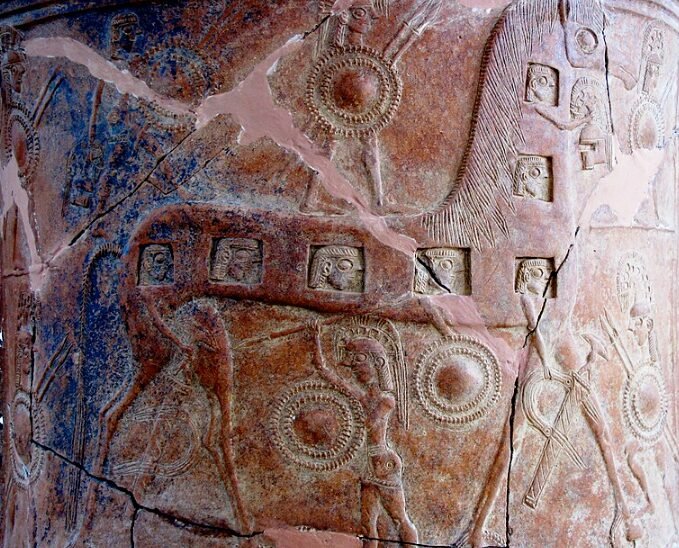
The Iliad concludes before the war’s end and does not mention the horse, but it appears briefly in the Odyssey and prominently in Virgil’s Aeneid. Image: The Mykonos vase (750–650 BC) features an early depiction of the Trojan Horse, with warriors’ faces visibly carved on its side.
Mythological Origins and Context
The Trojan Horse emerged as the Greeks’ final strategy after a ten-year siege of Troy. Conceived by the resourceful Greek hero Odysseus, the wooden horse represented a bold and cunning plan to infiltrate the heavily fortified city.
The Greeks, unable to breach Troy’s formidable defenses by conventional means, devised the ruse as a last resort to achieve victory.
Construction and Warriors Inside
The wooden horse was designed and built under the direction of Epeius, a master craftsman among the Greeks. The structure was immense, constructed to resemble a horse, a revered symbol in Troy. According to Quintus Smyrnaeus, it took only three days to build. The horse was hollow, allowing warriors to hide inside its massive frame.
Who hid inside the Trojan Horse?

Conceived by Odysseus, the Greeks built a giant wooden horse, hid soldiers inside, and pretended to retreat. The Trojans brought it into their city as a victory trophy. At night, Greek soldiers emerged, opened the gates, and sacked Troy. Image: Part of a Roman mosaic depicting Odysseus at Skyros unveiling the disguised Achilles, from La Olmeda, Pedrosa de la Vega, Spain, 5th century AD
Ancient sources differ on the exact number of Greek warriors concealed within the Trojan Horse:
- Quintus Smyrnaeus names 30 warriors, including Odysseus and Menelaus, though he implies there were more.
- The Bibliotheca suggests 50 warriors.
- Tzetzes records 23 warriors.
- Later traditions standardized the number at 40.
Two spies were stationed in the horse’s mouth, while the remaining soldiers were hidden within its hollow body. Among those who hid in the horse were some of the greatest Greek heroes, including Odysseus, Diomedes, and Neoptolemus.
The Plan
The Greeks feigned retreat, sailing to the nearby island of Tenedos under the cover of darkness. They left behind the Trojan Horse as a supposed offering to Athena, inscribed with the words, “For their return home, the Greeks dedicate this offering to Athena.”
Sinon, a Greek soldier, stayed behind to sell the ruse to the Trojans. His role was pivotal: he pretended to be a deserter who had been abandoned by the Greeks, and his convincing tale ensured the success of the plan.
Warnings Ignored by the Trojans
The Trojans, jubilant at the apparent retreat of the Greeks, pulled the horse into their city, believing it to be a trophy and a sign of their victory. However, not all Trojans were deceived:
Laocoön’s Warning
Laocoön, a Trojan priest, famously warned his people not to trust the horse, declaring, “Timeo Danaos et dona ferentes” (“I fear Greeks, even those bearing gifts”). However, his warning was ignored after Poseidon (or Apollo in some accounts) sent sea serpents to kill Laocoön and his sons, silencing opposition.
Cassandra’s Prophecy
Cassandra, the daughter of King Priam, foresaw the danger the horse posed. Cursed by Apollo, however, her prophecies were doomed to be disbelieved. Her warnings went unheeded, further sealing Troy’s fate.
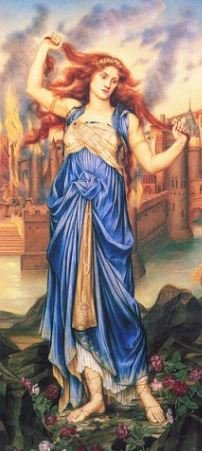
Cassandra by Evelyn De Morgan (1898, London); Cassandra in front of the burning city of Troy at the peak of her insanity.
Helen’s Test
Helen of Troy, suspecting the horse’s true purpose, walked around it and mimicked the voices of the Greek warriors’ wives, hoping to provoke a response. Odysseus, anticipating this, silenced Anticlus, who almost gave them away.
The Fall of Troy
Once the horse was inside the city, the Trojans celebrated their apparent victory late into the night. As the city fell asleep, Sinon lit a beacon to signal the Greek fleet’s return from Tenedos. The warriors concealed in the horse emerged, killing the guards and opening the city gates. The Greek army poured in, catching the Trojans by surprise. Troy was sacked and burned, and its people were slaughtered or enslaved, bringing the Trojan War to a devastating conclusion.

The Burning of Troy (1759-62), oil painting by Johann Georg Trautmann
Interpretations of the Trojan Horse
The story of the Trojan Horse has been interpreted in various ways, blending mythology with historical speculation.
The Trojan Horse has become a timeless symbol of deception, representing strategies that hide malicious intent within an innocuous guise. The metaphor is widely used in modern contexts, such as in cybersecurity, where “Trojan” describes malware disguised as legitimate software.
Some historians suggest the horse might have been a misinterpreted siege engine. Siege engines often bore animal names, and their wooden structures could resemble a horse. Covered in dampened hides to resist flaming arrows, such machines might have inspired the myth.
Another theory posits that the horse represented a ship. In ancient Greece, ships were occasionally adorned with horsehead figures, and the term “sea-horse” appears in the Odyssey. This interpretation suggests that the Greeks might have entered Troy using a ship disguised as a tribute.
Some scholars propose that the horse symbolized an earthquake that breached Troy’s walls. Poseidon, the god associated with both horses and earthquakes, is central to this theory. Archaeological evidence of earthquake damage at Troy VI lends credibility to this idea.
Did you know…?
In Homeric Greek, the horse is referred to as δουράτεος ἵππος (“wooden horse”), evolving into δούρειος ἵππος in Attic Greek. According to Dictys Cretensis, Helenus prophesied the need to dedicate the horse to Athena, inspiring its construction. The tale epitomizes cunning and subterfuge in Greek mythology.
Who was Homer, and why is he considered one of the greatest poets in history?
Depictions in Art and Literature
Ancient Representations
Artistic depictions of the Trojan Horse predate literary accounts. These include:
- The Mykonos Vase (c. 675–650 BC): This vase depicts the horse with Greek warriors visible inside.
- Corinthian Aryballos (c. 560 BC): Features a stylized representation of the horse.
- Attic Red-Figure Krater Fragment (c. 400 BC): Shows warriors emerging from the horse.
These artworks demonstrate the story’s early presence in Greek culture.
Literary Accounts
- Homer’s Odyssey: Mentions the horse briefly, emphasizing Odysseus’s role in its creation.
- Virgil’s Aeneid (Book II): Provides the most detailed account of the Trojan Horse, highlighting Sinon’s deception and the Trojans’ tragic folly.
- Euripides’ Trojan Women: References the horse, with Poseidon recounting its construction.
Legacy and Modern Relevance
The Trojan Horse remains a powerful symbol in culture and language. Its tale exemplifies the dangers of misplaced trust, the power of ingenuity, and the tragic consequences of hubris. It continues to inspire works of art, literature, and analysis, bridging the mythological and historical.
Conclusion
The Trojan Horse epitomizes the blend of strategy, divine intervention, and human error that characterizes much of Greek mythology. Its story endures as a cautionary tale and a testament to the ingenuity and complexity of ancient Greek storytelling. From its mythological origins to its modern metaphorical applications, the Trojan Horse remains a captivating symbol of cunning and the hidden perils of apparent gifts.
Frequently Asked Questions

The Trojan Horse (Greek: δούρειος ίππος, “wooden horse”) is a legendary device in Greek mythology used by the Greeks to infiltrate Troy and end the Trojan War. Image: “The Procession of the Trojan Horse into Troy” by Giovanni Domenico Tiepolo (1773)
Who conceived the idea of the Trojan Horse?
Odysseus, the clever Greek hero, conceived the idea of the Trojan Horse as a final gambit to infiltrate Troy.
How many warriors were hidden inside the Trojan Horse?
Different sources provide varying numbers: Quintus Smyrnaeus mentions 30 warriors but implies there were more, while the Bibliotheca suggests 50. Later traditions standardized the number at 40.
What role did Sinon play in the ruse of the Trojan Horse?
Sinon, a Greek soldier, pretended to be abandoned by his comrades. He convinced the Trojans that the horse was an offering to Athena, designed to atone for the Greeks’ desecration of her temple and ensure their safe return home.
What warnings did the Trojans receive about the horse?
- Laocoön, a Trojan priest, warned, “I fear Greeks, even those bearing gifts.”
- Cassandra, the prophetic daughter of King Priam, also foresaw the danger but was ignored due to her cursed inability to be believed.
- Helen tried to uncover the hidden warriors by mimicking the voices of their wives.
What ultimately silenced Laocoön’s warning?
Poseidon or Apollo sent sea serpents to kill Laocoön and his sons, which convinced the Trojans that the gods favored accepting the horse.
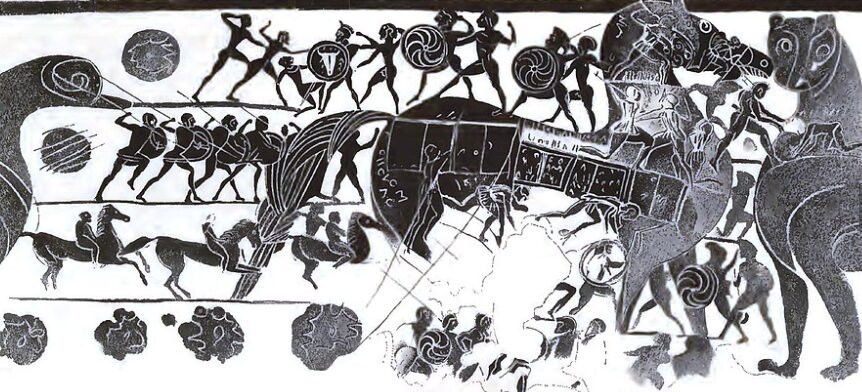
Depiction of the Trojan Horse on a Corinthian aryballos (ca. 560 BC) found in Cerveteri (Italy)
What happened once the horse was inside Troy?
At night, Sinon signaled the Greek fleet, and the warriors emerged from the horse, opening the gates for the returning Greek army. The Greeks infiltrated and destroyed Troy, ending the war.
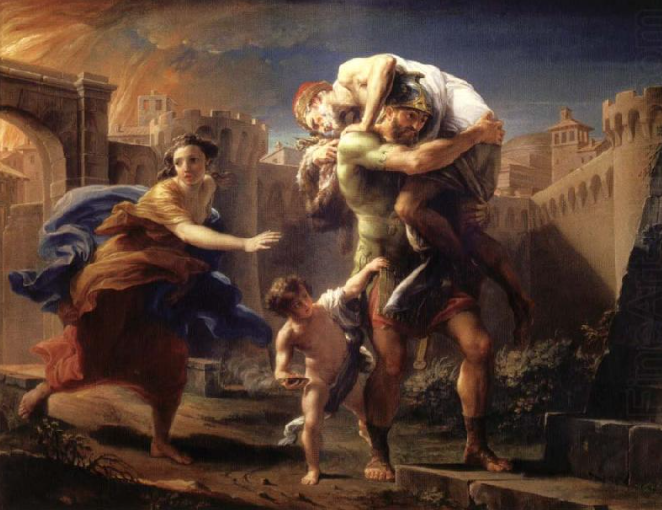
After fleeing the burning city of Troy, Aeneas and his followers went on to become the progenitors of the Romans. Image: Aeneas and his family fleeing from Troy. Painting by Pompeo Batoni (c. 1750).
What does the Trojan Horse symbolize metaphorically?
The Trojan Horse symbolizes deception and hidden threats. It has become a modern metaphor for strategies or entities that conceal malicious intent, such as in cybersecurity where “Trojan” refers to harmful software disguised as legitimate.
How do historians interpret the Trojan Horse?
- Siege Engines: Some believe the horse was a misinterpreted siege engine or ship used in warfare.
- Earthquake Allegory: Others theorize the horse represents an earthquake that breached Troy’s walls, tied to Poseidon’s association with seismic activity.
What artifacts depict the Trojan Horse?
- The Mykonos Vase (c. 675–650 BC): Depicts warriors inside the horse.
- Corinthian Aryballos (c. 560 BC): Illustrates the horse.
- Attic Red-Figure Krater Fragment (c. 400 BC): Shows Greeks emerging from the horse.
How is the Trojan Horse portrayed in ancient literature?
- Virgil’s Aeneid: Provides the most detailed narrative, emphasizing Greek ingenuity and Trojan hubris.
- Homer’s Odyssey: Briefly mentions the horse in relation to Troy’s downfall.
- Euripides’ Trojan Women: Highlights Poseidon’s role in its creation.
The Aeneid serves as the primary ancient source for the Trojan Horse story, which also appeared in the now-lost Little Iliad and Sack of Troy.
Why is the Trojan Horse a timeless theme?
The Trojan Horse represents ingenuity, divine intervention, and human folly. Its enduring legacy in art, literature, and metaphor continues to captivate audiences, bridging mythological and historical interpretations.

The term “Trojan horse” now metaphorically signifies a deceptive strategy to infiltrate and undermine a secure position. In modern usage, it also refers to malicious software that tricks users into executing it. Image: A replica of the Trojan Horse stands today in Turkey, the modern-day location of the city of Troy.





