Who was Virgil and what were some of his major works?
Publius Vergilius Maro, commonly known as Virgil (or Vergil), was one of the greatest poets of ancient Rome. He was born on October 15, 70 BC, near Mantua in northern Italy. Virgil is celebrated for his three major works: the Eclogues (or Bucolics), the Georgics, and his magnum opus, the Aeneid. These works have cemented his place as one of the most influential figures in Western literature. His poetry, blending personal reflection with national epic, has shaped not only Roman literature but also the entire Western literary tradition.

Image: Bust of Virgil.
Early Life and Education
Virgil was born into a relatively modest family, although not impoverished. His father was a farmer, and his family owned enough land to provide for a comfortable life. Virgil’s early education began in his hometown, but he was soon sent to Cremona and then to Milan for further schooling. Eventually, he traveled to Rome, where he studied rhetoric, medicine, and astronomy, among other subjects. He also studied philosophy, particularly under the Epicurean philosopher Siro, whose teachings had a lasting influence on Virgil’s worldview.
Virgil’s early life was marked by the social and political upheaval that characterized the late Roman Republic. The period was one of civil wars, political rivalries, and social change, and these experiences shaped Virgil’s outlook and influenced his later works. His education in both Greek and Latin literature and philosophy, combined with his experience of a Rome embroiled in conflict, provided the foundation for his literary achievements.
Virgil’s Major Works
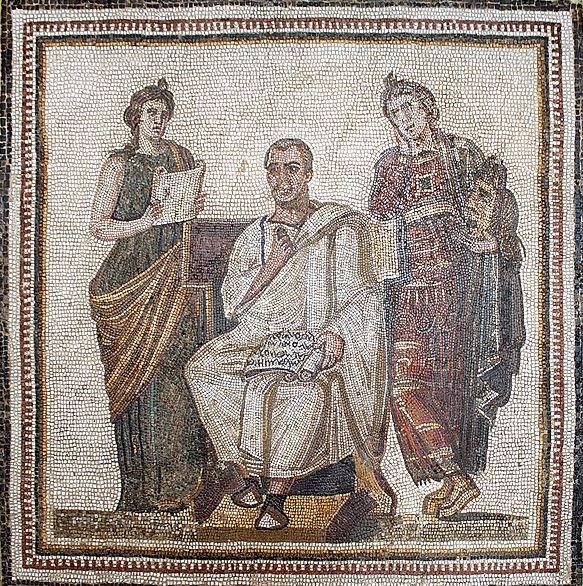
Virgil is regarded as one of the most important literary figures because of his ability to capture the spirit of his age, his influence on Western literature, and the lasting cultural and political significance of his works, especially the Aeneid. Image: Mosaic of Virgil (center) seated between Clio (left) and Melpomene (right).
The Eclogues (also known as Bucolics)
The Eclogues are a collection of ten pastoral poems that represent Virgil’s earliest significant work. Written between 42 and 39 BC, they are heavily influenced by the works of the Greek poet Theocritus, who also wrote pastoral poetry. The Eclogues explore the lives of shepherds and rural life, interweaving themes of nature, love, and politics.
Although the Eclogues appear to be simple pastoral poems, they often reflect the political realities of Virgil’s time. Written during the period of the Second Triumvirate and the proscriptions that followed, they offer an indirect commentary on the turbulence of Roman politics and society. For example, in the first eclogue, Virgil contrasts the fortunes of two shepherds—one who has been dispossessed of his land and another who has been allowed to remain—reflecting the land confiscations that followed the civil wars in Rome.
One of the most famous poems in the Eclogues is the fourth, often referred to as the “Messianic Eclogue.” This poem predicts the coming of a child who will usher in a new golden age of peace and prosperity. While its meaning is debated, some later Christian interpreters saw in it a prophecy of the birth of Christ, though it was more likely written to celebrate the birth of a child in a prominent Roman family.
The Eclogues established Virgil as a major literary figure in Rome and gained him the patronage of powerful individuals, including Maecenas, an influential advisor to the future emperor Augustus.
The Georgics
The Georgics, written between 37 and 29 BC, are a didactic poem in four books that focus on the subject of agriculture. The poem is divided into four parts, each dealing with different aspects of rural life: the cultivation of crops, the care of trees and vines, the raising of livestock, and the care of bees.
Though ostensibly a manual for farmers, the Georgics is much more than a simple agricultural guide. Virgil weaves themes of labor, nature, and the cycles of life and death throughout the poem, creating a work that reflects not only the Roman ideal of the virtuous farmer but also deeper philosophical questions about humanity’s relationship with nature and the gods. The poem draws on earlier works of Greek literature, such as Hesiod’s Works and Days, while also reflecting Virgil’s philosophical inclinations, especially his interest in Epicureanism and Stoicism.
The Georgics is widely regarded as one of Virgil’s most polished works, praised for its technical skill and lyrical beauty.
The Georgics were written during a time of relative peace following the chaos of the civil wars. As such, they also reflect Augustus’s desire to return Rome to a simpler, more virtuous way of life. The poem can be seen as part of Augustus’s cultural program to restore Roman values and to emphasize the importance of the countryside as a source of moral and social stability.
One of the most famous passages in the Georgics is the description of the farmer’s life in the second book, which presents a romanticized vision of rural simplicity in contrast to the decadence and corruption of urban life. Another famous passage describes the plague that afflicts livestock in the third book, a powerful and vivid depiction of the destructive forces of nature.
The Georgics is widely regarded as one of Virgil’s most polished works, praised for its technical skill and lyrical beauty. It was highly influential in later Latin literature and was seen by many as a celebration of Roman virtues, particularly the idea of labor as a noble pursuit.
The Aeneid
Virgil’s greatest work, the Aeneid, was written between 29 and 19 BC and is an epic poem in twelve books. It tells the story of Aeneas, a Trojan prince who, after the fall of Troy, embarks on a journey to Italy where he will eventually lay the foundations for the future city of Rome. The poem is both a national epic that provides Rome with a heroic past and a political work that celebrates Augustus and his vision of a new Roman era.
The Aeneid is heavily influenced by Homer’s Iliad and Odyssey, with the first six books of the poem mirroring the structure of the Odyssey (Aeneas’s journey) and the last six books reflecting the Iliad (the wars Aeneas fights in Italy). However, Virgil transforms the Homeric material to suit his own purposes, creating a uniquely Roman epic that is deeply concerned with the themes of fate, duty, and piety (pietas).
The poem opens with the famous lines, “I sing of arms and the man,” immediately linking Aeneas’s journey with the heroic tradition of Greek epic but also signaling a new direction as Aeneas’s mission is not merely personal but tied to the destiny of a people—the future Romans. Throughout the poem, Aeneas is portrayed as a man of deep duty and sacrifice, often forced to put aside his own desires for the greater good. His mission is divinely ordained, and he must follow the will of the gods, even when it leads to personal suffering, such as his separation from Dido, the queen of Carthage.
One of the most famous episodes in the Aeneid is the fall of Troy, recounted by Aeneas in Book 2. Virgil’s depiction of the destruction of the city and the grief of the Trojans is one of the most powerful in Latin literature. Another key episode is the tragic love story of Aeneas and Dido in Books 4 and 6. Dido falls in love with Aeneas after he arrives in Carthage, but their love is doomed by Aeneas’s obligation to fulfill his destiny in Italy. Dido’s subsequent suicide is one of the most memorable and tragic moments in the poem.
The Aeneid was written during the rule of Augustus, and the poem has often been interpreted as a reflection of the Augustan regime’s ideals and values.
The second half of the Aeneid focuses on Aeneas’s arrival in Italy and the war he wages against Turnus, the leader of the Rutulians. The conflict between Aeneas and Turnus is often seen as representing the struggle between fate and human resistance, with Aeneas embodying the forces of destiny. The final book of the poem culminates in a brutal one-on-one fight between the two men, ending with Aeneas’s victory and Turnus’s death. The poem famously concludes abruptly, leaving readers to reflect on the costs of Aeneas’s mission and the moral complexities of his triumph.
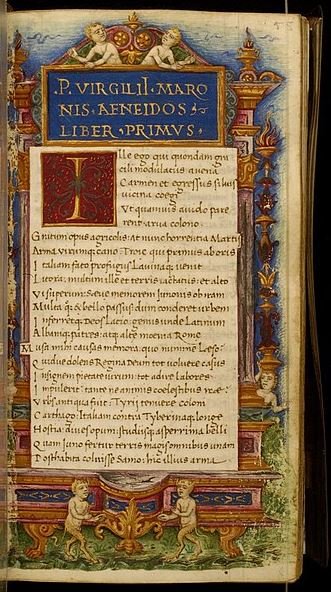
Image: Manuscript of the Aeneid circa 1470, Italian painter Cristoforo Majorana
The Aeneid was written during the rule of Augustus, and the poem has often been interpreted as a reflection of the Augustan regime’s ideals and values. It presents Rome as a city destined for greatness, with Aeneas’s journey serving as a metaphor for the establishment of Roman order and civilization. At the same time, the poem grapples with the darker aspects of empire-building, including the suffering and violence that come with conquest.
Virgil reportedly worked on the Aeneid for the last ten years of his life, and he died before he could finish it. According to tradition, he wished for the manuscript to be destroyed upon his death, but Augustus intervened, recognizing its immense cultural and political value. The poem was published posthumously, and it quickly became regarded as one of the greatest works of Latin literature. It was studied in schools throughout the Roman Empire and continued to influence writers for centuries.
Trojan War: the 10-year-long, bloody war between Troy and Greece
Virgil’s Influence on Western Literature
Virgil’s poetry has had a profound impact on Western literature and culture, from the ancient world to the present day. His works were central to the Roman educational system, and they remained essential reading throughout the Middle Ages and the Renaissance. Latin students were required to study the Aeneid, and it became a cornerstone of classical education in Europe.
In the Divine Comedy, Dante Alighieri chose Virgil as his guide through Hell and Purgatory. In the Inferno, Dante expresses his admiration for Virgil, referring to him as “the one from whom I took the beautiful style that has done honor to me.” Virgil represents reason and wisdom in Dante’s work, and his presence underscores the deep influence of Virgilian themes on medieval literature.
In the Renaissance, Virgil’s works were admired for their stylistic elegance and moral gravity. Writers such as Geoffrey Chaucer, Edmund Spenser, and John Milton drew inspiration from Virgil’s poetry, particularly the Aeneid. Milton’s Paradise Lost owes a great deal to the Aeneid, both in terms of its structure and its exploration of themes such as duty, sacrifice, and the conflict between free will and destiny.
T.S. Eliot, one of the most important poets of the 20th century, famously asserted that any definition of a classic must include Virgil. Eliot’s admiration for Virgil reflects the enduring relevance of his works in modern literature. Virgil’s exploration of human suffering, political power, and the moral challenges of leadership continue to resonate with readers across different historical periods.
Virgil’s Mastery of Language and Form
Virgil’s place in the Western literary canon is assured by the timeless quality of his poetry. His ability to weave personal experience with national epic, his mastery of language and form, and his exploration of universal themes such as duty, fate, and suffering have ensured that his works remain relevant more than two thousand years after his death. The Aeneid in particular continues to be read and studied as one of the great works of world literature, offering insights not only into Roman history and culture but also into the complexities of human experience.
Virgil’s legacy is one of profound influence, shaping the course of literature in ways that few other authors have. From antiquity through the Renaissance and into the modern era, his poetry has inspired countless writers and thinkers, making him one of the most significant literary figures in the history of the Western world.
Most Famous Poets of All Time and Their Notable Masterpieces
Frequently Asked Questions

What are Virgil’s three most famous works?
Virgil’s three most famous works are the Eclogues (or Bucolics), the Georgics, and the epic poem Aeneid. These works have had a lasting impact on Latin literature.
What themes are explored in Virgil’s Eclogues?
The Eclogues, a series of ten pastoral poems, explore themes of nature, love, and politics. They reflect the social and political turbulence of Virgil’s time.
What is the subject of Virgil’s Georgics?
The Georgics is a didactic poem that focuses on agriculture, offering insights into farming, animal husbandry, and viticulture, while promoting the Roman ideals of labor and a connection to the land.
What is the Aeneid about, and why is it important?
The Aeneid tells the story of Aeneas, a Trojan hero who embarks on a journey to establish what would become Rome. This epic served as a cultural and political symbol during Augustus’s reign, promoting values such as duty, fate, and piety.
How was Virgil regarded during his lifetime and after his death?
Virgil was highly respected during his lifetime as a literary genius, surpassing earlier Roman poets like Ennius. His reputation continued to grow after his death, with his works becoming a central part of Roman education and culture.
How did Virgil influence later literature, particularly in the works of Chaucer and Dante?
Virgil’s influence is evident in works like Geoffrey Chaucer’s The House of Fame, where Virgil is honored as a towering literary figure. Dante Alighieri also pays tribute to Virgil in the Divine Comedy, making Virgil his guide through Hell and Purgatory and crediting him as a major influence on his writing style.
How did Virgil’s works influence modern writers like T.S. Eliot?
T.S. Eliot emphasized Virgil’s importance in the Western literary canon, stating that any definition of a classic must include Virgil. Eliot recognized Virgil’s timeless influence on literature.
How did Virgil’s Aeneid reflect Roman ideals and Augustus’s vision of Rome?
The Aeneid reflected Roman ideals such as pietas (duty), fatum (fate), and virtus (courage). It also supported Augustus’s vision of a new era of peace and prosperity for Rome following years of civil war.
What is the Appendix Vergiliana, and what do scholars think about its authenticity?
The Appendix Vergiliana is a collection of minor poems attributed to Virgil. However, modern scholars generally regard many of these works as spurious, with only a few possibly being authentic.
How did Virgil’s works become foundational in education?
Virgil’s poetry became a cornerstone of education in both the Roman world and throughout the Middle Ages. His works were used to teach grammar, rhetoric, and moral philosophy, which ensured his lasting influence across centuries.





