What transpired at the Battle of Chaeronea in 338 BCE?

Location of the Battle of Chaeronea (338 BCE): Chaeronea, Boeotia, Greece
Diodorus Siculus, a Greek historian of the 1st century BC, chronicled many important events of ancient history in his work Bibliotheca Historica. Among the events he covered, the Battle of Chaeronea in 338 BC is particularly significant as it marked the rise of Philip II of Macedon as the dominant power in Greece. This battle is often viewed as a turning point in Greek history, and Diodorus’s account offers valuable insights into the battle’s significance, tactics, and its larger historical implications.

Bibliotheca historica, 1746
Context and Significance of the Battle
The Battle of Chaeronea took place during a time of great turmoil and instability in Greece. For much of the classical period, Greece was dominated by powerful city-states like Athens and Sparta.
However, internal divisions and a series of exhausting wars, such as the Peloponnesian War, left the Greek states weakened and vulnerable. Philip II of Macedon, through a combination of military brilliance, diplomacy, and political manipulation, gradually expanded his influence across the Greek world. The battle itself was the culmination of years of conflict between Macedon and a coalition of Greek city-states, particularly Athens and Thebes.
For the Greeks, this battle represented the last significant attempt to preserve their independence from the rising power of Macedon. Diodorus emphasizes the sense of urgency and desperation that pervaded the Greek forces as they prepared to face Philip’s army.

Ancient Greek historian Diodorus Siculus as depicted in a 19th-century fresco
The Forces Involved
According to Diodorus, the forces in the battle were composed of a coalition of Greek states led primarily by Athens and Thebes on one side, and the Macedonian army led by Philip II on the other. The Athenian forces were significant, representing the largest contingent of the Greek coalition, with the Theban Sacred Band—a renowned elite force—forming another crucial part of the alliance.
On the Macedonian side, Philip’s forces were well-organized and disciplined, thanks to the reforms he had instituted in his army. His military innovations, particularly the use of the Macedonian phalanx armed with the long sarissa spears, gave him a tactical advantage over the more traditional hoplite forces of the Greeks.
Philip was also joined by his son, Alexander, who would later become known as Alexander the Great. Although only 18 years old at the time, Alexander played a crucial role in the battle and demonstrated the military prowess that would later define his career.

A Niketerion (victory medallion) features King Philip II of Macedon’s image, minted in the 3rd century AD, likely during Emperor Alexander Severus’s reign.
The Course of the Battle
Diodorus provides a vivid account of the battle, which was fought near the town of Chaeronea in Boeotia. The Greek forces, though brave and determined, were ultimately outmatched by the superior organization and tactics of the Macedonians. Philip’s strategy involved a feigned retreat, which lured the Athenians into a trap. As the Athenian forces pursued the retreating Macedonians, they became disorganized and vulnerable to a counterattack.
It was at this moment that Alexander, commanding the Macedonian cavalry on the left wing, led a decisive charge against the Theban Sacred Band. Diodorus highlights this moment as a key turning point in the battle, as the Sacred Band was annihilated, and the Theban forces began to collapse. With the Thebans in disarray, the Athenians were left isolated and soon followed in defeat.
Aftermath and Historical Impact
The defeat of the Greek forces at Chaeronea had profound consequences for the Greek world. For many Greek city-states, this battle symbolized the end of their independence and the beginning of Macedonian dominance. In the immediate aftermath of the battle, Philip treated his defeated enemies with surprising leniency. Diodorus notes that Philip refrained from destroying Athens or Thebes, opting instead to integrate them into his growing empire. He formed the League of Corinth, a federation of Greek states that would serve as a tool for Macedonian control while maintaining the appearance of Greek autonomy.
The victory at Chaeronea solidified Philip’s control over Greece and paved the way for his planned invasion of the Persian Empire. However, Philip would not live to see this ambition realized, as he was assassinated just two years later. His son, Alexander, would go on to fulfill this vision, launching a campaign of conquest that would forever change the course of history.
Diodorus Siculus’ Perspective
Diodorus’ account of the Battle of Chaeronea provides us with an important historical perspective, but it should be noted that his work was written several centuries after the event. While Diodorus drew on earlier sources, such as Ephorus and Theopompus, there are some discrepancies between his account and other historical sources, including those of Polybius and Plutarch.
One area where Diodorus’ account stands out is his emphasis on the role of Alexander in the battle. While other sources also acknowledge Alexander’s participation, Diodorus seems particularly eager to highlight the young prince’s contributions, perhaps as a way of foreshadowing his later achievements. Additionally, Diodorus portrays the battle as a decisive moment in which the Greeks came to terms with their diminished power and the reality of Macedonian supremacy.
Diodorus also frames the battle within the larger context of Greek disunity. He repeatedly emphasizes how the Greeks’ inability to unite against a common enemy ultimately led to their downfall. In this way, Diodorus’ account serves as a cautionary tale about the dangers of internal division and the need for collective action in the face of external threats.
Tactics and Strategy
The Battle of Chaeronea is often studied for its military tactics, particularly the role of the Macedonian phalanx and cavalry. Philip’s use of the phalanx, armed with the sarissa, allowed his infantry to outmatch the more heavily armored but shorter-ranged Greek hoplites. Diodorus describes how the length of the sarissa gave the Macedonians a significant reach advantage, allowing them to strike their opponents before the hoplites could close in for hand-to-hand combat.
Philip’s use of a feigned retreat is another key aspect of the battle’s strategy. By drawing the Athenians out of their defensive positions, Philip was able to exploit their disorganization and deliver a devastating counterattack. This tactic of luring an enemy into a vulnerable position before launching a counteroffensive was a hallmark of Philip’s military genius and would later be employed by Alexander in his own campaigns.
The role of cavalry in the battle was also crucial. Diodorus emphasizes how Alexander’s cavalry charge against the Theban Sacred Band was a pivotal moment that shattered the Greek lines. The use of cavalry to outflank and disrupt enemy formations was another innovation that would become a hallmark of Macedonian warfare.
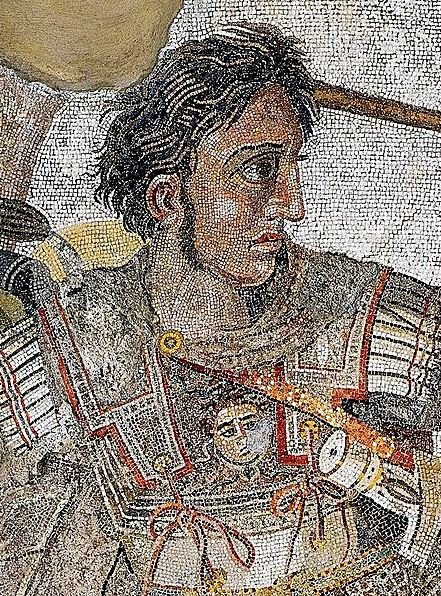
Alexander Mosaic, National Archaeological Museum, Naples.
The Sacred Band of Thebes
One of the most poignant elements of Diodorus’ account is his description of the fate of the Sacred Band of Thebes. The Sacred Band was an elite unit composed of 300 soldiers who were renowned for their discipline, bravery, and the strong bonds of loyalty that united them. According to tradition, the Sacred Band was made up of pairs of lovers, and this close-knit structure was believed to foster exceptional bravery and cohesion in battle.
At Chaeronea, the Sacred Band fought valiantly, but they were ultimately surrounded and overwhelmed by Alexander’s cavalry. Diodorus describes how the entire unit was killed to the last man, refusing to surrender even in the face of certain death. The destruction of the Sacred Band was a symbolic moment in the battle, representing not only the physical defeat of the Theban forces but also the end of an era in which the city-states of Greece could stand as independent powers.

Conclusion
The Battle of Chaeronea, as described by Diodorus Siculus, stands as one of the most significant military engagements in Greek history. It marked the end of Greek independence and the beginning of Macedonian dominance, setting the stage for the conquests of Alexander the Great and the spread of Hellenistic culture across the known world.
Diodorus’ account provides a detailed narrative of the battle, emphasizing the tactical brilliance of Philip II and the bravery of the Greek forces, particularly the Sacred Band of Thebes. His portrayal of the battle is not only a record of a historical event but also a reflection on the themes of unity, leadership, and the changing nature of power in the ancient world.
In the broader context of Greek history, Chaeronea symbolizes the decline of the independent city-state and the rise of larger, more centralized empires. It serves as a reminder of the fleeting nature of power and the ways in which internal divisions can lead to external domination. For Diodorus, the Battle of Chaeronea was a watershed moment in which the Greek world was irrevocably changed, paving the way for the age of Macedonian and, later, Roman dominance.
By offering this account, Diodorus Siculus helps modern readers understand not only the specifics of the battle but also its long-lasting implications for the ancient world, as Greece transitioned from a collection of autonomous city-states to a key region in a larger imperial framework.
Frequently asked questions

A funerary relief commemorating Athenian soldier Panchares, believed to have died in the Battle of Chaeronea.
What is the significance of the Battle of Chaeronea according to Diodorus Siculus?
The Battle of Chaeronea in 338 BCE was a pivotal moment in Greek history that marked the end of the independence of the Greek city-states. It resulted in Macedonian dominance over Greece and the unification of the Greek states under Philip II of Macedon.
Who led the Macedonian forces at the Battle of Chaeronea?
The Macedonian forces were led by Philip II of Macedon and his son, Alexander. Philip commanded one wing of the army, while Alexander, just of age, led the other wing, supported by experienced generals.
Why did Philip II seize Elateia, and what was its strategic importance?
Philip seized Elateia, a strategic town, to prepare for an invasion of Attica. Elateia controlled key mountain passes, making it a crucial position for launching an attack on Athens.
How did the Athenians react to the news of Elateia’s fall?
The Athenians were thrown into panic upon hearing the news. Trumpets blared warnings throughout the night, and by morning, citizens gathered in the assembly, anxious about the imminent threat. Fear gripped the assembly until Demosthenes rose to speak.
What role did Demosthenes play in the Athenian response to Philip’s invasion?
Demosthenes urged the Athenians to form an alliance with Thebes and the Boeotians to defend Greek liberty. He led the embassy to Thebes and successfully convinced them to join forces with Athens against Philip.

Bust of the Greek orator Demosthenes. Marble, Roman artwork, inspired from a bronze statue by Polyeuctos (ca. 280 BC). Found in Italy | Demosthenes orator Louvre
What were the respective strengths of the Macedonian and Greek armies at the Battle of Chaeronea?
The Macedonian army had superior numbers and military experience, with 30,000 infantry and 2,000 cavalry, led by Philip and his seasoned generals. The Greek forces, though courageous, were less experienced and disadvantaged by the absence of their best generals.
What was Alexander’s role in the battle according to Diodorus Siculus?
According to Diodorus, Alexander led a decisive charge against the Greek forces, breaking through their lines and turning the tide of the battle. His actions contributed significantly to the Macedonian victory.
What was the outcome of the Battle of Chaeronea for Athens and Thebes?
The battle ended in a catastrophic defeat for Athens and Thebes. Over 1,000 Athenians were killed, 2,000 were captured, and many Boeotians also perished. The defeat marked the end of their resistance to Macedonian dominance.
How did Philip II treat Athens and Thebes after the battle?
Despite his victory, Philip treated Athens leniently. He renewed peace with Athens, allowing it to retain much of its local autonomy. However, he placed a Macedonian garrison in Thebes to ensure control over the city.
What larger goal did Philip II aim to achieve after his victory at Chaeronea?
After unifying Greece, Philip aimed to lead a united Greek campaign against the Persian Empire. He was named the general of all Greece, with full authority to lead the expedition, but was assassinated before he could embark on the campaign.
Who carried on Philip II’s legacy after his assassination?
After Philip’s assassination, his son Alexander carried on his legacy. Alexander would later become known as Alexander the Great and fulfill his father’s vision by conquering the Persian Empire.





