What was the Armenian Question?
The Armenian Question originated in debates about securing rights and protections for a Christian minority in a crumbling empire. Over time, it came to symbolize both the broader Eastern Question—how to manage the disintegration of the Ottoman realm—and the clash between Armenians’ aspirations for self-determination and an imperial authority resisting further territorial losses.
Summary
The Armenian Question arose in the late 19th century as European powers debated how to address the political and human rights concerns of Armenians living under Ottoman rule. Following the Congress of Berlin in 1878, diplomats and news outlets popularized the term, which encapsulated widespread debates about the treatment of Armenians.
At its core, this “question” revolved around ensuring the safety, freedoms, and political representation of Armenian communities within the Ottoman Empire. Over the next four decades, shifting alliances, nationalist aspirations, and international negotiations contributed to a complex web of policies and promises that profoundly affected Armenian fortunes.
Ultimately, in 1915, the ruling Committee of Union and Progress (CUP) tried to resolve the Armenian Question through mass violence and forced expulsions—events remembered as the Armenian Genocide.

Anton von Werner’s 1881 painting, “Congress of Berlin”, portrays the final meeting held at the Reich Chancellery on July 13, 1878.
Early Nationalism and the Roots of the Armenian Question
Starting in the early 19th century, the Ottoman Empire began to unravel as nationalist fervor, inspired partly by the French Revolution, gained momentum. Various groups within the empire—Greeks, Serbs, Bulgarians, and others—sought either autonomy or outright independence.
With the support of major European powers, several of these populations managed to achieve national sovereignty. However, the Armenians, who were dispersed across multiple regions and rarely comprised a local majority, found it harder to claim an independent state.
By the late 19th century, discontent among Armenian communities led to the formation of political organizations such as the Hunchaks and the Dashnaks (Dashnaktsutyun), who hoped to leverage external support to achieve greater rights or autonomy within traditionally Armenian-populated areas.
Geopolitical Motivations and the Great Powers
As Ottoman influence waned, Russia, Great Britain, and other European powers vied for influence in the empire’s territories, seeking both strategic and economic advantages. While Christian populations were often championed by these powers—ostensibly in the name of humanitarianism—rivalries and power plays shaped their actions.
Russia, in particular, presented itself as a protector of Orthodox and Christian communities, including the Armenians. Over several decades, Russia expanded its southern borders, annexing regions with significant Armenian populations. These expansions fueled Armenian hopes that Russian intervention might lead to more secure lives or even political autonomy.
Meanwhile, European missionary endeavors, as well as the ideological currents of liberalism and nationalism, exposed Armenians to new political concepts, reinforcing discontent under Ottoman rule.
The Russo-Turkish War and the Treaty of San Stefano
Between 1877 and 1878, the Russo-Turkish War served as a pivotal moment for the Armenian Question. Russian forces advanced into Ottoman-held territories, which included large Armenian populations.
Many local Armenians, weary of violence and forced levies by regional paramilitaries, welcomed the Russian army as liberators. The Russian victory culminated in the Treaty of San Stefano (March 1878), where provisions for Armenian reforms were briefly considered.
Notably, Article 16 proposed that Russian troops would maintain a presence in areas with numerous Armenians until the Ottoman government could implement improvements to safeguard local populations. Although this clause generated hope among Armenian leaders, subsequent negotiations soon eroded its impact.
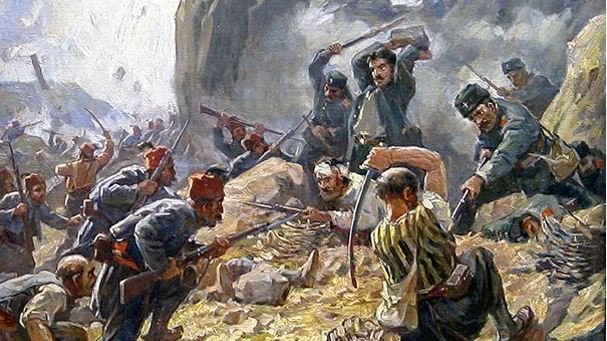
“Battle of Shipka Pass”, one of the major battles during the Russo-Turkish War.
The Congress of Berlin and Article 61
Alarmed by Russia’s growing influence, Great Britain and other powers convened the Congress of Berlin in mid-1878, aiming to redefine the balance of power in the region. The resulting Treaty of Berlin replaced the terms of the Treaty of San Stefano and, in so doing, considerably weakened guarantees of Armenian protection.
Article 16 was effectively diluted into Article 61, which acknowledged the need for reforms and security measures in Armenian-inhabited provinces but removed the provision that Russian troops would remain until those reforms took hold.
Instead, the Ottoman government was simply instructed to implement improvements and periodically report on its progress. This adjustment significantly reduced the tangible enforcement mechanisms that might have ensured Armenians’ safety, leaving them vulnerable to ongoing local hostilities.
Armenian National Awakening and European Diplomacy
After the Congress of Berlin, Armenian leaders such as Patriarch Nerses Varzhapetian and the Armenian National Assembly tried to maintain international interest in their cause. They approached European diplomats with evidence of abuses, including forced conversion, land seizures, and widespread violence. Yet promises of reform remained largely unrealized.
Activists, especially those affiliated with the newly formed political parties, believed that only forceful or conspicuous actions could attract international media coverage and nudge the powers to intervene. In this climate, some revolutionaries resorted to armed rebellion, hoping that inciting a crisis would precipitate foreign mediation. These strategies occasionally succeeded in grabbing headlines but rarely secured sustained diplomatic commitment.
From Reform Attempts to Massacres
Repeated calls for the Ottoman government to enact reforms resulted in sporadic, superficial adjustments rather than lasting changes. Beginning in the mid-1890s, frustrations ran high as ongoing violence targeted Armenian communities.
European powers orchestrated proposals such as the 1895 Armenian reform program, but there was scant enforcement, and atrocities continued. Instances like the Hamidian massacres of 1894–1896, which claimed tens of thousands of Armenian lives, underscored the empire’s failure to protect its minority subjects. Further turmoil in the early 20th century, including the 1909 Adana massacres, again highlighted the precarious situation.
World War I and the Armenian Genocide
When World War I broke out in 1914, Ottoman leaders suspected that disloyal Armenian subjects might ally with advancing Russian forces. These anxieties, combined with the CUP’s nationalist vision, laid the groundwork for extreme measures.
In April 1915, Ottoman authorities began rounding up Armenian intellectuals and community leaders in Constantinople (Istanbul), a move widely viewed as the first step in the systematic plan to eradicate the Armenian population.
The Armenian Genocide, which effectively sought to eliminate an entire people, was the grim culmination of decades of dashed promises and thwarted reforms.
Over the following months, mass deportations and killings took place throughout the empire, with women, children, and the elderly driven on forced marches or subjected to other deadly methods. This policy of extermination decimated the Armenian communities in their historic homelands and created a massive refugee crisis. International observers, diplomats, and missionaries documented the unfolding catastrophe, which was later recognized by many as genocide.