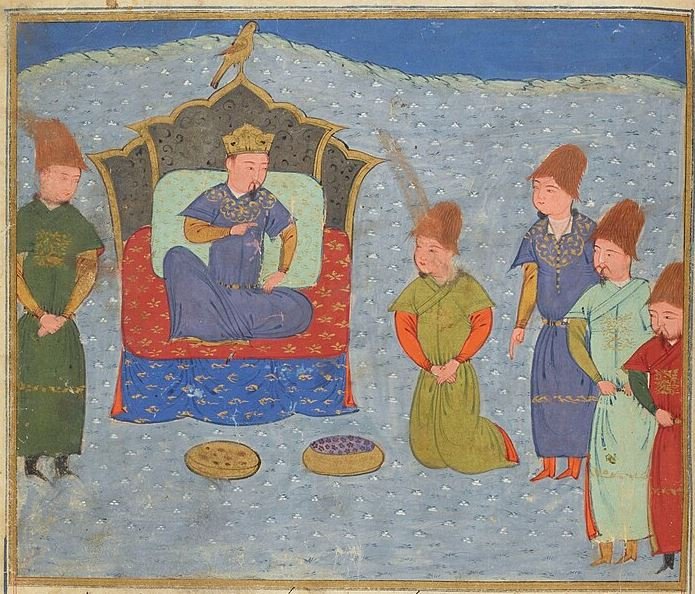
What was the Golden Horde? – History and Major Facts
The Golden Horde was a Mongol and later Turkicized khanate that originated in the 13th century as the northwestern segment of the Mongol Empire. It became a separate khanate after the Mongol Empire’s division in 1259 and was also known as the Kipchak Khanate or the Ulus of Jochi.
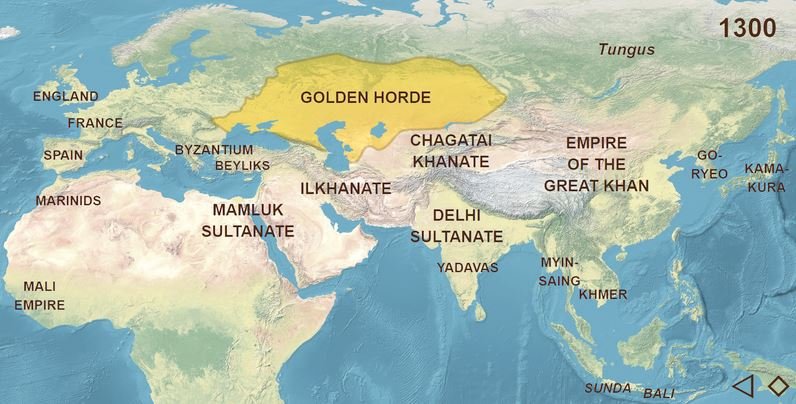
Map showing the Golden Horde, as highlighted in yellow.
Origins of the Golden Horde
The Golden Horde, self-designated as Ulug Ulus (Great State), was initially established as the northwestern sector of the Mongol Empire in the 13th century. The term “Golden Horde” evolved much later and reflects interpretations of its grandeur and wealth, often linked to the golden tents of its rulers. This khanate, often referred to as the Ulus of Jochi, was formed from the territory allocated to Jochi, the eldest son of Genghis Khan, although Jochi predeceased his father. The lands of the Golden Horde were officially ruled by Jochi’s descendants, with Batu Khan, his son, emerging as a key founder of this khanate.
By 1259, following the fragmentation of the Mongol Empire after the death of Möngke Khan, the Golden Horde became a fully autonomous political entity. It absorbed and replaced earlier nomadic confederations, notably the Cuman-Kipchak federation, and established itself as a dominant force in Eurasia.

A painting depicting Genghis Khan.
Expansion and Administration
The Golden Horde reached its zenith under the rule of Batu Khan and his successors. Its vast territory extended from the Ural Mountains and Siberian steppes in the east to the Danube River in the west. It covered large parts of modern-day Russia, Ukraine, Kazakhstan, and the Caucasus.
Batu Khan led the infamous Mongol invasions of Kievan Rus’, Poland, and Hungary between 1237 and 1242. The destruction wrought during these campaigns allowed the Horde to subjugate key principalities of Rus’, which became tributary states. Batu’s forces halted their European campaigns only after the death of Ögedei Khan in 1241, which required Mongol leaders to return to the empire for succession matters.
The Golden Horde maintained a feudal administrative system, dividing its territory into appanages governed by princes loyal to the khan. Sarai, its capital on the Volga River, became a thriving commercial and political hub, reflecting both Mongol traditions and the increasing Turkicization of the khanate. While the Mongolian language was used in official documents early on, Turkic languages gradually became dominant.
To maintain control, the Horde conducted regular censuses to enforce taxation and conscription. Local rulers, such as the princes of Rus’, collected tributes, which were then sent to Sarai.
Cultural and Religious Transformation
Under the reign of Özbeg Khan (1313–1341), the Golden Horde underwent significant cultural and religious transformation. Özbeg officially adopted Islam as the state religion, fostering its spread across the khanate. Islamization also shaped governance, with laws increasingly reflecting Islamic principles, and it strengthened ties with other Muslim states such as the Mamluk Sultanate.
Despite Islam’s prominence, the Horde exhibited remarkable religious tolerance. The Russian Orthodox Church, for instance, was exempted from taxes, and the Genoese merchants in the Crimea continued their trade activities unhindered.
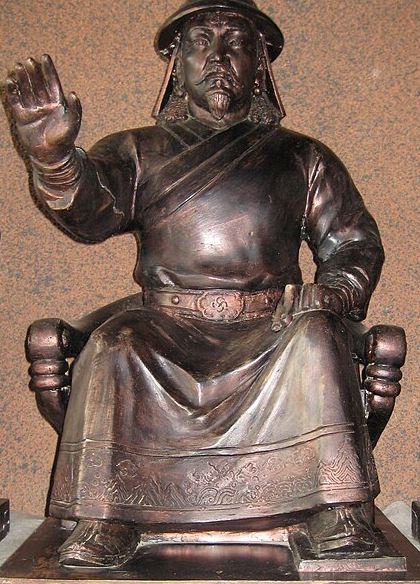
Statue of Jochi
Economic Powerhouse
The Golden Horde was a central player in the Eurasian trade networks, benefiting from its location along the Silk Road. Cities like Sarai and the Crimean ports flourished as trade hubs, linking the Mediterranean, Central Asia, and China. The Horde traded slaves, furs, silk, and spices, while taxing merchants traveling through its territory. The Genoese colonies in the Black Sea, such as Caffa, played a pivotal role in this trade.
Internal Struggles and Decline
The Golden Horde faced internal challenges starting in the late 14th century, leading to a gradual decline.
The Great Troubles (1359–1381)
After the death of Berdi Beg in 1359, the Horde plunged into a period of political chaos known as the Great Troubles. A succession crisis and infighting among the ruling elite weakened central authority. During this period, regional leaders, such as Mamai, emerged as powerful figures, further fragmenting the khanate.
Reunion under Tokhtamysh
In 1381, Tokhtamysh managed to reunite the Golden Horde briefly. He reasserted authority over Rus’ and launched campaigns against neighboring powers. However, his ambitions brought him into conflict with Timur (Tamerlane), the founder of the Timurid Empire. Timur’s devastating invasions (1395–1396) crippled the Golden Horde, leading to the destruction of its cities, including Sarai.
Fragmentation into Successor States
By the early 15th century, the Golden Horde had fractured into smaller, independent khanates. These included:
- Crimean Khanate: Became a dominant power in the Black Sea region and lasted until its annexation by the Russian Empire in 1783.
- Kazan Khanate: Established in the Volga region and was conquered by Ivan the Terrible in 1552.
- Astrakhan Khanate: Controlled parts of the Caspian coast and was annexed by Russia in 1556.
- Nogai Horde: A nomadic confederation that persisted into the 17th century.
The rise of Moscow as a powerful state further eroded the influence of the Golden Horde. The Great Stand on the Ugra River in 1480 marked the symbolic end of Mongol dominance over Russia.
Legacy of the Golden Horde
The Golden Horde left a lasting legacy in Eurasia, particularly in shaping the development of Russia and other successor states.
The Horde’s administrative practices, including taxation and military organization, influenced the political structures of its tributary states, particularly Muscovy. The centralization of power in Moscow was partly modeled on the Horde’s governance.
The Horde’s integration of Eurasian trade networks laid the groundwork for economic exchanges between East and West. It also facilitated the transmission of ideas, technologies, and cultural practices across its territories.
The Golden Horde contributed to the Turkicization of its population, particularly in the steppe regions. Modern Tatar, Kazakh, and Crimean Tatar identities trace their origins to the Horde’s diverse populace.

Timeline
1227: Genghis Khan’s empire is divided among his sons. Jochi’s descendants inherit the westernmost lands.
1240–1242: Batu Khan establishes the Golden Horde after conquering Kievan Rus’ and returning westward.
1255: Batu Khan dies; the Golden Horde becomes an independent khanate.
1312–1341: Özbeg Khan’s reign marks the peak of the Golden Horde, adopting Islam and expanding trade.
1359–1381: The Great Troubles—political instability and fragmentation weaken the khanate.
1381–1395: Tokhtamysh reunifies the Horde briefly but is defeated by Timur in the Battle of the Terek River.
1400–1419: Under Edigu, the Horde stabilizes but struggles with internal divisions and external threats.
1440s: Breakaway states emerge, including the Crimean, Kazan, and Astrakhan Khanates.
1480: The Great Stand on the Ugra River ends Mongol rule over Russia.
1502: The Crimean Khanate absorbs remnants of the Great Horde.
1783–1847: The last successor states, the Crimean and Kazakh Khanates, are conquered by Russia.