What was the Kingdom of the Lombards?
The Kingdom of the Lombards, also known as the Lombard Kingdom or the Kingdom of Italy, was a significant political and cultural entity that existed from the 6th to the 8th century in the Italian Peninsula. The Lombards, a Germanic people, migrated from Northern Europe and established a kingdom that played a crucial role in the transition from the Roman Empire to the medieval period.
In the article below, World History Edu delves into the history, major events, and cultural contributions of the Kingdom of the Lombards.

The Kingdom of the Lombards was a significant entity in early medieval Europe, bridging the gap between the Roman Empire and the later medieval kingdoms. Image: A map showing Lombard Kingdom circa 740 AD.
Origins of the Lombards
The Lombards, or Langobards, originated from the Scandinavian region, specifically from the area around the lower Elbe River. Their name, meaning “long beards,” is a reference to their distinctive appearance. Over centuries, they migrated southward through Europe, settling temporarily in various regions, including modern-day Hungary, before crossing the Alps into Italy.
Migration and Settlement in Italy
In 568 AD, led by their king Alboin, the Lombards crossed the Julian Alps into Italy, capitalizing on the weakened state of the Byzantine Empire, which was struggling to maintain control over the Italian territories. Alboin’s forces quickly seized control of large portions of northern and central Italy, including cities like Milan, Verona, and Pavia. The latter became the capital of the Lombard Kingdom.
Establishment of the Kingdom
Alboin established the Kingdom of the Lombards in 568 AD, marking the beginning of Lombard rule in Italy. The Lombards faced resistance from the Byzantines, who retained control over some coastal areas and parts of southern Italy, leading to a fragmented political landscape. Despite this, the Lombards maintained dominance over much of the Italian Peninsula.
Political Structure and Governance
The Lombard Kingdom was characterized by a decentralized political structure. It was divided into various duchies, each governed by a duke (duces). These duchies had considerable autonomy, often acting independently of the king. The king, however, held supreme authority and was responsible for the overall defense and administration of the kingdom.

Major Kings and Their Reigns
Several notable kings ruled the Lombard Kingdom, each contributing to its development and expansion:
- Alboin (568-572): The founder of the kingdom, Alboin’s reign was marked by initial conquests and the establishment of Lombard rule in Italy. His assassination in 572 led to a period of instability.
- Authari (584-590): Authari managed to consolidate Lombard control and resisted Byzantine attempts to reclaim territories. He also sought alliances with other Germanic tribes.
- Agilulf (591-616): Agilulf continued to strengthen the kingdom, both militarily and politically. He married Theodelinda, a Catholic Bavarian princess, which helped in promoting Christianity among the Lombards.
- Rothari (636-652): Known for his legal reforms, Rothari issued the Edictum Rothari, a codification of Lombard laws that blended Germanic customs with Roman legal traditions.
- Liutprand (712-744): One of the most successful Lombard kings, Liutprand expanded the kingdom’s territory and fostered closer ties with the Papacy. His reign saw the peak of Lombard power in Italy.

Image: An artwork portraying Alboin.
Religious and Cultural Transformation
Initially, the Lombards were pagans, but over time, they adopted Christianity. The conversion process was gradual, influenced by interactions with neighboring Christian communities and the efforts of missionary work. The marriage of King Agilulf to the Catholic Theodelinda played a significant role in this religious transformation.
The Lombards also made notable contributions to the cultural landscape of Italy. They preserved and adapted Roman infrastructure and institutions while introducing their own customs and administrative practices. Lombard law, as codified in the Edictum Rothari, reflects a blend of Roman and Germanic legal traditions.
Relations with the Papacy and the Byzantine Empire
The Lombard Kingdom’s relations with the Papacy and the Byzantine Empire were complex and often contentious. The Byzantines sought to reclaim their lost territories in Italy, leading to intermittent conflicts with the Lombards. However, the Lombards managed to maintain their dominance over most of the peninsula.
The relationship with the Papacy was similarly multifaceted. While there were periods of cooperation, especially under kings like Liutprand, there were also times of conflict. The Papacy, seeking to protect its interests and expand its influence, often found itself at odds with the Lombard rulers.
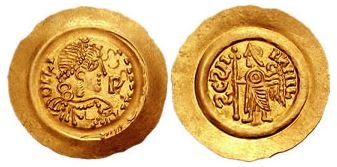
Image: A tremis of Liutprand.
Decline and Fall of the Kingdom
The decline of the Lombard Kingdom began in the 8th century. Internal strife, external pressures, and shifting alliances weakened the kingdom. The rise of the Frankish Empire under Charlemagne posed a significant threat to Lombard rule in Italy.
In 773, Pope Adrian I sought the assistance of Charlemagne to fend off Lombard aggression. Charlemagne’s campaign against the Lombards culminated in the siege of Pavia, the Lombard capital, in 774. King Desiderius was captured, and Charlemagne declared himself King of the Lombards, effectively ending the independent Lombard Kingdom.
Did you know…?
- Regions never fully under Lombard control included Latium, Sardinia, Sicily, Calabria, Naples, Venice, and southern Apulia.
- The Regnum Italiae was a reduced version of the Lombard Kingdom that continued to exist as a constituent kingdom of the Holy Roman Empire. It roughly corresponded to the territory of the former Langobardia Maior.
Legacy of the Lombard Kingdom
The legacy of the Lombard Kingdom is multifaceted, influencing various aspects of Italian and European history:
- Cultural Integration: The Lombards played a crucial role in the cultural and social integration of Germanic and Roman traditions in Italy. Their laws, administration, and customs contributed to the shaping of medieval Italian society.
- Legal Reforms: The Edictum Rothari and subsequent legal codes influenced the development of legal systems in medieval Europe. The integration of Roman legal principles with Germanic customs created a unique legal framework.
- Architectural Contributions: The Lombards left a lasting architectural legacy, including the construction of churches, monasteries, and fortifications. The Basilica of San Salvatore in Spoleto and the Temple of Clitumnus are notable examples of Lombard architecture.
- Religious Influence: The Lombard conversion to Christianity and their interactions with the Papacy had a lasting impact on the religious landscape of Italy. The Lombard support for monasticism and church-building initiatives contributed to the spread of Christianity.
- Political Legacy: The Lombard Kingdom’s decentralized political structure influenced the development of medieval European polities. The duchies and their relative autonomy foreshadowed the feudal system that characterized much of medieval Europe.

Frequently Asked Questions
Who were the Lombards, and where did they originally come from?
The Lombards were a Germanic people originally from the region around the lower Elbe River. They migrated southward over several centuries before invading Italy.
When did the Lombards invade Italy, and who was their leader?
The Lombards invaded Italy in 568 AD under the leadership of King Alboin.
What were Langobardia Maior and Langobardia Minor?
Langobardia Maior referred to the northern part of the Lombard Kingdom, including the duchies of Pavia, Milan, and Verona. Langobardia Minor referred to the southern part, comprising the more autonomous duchies of Spoleto and Benevento. These regions were separated by Byzantine-controlled territories.
How did the Byzantine Empire influence the Lombard Kingdom?
The Byzantine Empire retained control over significant portions of Italy, including the Exarchate of Ravenna and the Duchy of Rome, which strategically separated the northern and southern Lombard duchies. This ongoing conflict with the Byzantines influenced the kingdom’s political and military strategies.
How did the Lombards’ religious beliefs impact their relationship with the Roman population and the Pope?
Initially, the Lombards were Arian Christians or pagans, which created friction with the Roman Catholic population and the Pope. Over time, they gradually converted to Catholicism, a process completed by the end of the 7th century, though tensions with the Papacy persisted.
How did the Lombards integrate into the Roman-Italian cultural fabric?
The Lombards adopted Roman titles, names, and traditions, integrating into the Roman-Italian cultural fabric. By the late 8th century, their distinct language, dress, and hairstyles had largely disappeared, and their legal and administrative practices increasingly mirrored those of the Roman Empire.
What significant event marked the beginning of the decline of the Lombard Kingdom?
The rise of the Frankish Empire under Charlemagne marked the beginning of the decline of the Lombard Kingdom. In 773, Pope Adrian I sought Charlemagne’s assistance against the Lombards, leading to Charlemagne’s campaign and the siege of Pavia in 774, where King Desiderius was captured.
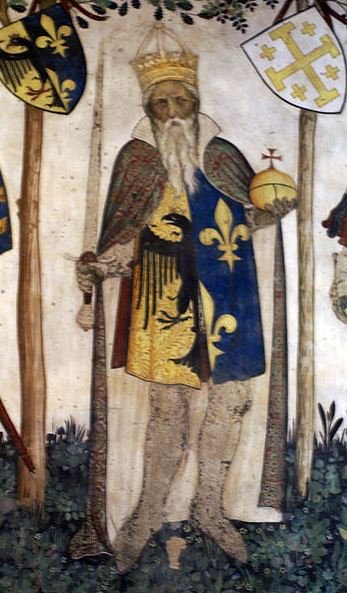
After defeating the Lombards, Charlemagne adopted the title “King of the Lombards.” Image: An artwork portraying Charlemagne as a knight.
It must be noted, however, the Lombard duchy of Benevento retained a degree of autonomy and was never fully controlled by Charlemagne.
What is the Iron Crown of Lombardy, and what is its significance?
The Iron Crown of Lombardy is one of the oldest surviving royal insignias of Christendom. It may have originated in Lombard Italy as early as the 7th century and was used to crown kings of Italy until the early 19th century, with Napoleon Bonaparte being one of the last to be crowned with it.





