Who was Marinus van der Lubbe?
Marnus van der Lubbe was a Dutch communist who was tried, convicted, and executed by Nazi Germany for allegedly setting fire to the Reichstag building on February 27, 1933.
Early Life and Political Awakening
Marinus van der Lubbe was born on January 13, 1909, in Leiden, South Holland, Netherlands. After his parents’ divorce and the death of his mother when he was 12, van der Lubbe lived with his half-sister’s family in Oegstgeest. Known for his physical strength, he earned the nickname “Dempsey” after boxer Jack Dempsey. He worked as a bricklayer until an accident in 1926 left him partially blind due to lime exposure. This injury not only ended his career but also plunged him into unemployment, where he received a modest pension.
Van der Lubbe’s introduction to political activism began in his teens. At the age of 16, he joined the Communist Party of the Netherlands (CPN) and its youth wing, the Communist Youth Bund. Over time, he became deeply involved in labor activism and founded the Lenin House in Leiden to organize political meetings. However, his relationship with the CPN deteriorated in 1931, leading him to align with the Group of International Communists. Unable to fulfill his dream of emigrating to the Soviet Union, van der Lubbe turned his focus to political activity among unemployed workers. In early 1933, he traveled to Germany, intending to contribute to the communist cause there.

A 1933 photo of Marinus van der Lubbe.
The Reichstag Fire and Arrest
On the evening of February 27, 1933, the Reichstag building, home to Germany’s parliament, caught fire. Shortly after the blaze began, van der Lubbe was found at the scene and arrested. He confessed to setting the fire, claiming he acted alone as a protest against the rise of fascism and the conditions of the German working class. The Nazis, however, seized on the incident to allege a communist conspiracy. This accusation aligned with their political agenda, as they were preparing for the Reichstag Fire Decree, which suspended civil liberties and enabled the suppression of political opposition.
Van der Lubbe’s arrest was pivotal. His confession provided the Nazis with a scapegoat, allowing them to portray the fire as part of a larger communist plot. This narrative justified mass arrests of communists, further consolidating the Nazis’ power.
Trial and Execution
Van der Lubbe stood trial alongside four others: Ernst Torgler, leader of the German Communist Party, and three Bulgarian communists—Georgi Dimitrov, Blagoy Popov, and Vasil Tanev. The trial, known as the Leipzig Trial, gained international attention, with van der Lubbe consistently asserting sole responsibility for the fire. While the other defendants were acquitted due to lack of evidence, van der Lubbe was convicted of arson and high treason. He was sentenced to death under the newly enacted “Lex van der Lubbe,” a Nazi law retroactively imposing the death penalty for such crimes.
On January 10, 1934, just three days before his 25th birthday, van der Lubbe was executed by guillotine in Leipzig. He was buried in an unmarked grave at the Südfriedhof cemetery. His execution symbolized the Nazi regime’s ruthlessness in using legal mechanisms to suppress dissent.
Controversies Surrounding His Role
The question of van der Lubbe’s true role in the Reichstag fire remains a subject of historical debate. While van der Lubbe claimed he acted alone, opinions differ on whether he was a lone arsonist, part of a communist plot, or a pawn in a Nazi false-flag operation. Journalist William Shirer and others have speculated that while van der Lubbe may have set a fire, the Nazis likely orchestrated a more extensive arson to frame communists and justify their crackdown.
In contrast, historian Ian Kershaw argued in 1998 that most evidence points to van der Lubbe acting independently, a conclusion accepted by many scholars at the time. However, recent discoveries, such as a 1955 affidavit from an SA officer alleging Nazi involvement, have reopened debates. This ongoing controversy highlights the complexities of interpreting events during a period marked by propaganda and political manipulation.
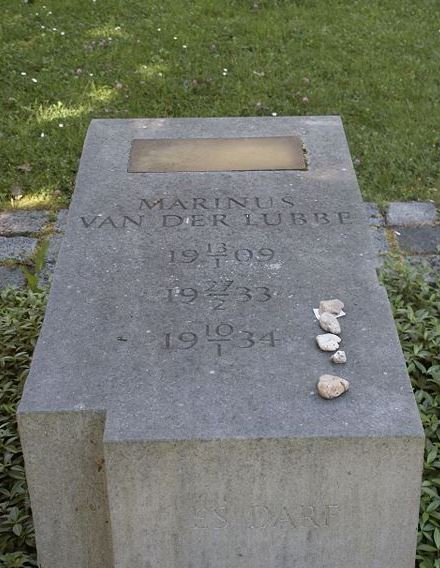
Marinus van der Lubbe’s memorial at Leipzig.
Legal and Posthumous Developments
Efforts to overturn van der Lubbe’s conviction began after World War II. His brother, Jan van der Lubbe, spearheaded campaigns to clear his name. In 1967, a German court reduced van der Lubbe’s sentence from death to eight years in prison. However, the verdict was later reinstated, and debates over his culpability persisted for decades.
In 2007, German federal prosecutor Monika Harms posthumously pardoned van der Lubbe under a law addressing unjust Nazi-era convictions. The pardon was based on the principle that laws imposed by the Nazi regime violated fundamental justice. This decision marked a significant step in acknowledging the misuse of legal systems by totalitarian governments.
Lex van der Lubbe: The Nazi Legal Framework
The Reichstag Fire Decree, issued on February 28, 1933, laid the groundwork for van der Lubbe’s prosecution. This decree suspended basic civil liberties, enabling the Nazis to suppress opposition. Subsequently, the Nazi government passed a law on March 29, 1933, retroactively imposing the death penalty for crimes like the Reichstag fire. This law, nicknamed “Lex van der Lubbe,” violated principles of constitutional legality but was justified under the Enabling Act, which granted Hitler’s government sweeping powers.
van der Lubbe’s case became a pivotal moment for the Nazis, enabling them to suppress political opposition and consolidate power under the Reichstag Fire Decree.
The retroactive application of the law exemplified the Nazi regime’s manipulation of legal norms to achieve political goals. The law was repealed after World War II by the Allied Control Council, underscoring its incompatibility with democratic principles.
Exhumation and Scientific Investigation
In January 2023, authorities exhumed van der Lubbe’s supposed remains to confirm their identity and investigate whether he had been drugged during his trial. Observers at the time noted that van der Lubbe appeared apathetic and lethargic, raising suspicions of coercion or sedation. Forensic analysis confirmed the remains belonged to van der Lubbe, but the toxicology report found no conclusive evidence of drug administration due to decomposition.
This investigation, while inconclusive, reignited interest in van der Lubbe’s case and the broader historical context of the Reichstag fire. It also highlighted the challenges of uncovering definitive truths about events shaped by propaganda and political agendas.
Legacy and Historical Significance
Marinus van der Lubbe remains a controversial figure in modern history. His actions and the subsequent trial played a pivotal role in the Nazi rise to power, as the Reichstag fire provided a pretext for dismantling democratic institutions. Whether he acted alone or was manipulated as part of a larger conspiracy, van der Lubbe’s case symbolizes the vulnerability of justice systems in times of political upheaval.
Questions and Answers
What motivated van der Lubbe to set the Reichstag fire, according to his confession?
He claimed to have acted alone to protest the conditions of the German working class and oppose fascist rule.
What were the trial’s outcomes for van der Lubbe and the other defendants?
Van der Lubbe was sentenced to death and executed, while the other four defendants, including communists Georgi Dimitrov and Ernst Torgler, were acquitted.
What is the controversy surrounding van der Lubbe’s role in the fire?
While he confessed to acting alone, historians debate whether the fire was part of a larger Nazi conspiracy or solely his doing.

A photo of the Reichstag building on fire.
What legal changes allowed for van der Lubbe’s execution?
The Nazis retroactively passed a law, later called “Lex van der Lubbe,” enabling the death penalty for crimes committed as of January 31, 1933.
What posthumous actions were taken regarding van der Lubbe’s conviction?
In 2007, the German government nullified his conviction and granted him a full posthumous pardon, citing unjust Nazi-era laws.
Why was van der Lubbe’s grave exhumed in 2023?
To confirm the grave’s identity and perform toxicological analysis, amid suspicions he was drugged during his trial. The tests found no conclusive evidence.