Who was Queen Seondeok of Silla?
Early Life and Accession
Queen Seondeok of Silla, born Princess Deokman around 580 or 610 CE, ascended to the throne in 632 CE following the death of her father, King Jinpyeong. As the eldest daughter, her rise to power was necessitated by the absence of a male heir within the sacred bone rank system, which strictly governed Silla’s social hierarchy. This system typically reserved the highest privileges for the royal family, particularly males of the sacred bone class. With no eligible male successor, Seondeok’s accession marked a significant moment in Korean history, highlighting the respected status of women in Silla’s royal lineage.
Titles and Their Significance
Queen Seondeok was known by several titles, each reflecting her esteemed position. Commonly referred to as Seondeok yeowang (female king), she was also called Seondeok wang (king) and Seondeok yeodaewang (great female king).
Additionally, she held the title Seongjohwanggo, meaning “Empress descended from divine ancestors,” emphasizing her divine right to rule. These titles underscored her authority and the unique status of female monarchs in East Asian societies, where such distinctions were necessary to differentiate female rulers from their male counterparts.

The Rock-carved Seated Buddha in Namsan, Gyeongju, is believed to depict Queen Seondeok, per Professor Kim Ki-heung.
Reign and Domestic Policies
During her reign from 632 to 647 CE, Queen Seondeok focused on the welfare of her people and the strengthening of Silla. She implemented policies to support widows, orphans, the poor, and the elderly, earning widespread support among the populace.
Her administration prioritized tax exemptions for peasants and reduced taxes for the middle class, fostering economic stability and gaining favor against the male aristocracy’s opposition. Seondeok also centralized the state, enhancing administrative efficiency and consolidating royal power.
Foreign Relations and Military Campaigns
Queen Seondeok navigated complex foreign relations, particularly with neighboring kingdoms Baekje and Goguryeo, as well as with the Tang Dynasty of China. In response to military threats from Baekje and Goguryeo, she sought assistance from Tang China.
Despite initial resistance from Emperor Taizong, who questioned her legitimacy as a female ruler, Seondeok successfully forged an alliance. This collaboration laid the groundwork for future military campaigns that eventually led to the unification of the Korean peninsula under Silla.
Cultural and Scientific Achievements
Seondeok’s reign is renowned for a flourishing of the arts, literature, and sciences. She was a patron of Buddhism, overseeing the construction of grand temples like Hwangnyongsa and the iconic Cheomseongdae Observatory.
Cheomseongdae, the oldest surviving observatory in East Asia, exemplified advancements in astronomy and served practical purposes for agriculture. Her support for education and the arts fostered a cultural renaissance, solidifying Silla’s prominence in the region.

Bidam’s Rebellion
In 647 CE, Queen Seondeok faced a significant challenge in the form of Bidam’s Rebellion. Led by Bidam, a high-ranking official dissatisfied with her rule, the rebellion sought to overthrow her authority based on gender prejudices. Utilizing his influence, Bidam attempted to destabilize the monarchy.
However, Queen Seondeok’s loyal generals, including the esteemed Kim Yu-sin, swiftly suppressed the uprising. The rebellion’s failure reinforced her position, although she succumbed to illness shortly after, amidst the turmoil.
Death and Succession
Queen Seondeok passed away on February 20, 647 CE, likely due to an illness that plagued her towards the end of her reign. Her death occurred shortly after the suppression of Bidam’s Rebellion, marking the end of her influential rule. She was succeeded by Queen Jindeok, another female monarch, who continued her legacy. The transition underscored the evolving bone rank system, eventually allowing leaders outside the sacred bone class to ascend, paving the way for Silla’s unification of Korea.
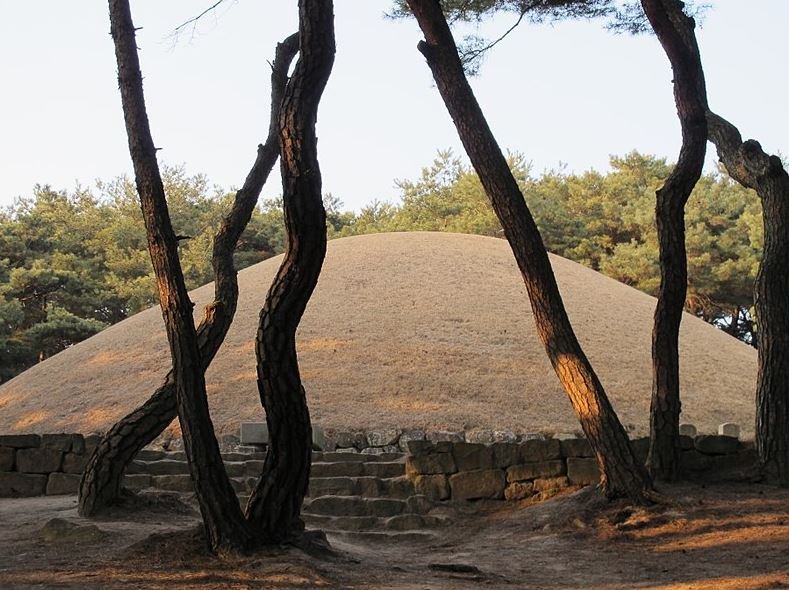
Queen Seondeok’s tomb.
Legends and Folklore
Queen Seondeok’s legacy is enriched by numerous legends that highlight her wisdom and benevolence. One such tale involves the Cheomseongdae Observatory, where her foresight in astronomy was believed to protect Silla from invasions. Another legend, the Legend of Jigwi, speaks of a devoted admirer whose tragic end symbolized unwavering loyalty and the queen’s compassionate nature. These stories not only celebrate her reign but also reflect the cultural and spiritual values of Silla society.
Family and Legacy
Queen Seondeok hailed from the illustrious Kim family, with her father King Jinpyeong and mother Queen Maya playing pivotal roles in her upbringing. Her siblings included Princess Cheonmyeong and the influential Kim Chun-chu, who later became King Muyeol, instrumental in Silla’s unification efforts. Her lineage continued to shape Silla’s destiny, demonstrating the enduring impact of her reign on Korean history. Seondeok’s dedication to Buddhism, education, and cultural development left an indelible mark, ensuring her status as one of Korea’s most revered monarchs.
Frequently Asked Questions

How did Queen Seondeok ascend to the throne of Silla?
She became queen because her father, King Jinpyeong, had no male heir, and the sacred bone class had no living males, allowing a female ruler to take the throne under the rigid Silla bone rank system.
What significant architectural achievement is Queen Seondeok known for?
She commissioned the Cheomseongdae Observatory in Gyeongju, the oldest surviving observatory in East Asia, which symbolized advancements in science and astronomy.
How did Queen Seondeok strengthen Buddhism in Silla?
She encouraged Buddhism further, rebuilt Buddhist temples, and invested in schools, enhancing the ruling class’s power by endorsing the monarch as an incarnation of the Buddha.
Who were the two key figures that supported Queen Seondeok’s reign?
General Kim Yu-sin and diplomat Gim Chun-chu (later King Muyeol) were instrumental in her efforts to unify Korea and strengthen Silla.
What was Queen Seondeok’s relationship with the Tang Dynasty?
She formed an alliance with Tang China for military assistance against Baekje and Goguryeo, refusing to allow a Chinese prince to rule Silla and successfully securing Tang support.
What challenges did Queen Seondeok face during her reign?
She dealt with aggressive neighbors Baekje and Goguryeo, multiple military defeats by Tang-Silla forces, and a rebellion led by aristocrats opposed to a female ruler.
What legacy did Queen Seondeok leave in terms of cultural and scientific progress?
Her reign saw a flourishing of the arts and sciences, centralization of the state, construction of significant structures like Cheomseongdae and Hwangnyongsa Temple, and the promotion of education.
Who succeeded Queen Seondeok, and how did it impact the Silla monarchy?
She was succeeded by another queen, Jindeok, which led to modifications in the bone rank system, eventually allowing King Muyeol and his son to unify the Korean peninsula under Unified Silla.





