William Ewart Gladstone (1809–1898) was a towering figure in 19th-century British politics, known for his eloquence, liberal principles, and long-lasting influence on the United Kingdom’s political landscape. Over his six-decade political career, Gladstone served four separate terms as Prime Minister, totaling 12 years, a record unmatched by any other British leader. His career spanned critical transformations in British society, and he played an instrumental role in shaping modern British liberalism.

A pensive Gladstone, from the book Great Britain and Her Queen, by Anne E. Keeling
READ MORE: Most Renowned British Prime Ministers
Early Life and Background
Gladstone was born on December 29, 1809, in Liverpool, to a Scottish family that valued education and morality. His father, John Gladstone, was a successful businessman and merchant involved in trade with the Caribbean.
Although his family background was conservative and rooted in commerce, William was deeply influenced by his Scottish mother, Anne, who emphasized piety, virtue, and service. This influence would mark Gladstone’s life and political ideology, making him a leader with a strong moral foundation.
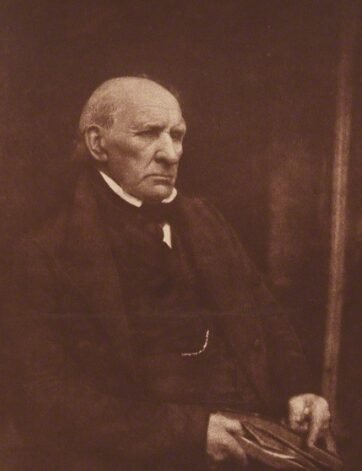
Sir John Gladstone, 1st Baronet, was a prosperous merchant and Tory politician. William received a high-caliber education, attending Eton College and later Christ Church, Oxford, where he excelled in Classics. Image: Photograph of Sir John Gladstone, father of William Gladstone.
Gladstone attended Eton College and later studied at Christ Church, Oxford, where he excelled in classics and was known for his public speaking skills. Although he initially planned to become a clergyman, his family’s expectations and his father’s connections led him toward a political career. His interest in religion and moral principles, however, would profoundly shape his political path.
Entry into Politics and Early Career

Initially aiming to become a barrister, William Gladstone abandoned this goal in favor of full-time politics. Known for his oratory skills, he quickly rose to prominence and served in several government positions. Image: William Ewart Gladstone in the 1830s
Gladstone first entered Parliament in 1832 at age 22, representing Newark as a Tory (the political group that evolved into the modern Conservative Party). Initially, he was a staunch High Tory, adhering to conservative values that opposed rapid change and defended the Church of England. Early in his career, he was known for his defense of slavery, a stance he later renounced as his views evolved.
Gladstone entered politics under the patronage of the Duke of Newcastle, securing a seat for Newark in 1832. His early political stance was deeply conservative, often opposing measures like the 1833 Factory Act.
Gladstone’s early political mentor was Robert Peel, a fellow Tory who was Prime Minister from 1834 to 1835 and again from 1841 to 1846. Peel was a reform-minded conservative and became an influential figure in Gladstone’s life.
Under Peel, Gladstone held various junior roles, eventually serving as a minister in both of Peel’s governments. When Peel repealed the Corn Laws in 1846, which marked a significant shift towards free trade, Gladstone supported his mentor despite the move creating a rift within the Conservative Party. This division led to the formation of the Peelite faction, a group of Tories who favored free trade and economic reform, in contrast to the protectionist Tories. Gladstone joined this group, setting the stage for his later ideological shift toward liberalism.
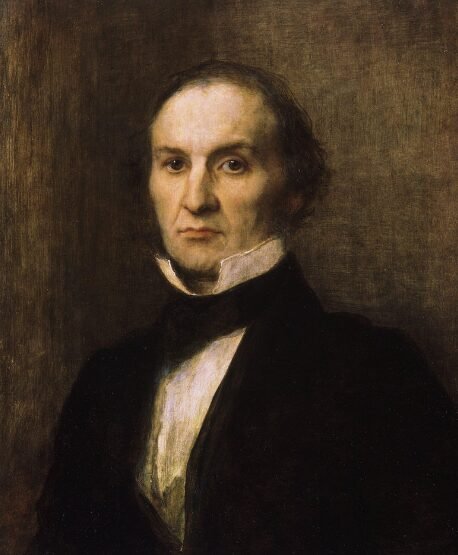
Gladstone served under Prime Minister Robert Peel as President of the Board of Trade from 1843 to 1845, championing significant reforms like the Railways Act of 1844. Image: Gladstone in 1859, painted by British painter George Frederic Watts
Transition to Liberalism
After Peel’s death in 1850, Gladstone continued his political evolution, gradually moving away from traditional Tory values toward a liberal approach that emphasized equality, limited government intervention, and individual freedoms. During this period, he became associated with the Whigs and the Radicals, two political groups that eventually merged with the Peelites to form the Liberal Party in 1859. Gladstone’s conversion to liberalism was based on his belief in the sanctity of individual conscience, opposition to privilege, and support for a fair and just society.
Gladstone’s tenure as Chancellor of the Exchequer under Prime Minister Lord Aberdeen (1852–1855) cemented his reputation as a skilled financial reformer. His budget reforms aimed at reducing taxes on the lower classes and promoting economic growth by eliminating trade barriers. His fiscal policies helped solidify his position as a leader of the Liberal Party, earning him admiration among the working classes and middle-income earners.
During his time as Chancellor, Gladstone was a fierce advocate of free trade, believing that economic liberalization would lead to prosperity for all. His budgets aimed to reduce government expenditure, lower taxes, and remove protectionist tariffs, allowing British commerce to flourish. These policies became the foundation of what was known as “Gladstonian liberalism,” which also emphasized transparency in government spending and a strong ethical foundation for economic policy.

Gladstone championed free trade and economic liberalism, pushing for the Cobden–Chevalier Treaty with France, which reduced tariffs and promoted peace. Image: Gladstone in 1861, photographed by English photographer John Mayall
First Term as Prime Minister (1868–1874)

In 1868, Gladstone became Prime Minister, beginning his first of four terms. His reforms focused on improving public institutions, reducing government spending, and promoting individual liberty. Image: Gladstone in 1874, painted by German painter Franz von Lenbach
In 1868, Gladstone became Prime Minister for the first time, marking the beginning of a transformative period in British politics. His first term focused on sweeping reforms, particularly aimed at improving conditions for the working class and promoting individual rights. Gladstone’s government passed several landmark reforms that restructured British society and governance:
- The Irish Church Act (1869): This act disestablished the Anglican Church of Ireland, which had been privileged despite the predominantly Catholic population in Ireland. Gladstone believed this disestablishment was essential to religious equality and sought to address long-standing grievances of the Irish people.
- The Education Act (1870): This act established state-supported elementary education, making it accessible to children from all backgrounds. This was a critical step in addressing educational inequality, as it provided funding and support for schools across the country.
- The Ballot Act (1872): This act introduced secret voting, reducing electoral corruption and ensuring greater freedom in elections. By protecting voters from coercion and bribery, it laid the groundwork for more democratic elections.
Gladstone’s first term also saw the introduction of other social and economic reforms that reduced government intervention in personal lives, which he believed would allow individuals to thrive independently. However, his push for reforms also attracted opposition, particularly from Conservative members of Parliament and other traditionalists.
The Midlothian Campaign and Return to Power
After a Liberal defeat in the 1874 election, Gladstone temporarily retired as leader of the party, but he returned to public life in response to growing humanitarian concerns. He strongly criticized the Ottoman Empire’s brutal suppression of Bulgarian nationalists during the April Uprising, a stance that demonstrated his commitment to international human rights and moral justice.
His Midlothian Campaign of 1879–1880 marked his re-entry into politics and is often cited as one of the first modern political campaigns, as Gladstone toured Britain giving speeches, holding rallies, and appealing directly to voters on moral grounds.
During his famous Midlothian Campaign, Gladstone criticized imperial expansion and advocated for moral governance, which gained him widespread support.
The Midlothian Campaign galvanized public support for Gladstone, who was subsequently re-elected in the 1880 general election. His campaign not only demonstrated his political influence but also marked a new era of political activism and public engagement in British politics.
Second Term as Prime Minister (1880–1885)
During his second term, Gladstone’s government passed the Third Reform Act (1884), which significantly extended the right to vote by enfranchising rural male householders. This reform was crucial in making British society more democratic, as it expanded the electorate to include a broader segment of the working class.

The Cabinet Council, 1883 by French academic painter Théobald Chartran, published in Vanity Fair, 27 November 1883
Gladstone also faced significant challenges in foreign policy during this period. His government was drawn into the Egyptian Crisis, which culminated in the death of General Charles Gordon during the siege of Khartoum in 1885. Gladstone’s handling of the crisis drew criticism and weakened his popularity, but his focus remained on domestic reforms, particularly regarding Ireland.
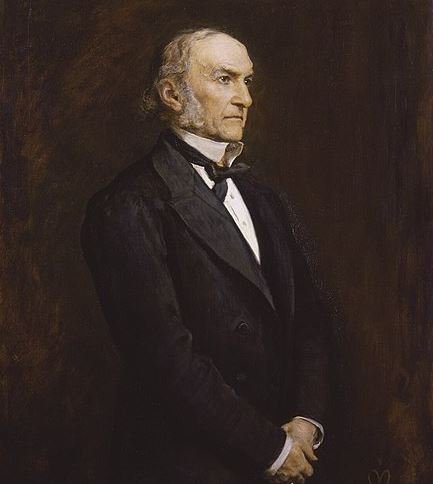
Gladstone’s advocacy for electoral reform grew over time, especially after his 1864 statement suggesting universal male suffrage for the mentally capable. He later became a leading voice for extending the vote to the working class, aligning his views with the Liberal Party’s reform agenda. Image: William Ewart Gladstone, 1879
Irish Home Rule and the Liberal Split
Gladstone’s commitment to Irish Home Rule became a defining feature of his later political career. In 1886, he introduced a bill to grant Ireland its own parliament, which was a controversial step intended to address the long-standing issues of Irish autonomy and British-Irish relations. However, the bill was defeated in the House of Commons, leading to a split within the Liberal Party. Many party members, known as Liberal Unionists, opposed Home Rule, fearing it would lead to the dissolution of the United Kingdom.
Gladstone passionately supported Irish Home Rule, introducing a bill in 1886 to grant Ireland its own parliament. The proposal split the Liberal Party, leading to its defeat and his resignation.
This division within the Liberal Party weakened its political strength and allowed the Conservative Party to dominate British politics for the next two decades. Gladstone’s unwavering support for Irish Home Rule, however, marked him as a champion of self-governance and autonomy, despite the opposition he faced.
Final Term as Prime Minister and Retirement
Gladstone returned to power for a final time in 1892 at the age of 82, making him the oldest British Prime Minister to serve. His government attempted to pass another Irish Home Rule Bill in 1893, which successfully passed the House of Commons but was ultimately rejected by the House of Lords. This defeat marked the end of Gladstone’s efforts to achieve Home Rule, and he resigned in 1894, leaving public office the following year.
Throughout his life, Gladstone remained deeply committed to his principles of liberty, morality, and self-determination, which defined his political legacy. He continued to influence the Liberal Party even after his retirement, and his ideas about limited government, economic liberalization, and social reform had a lasting impact on British political thought.
Legacy and Historical Significance
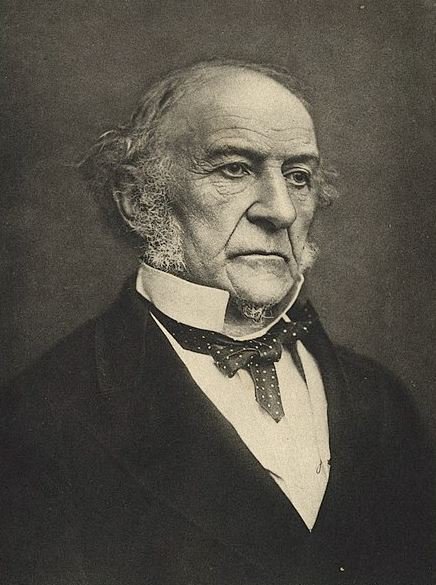
Gladstone’s commitment to anti-imperialism defined his foreign policy. In the 1870s, he strongly opposed Disraeli’s aggressive foreign policy and Britain’s involvement in the Anglo-Zulu War and the Second Anglo-Afghan War. Image: Portrait of William Ewart Gladstone
William Gladstone is remembered as one of Britain’s greatest prime ministers, celebrated for his moral integrity, commitment to liberal ideals, and his deep empathy for the British people.
His supporters affectionately called him “The Grand Old Man,” reflecting their respect and admiration for his long service and dedication to the public.
His political opponents sometimes sarcastically used the same initials to call him “God’s Only Mistake,” underscoring the polarizing nature of his policies and the intensity of British politics during his time.
Historians rank Gladstone among the most influential figures in British history, highlighting his progressive reforms that modernized British society and governance. His advocacy for Irish Home Rule, although unsuccessful, laid the groundwork for later discussions on autonomy and self-governance in British colonies.

Statue of Gladstone at Bow Church, London, England
Gladstone’s intellectual contributions extended beyond politics. He was an accomplished scholar, widely read in literature, philosophy, and theology, and known for his speeches and writings. His work emphasized the importance of ethical considerations in governance, making him a role model for future generations of politicians who viewed public office as a moral responsibility.
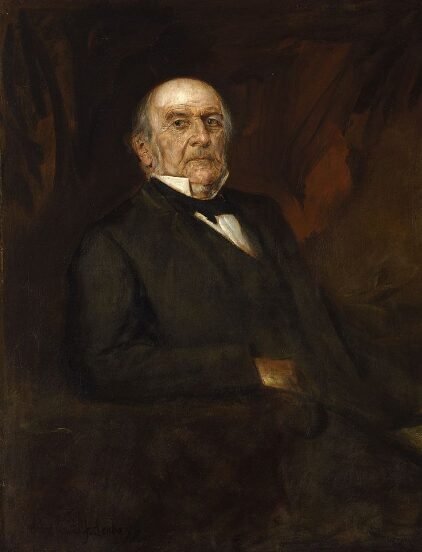
William Ewart Gladstone in the 1880s; portrait by German painter Franz von Lenbach
In summary, William Ewart Gladstone’s life and career exemplify the evolution of British politics in the 19th century, as Britain transitioned from aristocratic rule to a more inclusive, democratic society. His dedication to reform, economic liberalism, and individual rights shaped the Liberal Party’s identity and set a standard for political leaders who followed in his footsteps.
Frequently Asked Questions
A pensive painting of Gladstone, from the book “Great Britain and Her Queen”, by Anne E. Keeling
How long did Gladstone’s political career last?
Gladstone’s political career spanned over 60 years, during which he served as Prime Minister for 12 years and as Chancellor of the Exchequer four times.
What nickname was given to Gladstone due to his popularity with the working class?
Gladstone was affectionately known as “The People’s William” due to his alignment with working-class interests.
What was Gladstone’s political philosophy known as, and what did it emphasize?
His political philosophy, known as Gladstonian liberalism, emphasized equality of opportunity, limited government intervention, and opposition to trade protectionism.

He retired in 1894, dedicating his remaining years to reading and philanthropy. His later views on social issues, such as labor rights and anti-imperialism, laid the groundwork for future liberal policies. Image: Portrait of Gladstone at Hawarden in 1877
What significant reforms did Gladstone introduce during his first term as Prime Minister?
During his first term, Gladstone’s government disestablished the Church of Ireland and introduced secret voting through the Ballot Act.
What event helped revive Gladstone’s political career after his resignation in 1874?
His career revival was fueled by his opposition to the Ottoman Empire’s treatment of Bulgarian rebels during the April Uprising, which he used as the basis for his influential Midlothian Campaign.
The Midlothian Campaign was significant as it was one of the first modern political campaigns, using public rallies and direct appeals to voters.

Statue Prime Minister William Gladstone at Aldwych, London, England
What major reform was introduced during Gladstone’s second government in 1880?
Gladstone’s second government introduced the Third Reform Act, which expanded voting rights to a larger segment of the British population.
What issue caused a split within the Liberal Party during Gladstone’s third term as Prime Minister?
The proposal for Irish Home Rule, which aimed to give Ireland devolved government, caused a split within the Liberal Party when it was defeated in the House of Commons.
How did Gladstone’s supporters and opponents refer to him, and what did the initials stand for?
Gladstone’s supporters referred to him as the “G.O.M.” or “Grand Old Man,” while his opponents mockingly called him “God’s Only Mistake.”
Why do historians regard Gladstone as one of Britain’s greatest prime ministers?
Historians regard Gladstone as one of Britain’s greatest prime ministers due to his commitment to liberal reforms, advocacy for working-class rights, and contributions to modernizing British politics.

Statue of William Ewart Gladstone in Blackburn, Lancashire
What was one of the significant challenges faced by Gladstone’s second government?
Gladstone’s second government faced military conflicts in Egypt and political unrest in Ireland, requiring strict measures to control Irish opposition while also passing laws to protect tenant farmers’ rights.
What impact did the Government of Ireland Bill of 1893 have on Gladstone’s efforts for Irish Home Rule?
The Government of Ireland Bill of 1893 passed in the House of Commons but was defeated in the House of Lords, diminishing hopes for Irish Home Rule during Gladstone’s tenure.
When did Gladstone retire, and what was his legacy?
Gladstone retired in 1895 and passed away in 1898. His legacy endures as a symbol of progressive change and commitment to public service, with a reputation as one of Britain’s most influential prime ministers.
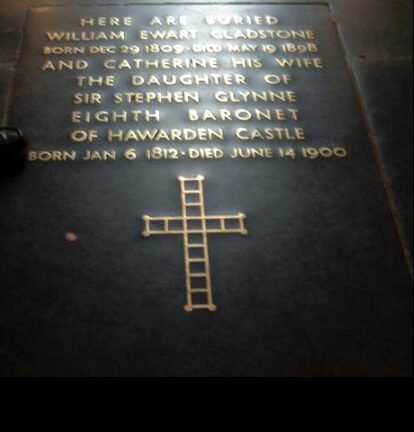
Gladstone died in 1898, leaving a legacy as a principled statesman committed to moral governance and liberal reform. Image: Prime Minister William Ewart Gladstone’s grave in Westminster Abbey





