Wolfgang Amadeus Mozart
Mozart was a prolific composer of the Classical period, known for over 750 works spanning symphonies, operas, concertos, and choral music. His works are celebrated for their melodic beauty, elegance, and harmonic richness.
Birth and Early Childhood
Wolfgang Amadeus Mozart was born on January 27, 1756, in Salzburg, an ecclesiastical principality within the Holy Roman Empire, now part of Austria. He was the youngest child of Leopold Mozart, a composer and violinist, and Anna Maria Pertl. Among the seven children born to the couple, only Wolfgang and his elder sister, Maria Anna (nicknamed “Nannerl”), survived infancy.
Mozart was born on January 27, 1756, in Salzburg, part of the Holy Roman Empire (now Austria).
From an early age, Mozart exhibited extraordinary musical talent. His father, Leopold, recognized Wolfgang’s potential and became his primary teacher. By the age of five, Mozart was already composing short pieces and performing before European royalty. His sister recalled his uncanny ability to pick out chords and melodies on the clavier even as a toddler.

A portrait of Wolfgang Amadeus Mozart during his early teens.
Family Influences
Leopold Mozart was a significant influence on his son’s musical development. A respected musician in his own right, Leopold published a widely acclaimed violin textbook, Versuch einer gründlichen Violinschule, the same year Wolfgang was born. As Wolfgang’s talents became evident, Leopold dedicated himself entirely to nurturing his son’s gifts, often at the expense of his own career.
Early Musical Training and Prodigious Travels
Mozart’s father orchestrated numerous tours across Europe to showcase his children’s prodigious talents. The first journey in 1762 included performances for the Bavarian court in Munich and the imperial court in Vienna. These tours expanded to longer, more ambitious itineraries, including stops in Paris, London, and The Hague.
Mozart started composing at the age of five, displaying prodigious talent as a child.
During a three-year tour beginning in 1763, Mozart met prominent musicians and composers, such as Johann Christian Bach, whose work influenced the young prodigy. By age eight, Mozart had composed his first symphony, likely transcribed with assistance from his father.
Between 1769 and 1773, Mozart and Leopold embarked on three tours to Italy, a hub of operatic and symphonic innovation. In Rome, Mozart’s remarkable memory allowed him to transcribe Gregorio Allegri’s Miserere after hearing it performed in the Sistine Chapel—a feat that added to his growing reputation. His operatic works Mitridate, re di Ponto and Lucio Silla premiered during this period, marking the beginning of his career as an opera composer.
Salzburg Court and Early Compositions
Mozart returned to Salzburg in 1773 and took up a position as a court musician under Prince-Archbishop Hieronymus Colloredo. While the post allowed him to compose symphonies, sonatas, and sacred works, Mozart grew increasingly frustrated by the lack of creative freedom and financial support.
During his tenure, Mozart composed notable works such as the violin concertos K. 216, 218, and 219 and the Piano Concerto in E-flat Major, K. 271. His dissatisfaction with Salzburg culminated in his resignation in 1777, after which he embarked on a journey to find better opportunities.
Mozart’s most famous compositions include The Marriage of Figaro, Don Giovanni, The Magic Flute, Eine kleine Nachtmusik, the Requiem, and the Jupiter Symphony.
Mozart’s search for employment led him to Mannheim, where he fell in love with Aloysia Weber, a soprano. The journey eventually brought him to Paris, where he struggled to secure a stable position. His mother, who had accompanied him, died during this period, adding to his hardships. Despite these challenges, Mozart composed significant works, including the Paris Symphony (K. 297) and the Concerto for Flute and Harp (K. 299).
Vienna: The Pinnacle of Mozart’s Career
In 1781, Mozart relocated to Vienna after a quarrel with Archbishop Colloredo. Determined to establish himself as an independent composer, he gained popularity through public performances and the opera Die Entführung aus dem Serail (“The Abduction from the Seraglio”). His virtuosity as a pianist and innovative compositions earned him a reputation as Vienna’s leading musician.
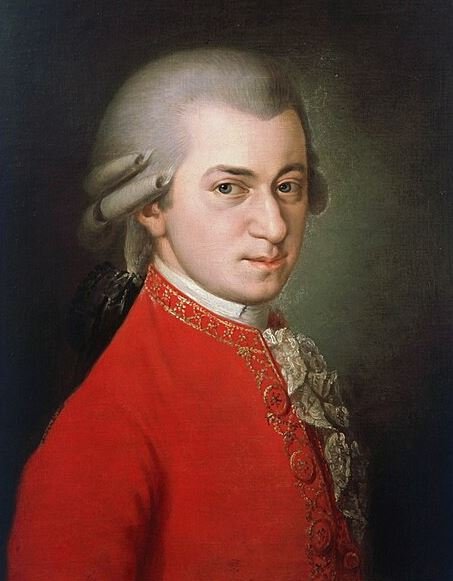
A painting of Mozart by Austrian artist Barbara Krafft
Marriage and Domestic Life
Mozart married Constanze Weber, Aloysia’s younger sister, in 1782. Their marriage faced financial difficulties due to Mozart’s extravagant lifestyle, though their relationship remained affectionate. The couple had six children, only two of whom survived infancy.
The “Haydn” Quartets and Collaborative Efforts
Mozart formed a close friendship with Joseph Haydn, to whom he dedicated a set of six string quartets. Haydn praised Mozart’s genius, famously stating to Leopold Mozart, “Your son is the greatest composer known to me.” This period also saw the creation of groundbreaking piano concertos, including K. 466 and K. 491, which remain central to the repertoire.
Mozart’s Masterpieces and Later Years
Mozart’s collaboration with librettist Lorenzo Da Ponte resulted in three of his greatest operas: The Marriage of Figaro (1786), Don Giovanni (1787), and Così fan tutte (1790). These works exemplify his ability to combine complex characters, profound emotions, and innovative orchestration.
Mozart composed over 750 works, spanning nearly every genre of Western classical music, including symphonies, operas, chamber music, and sacred works.
Despite his artistic successes, Mozart faced financial difficulties throughout his life. He relied on loans from friends and patrons to sustain his family. His appointment as court composer to Emperor Joseph II in 1787 provided some income but was insufficient to alleviate his debts.
Final Years and the Requiem
In 1791, Mozart experienced a surge in productivity, composing several renowned works, including the Clarinet Concerto in A Major (K. 622), The Magic Flute, and his unfinished Requiem. Commissioned anonymously, the Requiem became shrouded in mystery and myth after Mozart’s untimely death.
Death and Legacy
Mozart died on December 5, 1791, at the age of 35. The cause of his death remains uncertain, with theories ranging from rheumatic fever to poisoning. He was buried in a common grave, in accordance with Viennese customs of the time.
Following his death, Mozart’s music gained widespread acclaim, and his reputation as one of history’s greatest composers solidified. His works are celebrated for their melodic beauty, structural perfection, and emotional depth, influencing countless composers, including Beethoven and Schubert.
Frequently Asked Questions about Mozart

An early 1780s portrait of Wolfgang Amadeus Mozart
When and where was Mozart born?
Mozart was born on January 27, 1756, in Salzburg, which was then part of the Holy Roman Empire.
What were Mozart’s early musical achievements?
By age five, Mozart was composing music, playing keyboard and violin, and performing for European royalty. His early compositions were recorded in the Nannerl Notenbuch.
How did Mozart’s career develop in Vienna?
In Vienna, after leaving his Salzburg court position in 1781, Mozart gained fame as a composer and performer, producing significant works such as The Marriage of Figaro, Don Giovanni, and numerous piano concertos.
What were Mozart’s most famous works?
Some of his best-known pieces include Eine kleine Nachtmusik, the Requiem, The Magic Flute, the Jupiter Symphony, and the Clarinet Concerto.
What challenges did Mozart face?
Despite his fame, Mozart struggled financially, faced frequent health issues, and had a precarious relationship with patrons and employers.
What was Mozart’s influence on music?
Mozart greatly advanced the Classical style, influenced composers like Beethoven, and set enduring standards in symphonic, operatic, and chamber music.
When and how did Mozart die?
Mozart died on December 5, 1791, at age 35. The exact cause of death remains unclear, but his modest funeral and burial reflected Viennese customs of the time.





