1970 Cambodian coup d’état
The 1970 Cambodian coup d’état was the removal of Prince Norodom Sihanouk as Chief of State through a vote in the National Assembly on March 18, 1970, led by Prime Minister Lon Nol and his ally Sirik Matak.
The 1970 Cambodian coup d’état marked the end of Cambodia’s monarchy and the establishment of the Khmer Republic later that year.
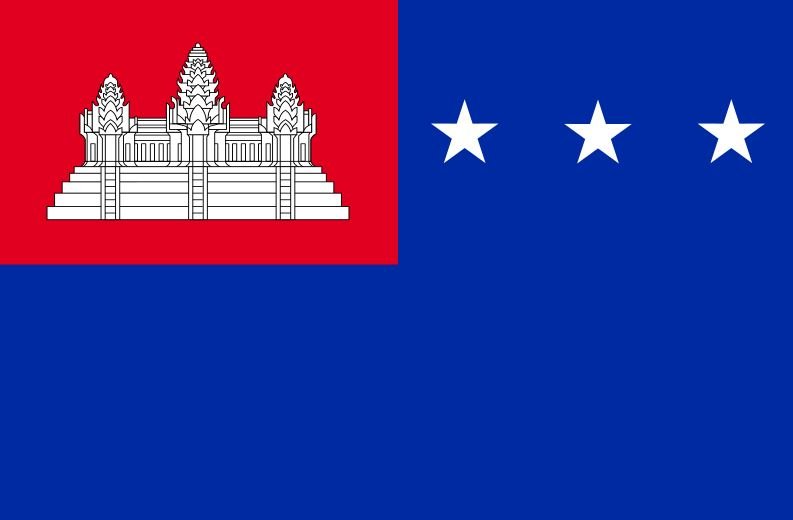
Flag adopted by the Khmer Republic.
Summary
The 1970 Cambodian coup d’état marked a significant shift in Cambodia’s political landscape, bringing an end to Prince Norodom Sihanouk’s reign as Chief of State and setting the stage for the Khmer Republic. The coup, orchestrated by Prime Minister Lon Nol with the support of his political ally Sirik Matak, was executed through a parliamentary vote on March 18, 1970, rather than a direct military takeover. This event not only reshaped Cambodia’s government but also escalated the country’s involvement in the Vietnam War, leading to increased instability and eventually, the Cambodian Civil War.
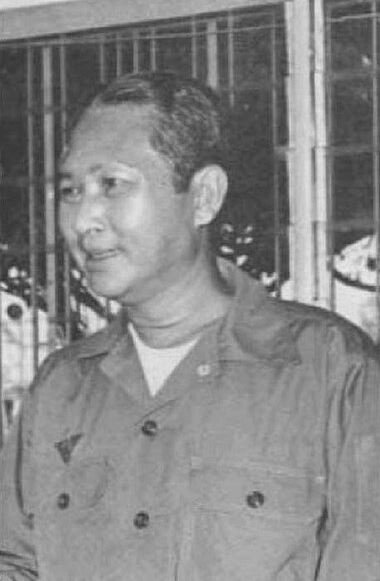
A photo of Lon Nol, taken during the early parts of the 1970s.
Background: Cambodia Under Sihanouk
Following Cambodia’s independence from France in 1953, Prince Norodom Sihanouk established the Sangkum political movement, effectively consolidating power and suppressing opposition. By 1960, after the death of his father, King Norodom Suramarit, Sihanouk amended the constitution to secure his position as Chief of State indefinitely. While Queen Sisowath Kossamak remained a ceremonial figure, Sihanouk wielded absolute political authority.
Sihanouk maintained his grip on power through political maneuvering, balancing both leftist and rightist elements in Cambodian politics. He used nationalist rhetoric to appease the right, while simultaneously adopting socialist policies to marginalize the growing Cambodian communist movement, which he labeled the Khmers Rouges (Red Khmers).
However, Cambodia’s economy faced serious challenges due to corruption and rice smuggling. The situation worsened as the Vietnam War intensified, with North Vietnamese forces using Cambodian territory for supply routes and bases. Sihanouk’s policy of tolerating Viet Cong and North Vietnamese presence within Cambodia angered nationalist and military factions, particularly Lon Nol and Sirik Matak.
Why did many American colleges fiercely oppose the Vietnam War?
Growing Discontent and Political Fractures
By 1969, frustration within Cambodia’s government was growing. Lon Nol, a nationalist and staunch anti-communist, found Sihanouk’s leniency towards North Vietnam unacceptable. Meanwhile, the liberal modernizers within the Sangkum, such as In Tam, also began opposing Sihanouk’s increasingly authoritarian rule. The divide between Sihanouk’s leftist foreign policies and Cambodia’s growing right-wing nationalist movement became irreconcilable.
At the same time, tensions escalated within the broader Indochina conflict. Sihanouk’s secret deal with Hanoi—which allowed weapons shipments to the Viet Cong through the port of Sihanoukville in exchange for economic benefits—further alienated Lon Nol and his supporters. By 1970, political and military figures in Cambodia had lost confidence in Sihanouk’s leadership, paving the way for his ousting.
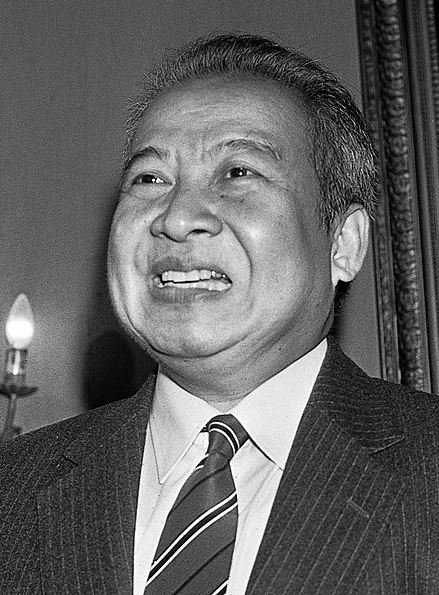
Norodom Sihanouk during the early 1980s.
The Coup: March 1970
In early March 1970, while Sihanouk was on a diplomatic trip to France, the Soviet Union, and China, a wave of anti-Vietnamese protests erupted in Cambodia. Some historians suggest these demonstrations were orchestrated by Lon Nol and Sirik Matak to justify action against Sihanouk and the Vietnamese presence.
On March 11, 1970, anti-communist demonstrators in Phnom Penh attacked the embassies of North Vietnam and the National Liberation Front of South Vietnam (Viet Cong). The unrest spread, targeting Vietnamese businesses, churches, and homes. While Sihanouk may have initially supported the protests to pressure Hanoi, the violence spiraled out of control.
On March 12, Sirik Matak canceled Cambodia’s trade agreements with North Vietnam and closed the port of Sihanoukville to communist supplies. Shortly after, Lon Nol issued an ultimatum demanding that all North Vietnamese and Viet Cong forces leave Cambodia within 72 hours or face military action.
By March 16, tens of thousands of anti-Vietnamese demonstrators gathered outside Cambodia’s National Assembly. On the same day, Colonel Oum Mannorine—Sihanouk’s brother-in-law and security chief—attempted to crush the coup plot but was arrested by Lon Nol’s forces before he could act.
On March 17, Sirik Matak allegedly forced Lon Nol at gunpoint to sign the coup documents, as Lon Nol initially hesitated to remove Sihanouk. The next day, March 18, 1970, Cambodia’s National Assembly officially voted to remove Sihanouk from power. The vote was unanimous, solidifying the transition of power to Lon Nol, who declared a state of emergency.
Aftermath: The Birth of the Khmer Republic
Following the coup, Lon Nol assumed control as the head of government, while Cheng Heng was appointed as Cambodia’s interim Head of State. Queen Sisowath Kossamak was forced to leave the royal palace and later went into exile in China, where she died in 1975.
For the next six months, Cambodia was officially known as “État du Cambodge” (State of Cambodia) before the Khmer Republic was formally proclaimed on October 9, 1970. This marked the abolition of Cambodia’s monarchy and the beginning of an unstable republic that would later collapse under Khmer Rouge control.
Though Lon Nol’s government attempted to reshape Cambodia into a pro-Western republic, it ultimately failed to maintain stability.
U.S. Involvement: Did the CIA Support the Coup?
Following the coup, Sihanouk accused the United States of orchestrating the overthrow. While direct CIA involvement remains unproven, there is substantial evidence that the U.S. government facilitated the coup.
Historians argue that the U.S. military and intelligence agencies were aware of and possibly encouraged the coup. Some reports indicate that Lon Nol had been in contact with U.S. military officials as early as 1969, seeking support for action against Sihanouk. Additionally, U.S. Special Forces and military intelligence officers were reportedly aware of coup preparations and provided indirect assistance.
While President Richard Nixon and National Security Advisor Henry Kissinger denied direct U.S. involvement, U.S. officials saw the coup as a strategic opportunity to combat North Vietnam’s influence in Cambodia. Within a month of the coup, Nixon approved U.S. military aid to Cambodia, further entrenching the country in the Vietnam War.

Richard Nixon in 1972
Resistance to the Coup: Pro-Sihanouk Demonstrations
Despite the National Assembly’s legal vote to remove Sihanouk, the coup was not universally accepted. On March 23, 1970, Sihanouk—now in exile in China—called for a nationwide uprising against Lon Nol. Pro-Sihanouk demonstrations erupted in Kompong Cham, Takéo, and Kampot provinces.
In Kompong Cham, the protests turned violent. Two pro-Lon Nol National Assembly deputies were murdered, and Lon Nol’s brother was killed by a mob. The Cambodian army suppressed the demonstrations with brutal force, killing hundreds of protestors. These events solidified opposition to Lon Nol’s government and helped drive recruitment for the Khmer Rouge.
Consequences: Cambodia’s Deepening Conflict
The Cambodian coup of 1970 had far-reaching consequences:
- Escalation of the Vietnam War: Lon Nol’s ultimatum to North Vietnam led to direct military intervention by Vietnamese communist forces in Cambodia.
- Massacres of Vietnamese civilians: Lon Nol’s forces targeted ethnic Vietnamese, killing thousands and dumping their bodies in the Mekong River.
- Growth of the Khmer Rouge: The coup drove many Cambodians into the communist resistance, strengthening the Khmer Rouge, who would later take over in 1975.
- Increased U.S. involvement: The U.S. resumed military aid to Cambodia, and American bombing campaigns intensified, further destabilizing the region.
Date of events of leading up to the 1970 Cambodian Coup d’État
- 1953: Cambodia gains independence from France.
- 1955: Prince Norodom Sihanouk’s Sangkum movement wins elections, securing political dominance.
- 1960: Sihanouk assumes the role of Chief of State after King Norodom Suramarit’s death.
- 1966: Right-wing factions gain power in elections, with Lon Nol becoming prime minister.
- 1969: Lon Nol and rightists grow frustrated with Sihanouk’s policies, especially his tolerance of Vietnamese forces in Cambodia.
- 8 March 1970: Anti-Vietnamese demonstrations begin while Sihanouk is abroad.
- 11 March 1970: Riots escalate, with embassies attacked.
- 16 March 1970: Lon Nol demands Vietnamese withdrawal; the military and politicians prepare to oust Sihanouk.
- 18 March 1970: National Assembly votes to remove Sihanouk; Lon Nol assumes power.
- 23 March 1970: Sihanouk calls for an uprising; protests erupt but are violently suppressed.
- October 1970: Cambodia is declared a republic, ending its monarchy.
Frequently asked questions
Why was Prince Norodom Sihanouk overthrown?
Sihanouk’s tolerance of North Vietnamese forces in Cambodia, his authoritarian rule, and growing economic instability angered nationalist and military leaders, particularly Lon Nol and Sirik Matak. They saw his policies as harmful to Cambodia’s sovereignty and decided to remove him while he was on a diplomatic trip abroad.
What role did Lon Nol play in the coup?
Lon Nol, then Prime Minister, took emergency powers after the coup and became Cambodia’s leader, pushing an anti-communist and nationalist agenda. He later declared Cambodia a republic, aligning the country with the United States against North Vietnam and the Khmer Rouge.
Did the United States support the coup?
There is no definitive proof of direct CIA involvement, but evidence suggests that U.S. military intelligence and Special Forces were aware of the coup preparations and may have provided indirect support. President Richard Nixon and Henry Kissinger denied foreknowledge, but the U.S. quickly resumed military aid to Cambodia after the coup.
How did Sihanouk respond to the coup?
From exile in China, Sihanouk called for a national uprising against Lon Nol, leading to violent protests in Cambodia. Many of his supporters later joined the Khmer Rouge, strengthening the communist movement that would eventually seize power in 1975.
What were the consequences of the coup?
The coup led to Cambodia’s deeper involvement in the Vietnam War, an invasion by North Vietnamese forces, widespread anti-Vietnamese massacres, and the collapse of Lon Nol’s regime in 1975, when the Khmer Rouge took control and began a brutal genocide.
How did the coup affect Cambodia’s relationship with Vietnam?
Lon Nol immediately demanded the withdrawal of all North Vietnamese forces from Cambodia. This led to increased attacks by North Vietnamese and Khmer Rouge forces, plunging Cambodia into a full-scale civil war and further destabilizing the country.
What was the long-term impact of the coup?
The coup weakened Cambodia’s stability, set the stage for the Khmer Rouge’s rise to power, and contributed to years of violence and genocide. The Khmer Rouge, led by Pol Pot, would take over in 1975, killing nearly two million people in one of history’s worst atrocities.





