Its text, composed toward the end of the 13th century BCE, offers insights into Egypt’s relations with neighboring territories at a moment when the empire’s long-standing supremacy was beginning to show signs of strain.
Within its carved lines, scholars discern not only evidence of military action but also the earliest known external mention of a group identified as “Israel.” As a result, this monument has become a cornerstone of debate among historians, archaeologists, and biblical scholars, representing an important intersection of textual, political, and cultural historical study.

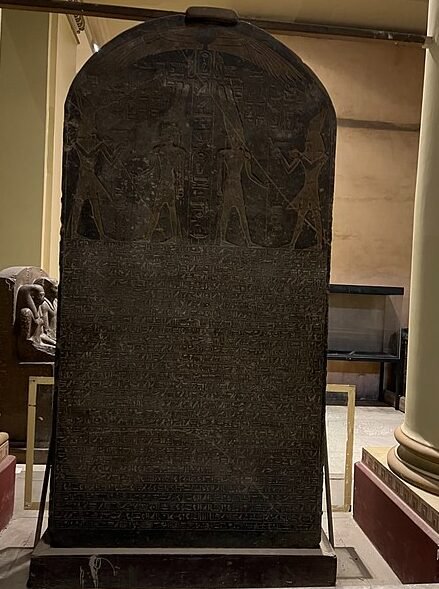
The Merneptah Stele is an inscription by Pharaoh Merneptah (1213–1203 BCE), discovered in 1896 by Flinders Petrie at Thebes and now in Cairo’s Egyptian Museum. Image: A 2023 picture of the Stele.
Archaeological Discovery
In 1896, British archaeologist Flinders Petrie unearthed the Merneptah Stele in the ancient Egyptian city of Thebes (modern-day Luxor), a locale once graced by numerous temples and monumental structures. At the time, Petrie was engaged in a systematic exploration of the region’s archaeological layers, aiming to uncover physical evidence of Egypt’s storied past.
The stele was found as part of material reused in architectural adjustments, indicating that it had been set against a wall, incorporating older stone into a later building phase. Once removed from its resting place, the slab offered researchers an unexpected window into the political landscape and external relations of Merneptah’s Egypt.
Physical Characteristics and Material Composition
This imposing black granite slab, standing over three meters in height, was originally inscribed with hieroglyphic text chiseled onto a somewhat uneven surface. The decision to carve the inscription onto the reverse side of an older monument of Amenhotep III likely explains the somewhat imperfect carving and less than ideal workmanship.
Although this choice presented challenges to early translators, the stele remains legible enough to reveal its essential narrative. Its impressive stature and enduring stone material have allowed it to survive largely intact, weathering the centuries so that modern scholars can appreciate its significance.
Historical Context of Merneptah’s Reign
Merneptah ruled Egypt during a politically dynamic period. He was the son and successor of the famous Ramesses II, a pharaoh renowned for extensive building projects and military engagements that solidified Egyptian power and influence. By Merneptah’s time, however, geopolitical pressures had begun to mount.
The Merneptah Stele primarily recounts a victory over Libyans, with its final lines referencing a campaign in Canaan.
Peoples from Libya, along with their Sea People allies, challenged Egyptian borders to the west. At the same time, within the eastern sphere—particularly in Canaan—local city-states sought to assert greater independence as Egyptian hegemony began to wane.
The stele’s inscription highlights these tensions, reflecting a phase when imperial control was no longer absolute. Against this backdrop, the text both celebrates an Egyptian victory and laments the shifting balances of power that would eventually erode the empire’s presence abroad.
Commemorating Victories Over External Adversaries
The majority of the inscription recounts Merneptah’s campaign against a Libyan coalition and allied northern groups. The pharaoh’s success over these western aggressors is emphasized in grandiloquent terms, underscoring Egypt’s capacity to repel incursions and maintain its territorial integrity.
Lines of text praise the achievement of subduing foreign foes, painting a picture of a king whose military acumen and strategic prowess safeguarded Egypt’s borders. At a time when external threats loomed large, such an account was intended to reassure the populace of the sovereign’s competence and divine endorsement.
Shift from West to East: The Canaanite Campaign
Toward the end of the inscription, the narrative moves abruptly from the western frontier to events occurring eastward, in the lands collectively referred to as Canaan.
Here, the text mentions various locales, naming Asqaluna, Gezer, and Yanoam, all of which had traditionally recognized Egyptian suzerainty. By citing these places in the aftermath of hostilities, the inscription implies that some had posed challenges—perhaps in the form of rebellions or refusals to send tribute.
These city-states, long tied to the Egyptian empire, apparently required renewed attention and military intervention. This shift in geographical focus underscores the complexity of late Egyptian imperial management, where threats emerged not only from large-scale foreign enemies but also from local entities seeking to assert themselves.
Earliest Non-Biblical Mention of Israel
The mention of “Israel” within the Merneptah Stele constitutes one of its most remarkable aspects. Unlike the cities listed, Israel appears with determinatives identifying it as a group of people rather than an urban center. This subtle linguistic feature suggests that, from the Egyptian viewpoint, Israel did not align neatly with the established pattern of fortified city-states.
Scholars widely identify the name ‘Israel’ among these hieroglyphs, making this the earliest known Egyptian mention of Israel.
Instead, it might have represented a less centralized population occupying the highland regions. For historians, this line holds enormous value: it is the earliest known reference to Israel outside the Hebrew Bible, proving that an entity by this name existed in the region by the late 13th century BCE. This single reference influences scholarly narratives regarding the emergence and social complexity of early Israelite culture.
Interpretations of Israel’s Status
The formulaic phrase “Israel is laid waste, its seed is no more” can be read as an expression of total defeat aimed at undermining the agricultural subsistence of a people. Such language, also applied to other subdued polities, indicates that the Egyptians intended to cripple future resistance by destroying food supplies and livestock.
While not necessarily a literal description, this rhetorical flourish reveals how Egypt’s leadership conceptualized total victory. The reference to Israel’s lack of a city determinative has led some experts to envision Israel’s population as rural or partly nomadic, possibly an emerging socioethnic formation rather than a fully developed urban polity.
Yet these interpretations remain cautious, as the evidence does not provide a complete picture of social structures or economic practices. Instead, it offers a valuable data point in a broader historical puzzle.
Scholarly Debates and Minority Views
Although the mainstream consensus interprets the inscription’s mention of Israel as referring to the group known from biblical traditions, alternative readings have been proposed.
A few have suggested that the hieroglyphs might represent “Jezreel” or some other name. There have also been attempts to connect the passage to Libyan entities. These dissenting views, however, have not gained wide acceptance. The dominant scholarly position continues to hold that Merneptah’s scribes intended to name Israel, confirming that by this date the group was known in Egyptian circles.
Disagreements over the precise social complexity, location, or organization of this Israel remain, ensuring ongoing discussions among historians, philologists, and archaeologists.

Image: Statue of Pharaoh Merneptah.
Implications for Biblical Studies and Ancient History
The significance of the Merneptah Stele extends into fields beyond Egyptology. For biblical scholars, it provides an anchor point of extra-biblical attestation, placing a named Israel in a recognized historical period. Such external corroboration is rare, especially for the era preceding the establishment of a monarchy in ancient Israelite society.
The stele thus contributes to debates on the timeline of Israel’s formation, the historicity of events later narrated in biblical texts, and the relationship between textual traditions and archaeological findings. While it does not confirm any specific narrative from the Hebrew Bible, it proves that a people called Israel existed on the historical stage well before later kingdoms arose in the region.
Cultural Significance and Interpretive Shifts
Beyond the scholarly arena, the Merneptah Stele holds cultural resonance. As a tangible artifact bridging ancient civilizations and modern inquiry, it offers public audiences a link to the distant past. Museums, educational institutions, and media outlets highlight its importance, reinforcing how material remains complement written accounts to reconstruct vanished worlds.
Over time, increased familiarity with the stele’s contents and context has encouraged more nuanced interpretations of identity, power, and resistance in ancient Canaan. By recognizing that the Egyptians perceived their eastern subjects in varied ways, historians refine broader narratives about intercultural interactions and the processes that shaped the ancient Near East.
Connecting Textual Records and Artistic Reliefs
In addition to the stele’s inscription, reliefs discovered at Karnak may portray events similar to those described in the text. Although scholarly consensus is not uniform on whether these images correspond exactly to the mentioned campaigns, their presence opens an avenue for interdisciplinary study.
Matching inscriptions to visual representations enhances understanding of how Egyptians recorded accomplishments, how they depicted subject peoples, and how the empire’s visual culture communicated legitimacy. Such correlations serve as a reminder that textual and pictorial evidence must be considered together, broadening the scope of interpretation and strengthening the reliability of historical reconstructions.
Concluding Reflections
The Merneptah Stele stands at a crossroads of archaeological discovery, geopolitical history, and cultural interpretation. Emerging from excavations in Thebes, carved onto reused stone, and inscribed with details of military conquests and territorial dynamics, it reveals an Egypt balancing on the cusp of changing regional fortunes.
By highlighting the presence of a socioethnic group called Israel, the text has become a key artifact for charting the intersection of Egyptian imperial narratives and the formative stages of a people whose story would one day be recorded in the Hebrew Bible.