Pyramidion of Amenemhat III
The pyramidion of Amenemhat III, often regarded as a pinnacle of ancient Egyptian craftsmanship and symbolism, originates from the 12th Dynasty during the Middle Kingdom (circa 1850 BC).
It was designed to cap the Black Pyramid at Dashur, a significant burial complex constructed under the reign of Pharaoh Amenemhat III. Pyramidions, serving as the crowning element of pyramids, symbolized the sun’s rays, emphasizing the divine connection between the pharaoh and the solar deity Ra.
Amenemhat III’s reign marked a period of architectural innovation, and his pyramid was a testament to his ambition to achieve eternal union with the gods.
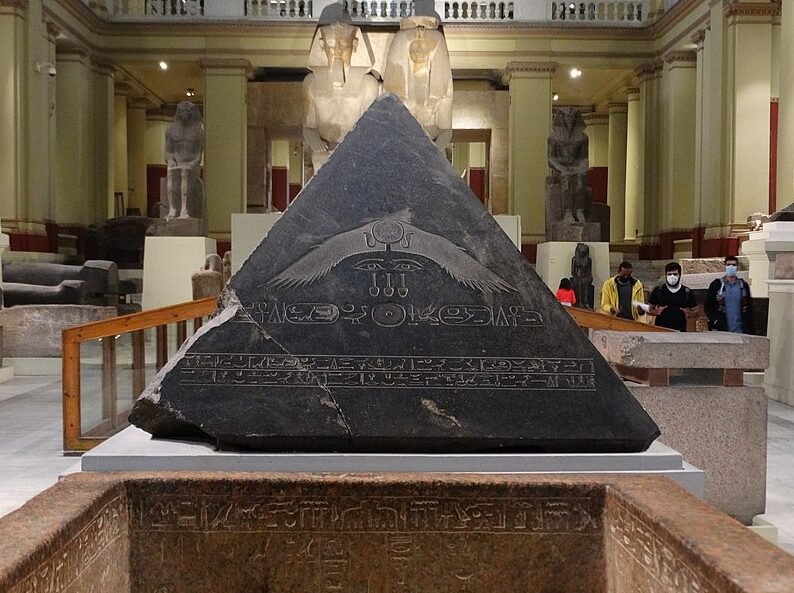
The pyramidion of Amenemhat III, crafted around 1850 BC during Egypt’s Middle Kingdom, topped the Black Pyramid at Dashur. Image: East face of the pyramidion at the Egyptian Museum.
Constructed from basalt, a material often referred to as black granite, the pyramidion represents advanced engineering and meticulous attention to detail. It was carved as a single block, showcasing both structural precision and artistic sophistication. The material choice and intricate inscriptions reflect the importance of preserving the pharaoh’s legacy and securing his place in the afterlife.
READ MORE: Most Famous Ancient Egyptian Pharaohs and their Accomplishments
Discovery of the Pyramidion
The pyramidion’s discovery is closely tied to the efforts of Gaston Maspero, director of Egypt’s Department of Antiquities in 1900. Maspero ordered an inspection of Dashur following incidents of robberies targeting the Saqqara necropolis, a nearby burial site. During this survey, a grey block protruding from the sand was found on the eastern side of the pyramid of Amenemhat III. Initially obscured by desert sands, this artifact was revealed upon excavation to be the capstone of the Black Pyramid.
The discovery of the pyramidion was a remarkable archaeological find. The block’s polished surfaces and inscribed hieroglyphs made it immediately clear that it was a significant element of the pyramid’s structure. After thorough documentation and analysis, the pyramidion was transported to the Egyptian Museum in Cairo, where it remains preserved and displayed for public and scholarly examination.
Physical Description
The pyramidion is a monolithic block, meticulously carved from basalt, measuring 1.40 meters (4.6 feet) in height and 1.85 meters (6.1 feet) along its base. It weighs approximately 4.5 tonnes (9,900 pounds), emphasizing the challenges of both its original construction and later transportation. The base edges of the pyramidion were undercut, a design feature that helped secure it atop the pyramid. This engineering detail underscores the skill and ingenuity of ancient Egyptian builders.
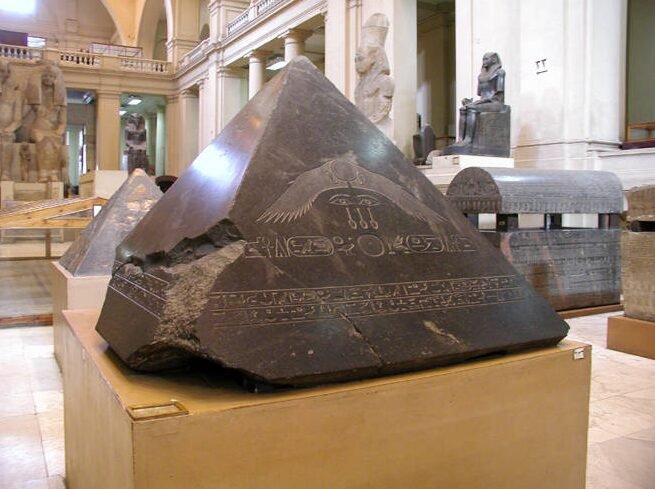
Although mostly intact, the pyramidion shows minor damage, with one corner broken. Despite this, its overall preservation is exceptional, allowing modern scholars to study its inscriptions and design with minimal reconstruction. The artifact’s large size, durable material, and intricate detailing reflect the symbolic importance it held within the pyramid complex.
Artistic and Theological Elements
The pyramidion’s four polished upper faces were adorned with intricate inscriptions and symbols that conveyed profound religious and artistic significance. These inscriptions highlighted the pharaoh’s divine status and his eternal relationship with the gods.
Eastern Face
The eastern face of the pyramidion, oriented toward the rising sun, features a winged sun disk flanked by two cobras (uraei). Below this motif are two wedjat eyes, which symbolize the king’s divine vision and protection. Beneath these are three nefer signs, representing beauty or perfection, and a sun disk signifying the god Ra. Collectively, the symbols and inscriptions proclaim: “Amenemhat beholds the perfection of Ra.” This side reflects the king’s aspiration to align with the life-giving power of the sun.
Northern Face
The northern face contains celestial references, associating the pharaoh’s spirit with the constellation Orion and the starry sky. The inscriptions emphasize Amenemhat’s ascension to divine status, with lines that invoke Ra-Horakhty (Ra in his form as the horizon god) and Neith, the goddess of creation and war. These celestial allusions underline the pharaoh’s role in the cosmic order.
Western Face
The western face invokes Osiris, the god of the afterlife, and Ptah, the god of creation and truth. This side emphasizes Amenemhat’s eternal reign in the afterlife, highlighting his connection to the divine realms and his enduring legacy as a ruler. The inscriptions on this side bridge the concepts of life, death, and rebirth, which were central to Egyptian theology.
Southern Face
The southern face focuses on Anubis, the god associated with mummification and the afterlife. Inscriptions depict Anubis granting Amenemhat dominion over the western desert, a symbolic representation of the afterlife. The text calls for eternal peace and prosperity for the king in the afterlife, ensuring his continued guidance and protection of the land.

Image: An illustration depicting Anubis.
Significance of the Inscriptions
The inscriptions on the pyramidion serve multiple purposes. First, they reinforce the pharaoh’s divine status, presenting him as both a mortal ruler and a god in the eternal cycle of life and death. Second, they establish his connection to specific deities—Ra, Osiris, Ptah, and Anubis—each representing different aspects of life, creation, and the afterlife. Third, the inscriptions highlight the ancient Egyptians’ belief in the pharaoh’s role as a mediator between the gods and his people, ensuring cosmic balance and harmony.
Historical Context of Erasures
One of the most intriguing features of the pyramidion is the erasure of the god “Amen” from the cartouches of Amenemhat III’s name. This alteration is believed to have occurred during the 18th Dynasty, particularly during the reign of Akhenaten (circa 1350 BC), who promoted the worship of Aten, the sun disk, while suppressing the worship of other gods. This act of erasure is a historical marker of Akhenaten’s radical religious reforms, which disrupted long-standing traditions.
Symbolizing the sun’s rays, Pyramidion of Amenemhat III was a vital element of royal tombs.
The removal of the god’s name also raises questions about the pyramidion’s history. Scholars debate whether the artifact ever crowned the Black Pyramid or if it remained buried beneath the sands for centuries, protected from extensive damage.
Cultural and Architectural Significance
The pyramidion of Amenemhat III exemplifies the fusion of artistry, engineering, and religious ideology during the Middle Kingdom. Pyramidions were not merely decorative; they symbolized the pharaoh’s divine nature and the pyramid’s function as a bridge between earth and the heavens. The design and inscriptions of this pyramidion reveal insights into the Middle Kingdom’s theological perspectives, particularly the emphasis on solar worship and eternal life.
The craftsmanship of the pyramidion also reflects the technical advancements of the time. Its precise carving and intricate inscriptions highlight the skill of artisans who worked on royal monuments. Moreover, the artifact demonstrates the logistical capabilities of the ancient Egyptians, who transported and positioned such heavy materials with limited technology.
Legacy and Modern Interpretation
The pyramidion holds immense value for modern historians and archaeologists. It provides a tangible connection to the reign of Amenemhat III and the architectural innovations of the 12th Dynasty. By analyzing its inscriptions and design, scholars gain a deeper understanding of the religious beliefs, political ideology, and artistic achievements of the Middle Kingdom.
Its relatively intact condition allows for detailed study, making it an essential artifact in the study of ancient Egyptian history. The pyramidion’s current placement in the Egyptian Museum in Cairo ensures its preservation and accessibility for future generations, serving as a source of education and inspiration.
Conclusion
The pyramidion of Amenemhat III is a masterpiece of ancient Egyptian culture, embodying the intersection of religion, art, and engineering. From its origins as the crowning element of the Black Pyramid to its discovery in 1900, the artifact tells a story of divine kingship, cosmic balance, and cultural innovation. Its inscriptions and design provide invaluable insights into the Middle Kingdom’s theological and architectural achievements, while its preservation allows for ongoing exploration of ancient Egypt’s enduring legacy.
Frequently Asked Questions

Image: Statue of Amenemhat III.
Who ordered the inspection of Dashur in 1900, and why?
Gaston Maspero, the director of Egypt’s Department of Antiquities, ordered the inspection following attacks on guards at the Saqqara necropolis.
What was discovered at Dashur during the inspection?
A grey block protruding from the sand on the east side of Amenemhat III’s pyramid was uncovered, later identified as the pyramidion of the Black Pyramid.
Where is the pyramidion located today?
The pyramidion is now housed in the Egyptian Museum in Cairo.
What material was used to craft the pyramidion, and how intact is it?
It was crafted from basalt (black granite) and is mostly intact, with only minor damage to one corner.
What are the dimensions and weight of the pyramidion?
It measures 1.40 meters in height, 1.85 meters at its base, and weighs approximately 4.5 tonnes.
What inscriptions were found on the eastern side of the pyramidion?
The eastern side features a winged sun disk flanked by cobras (uraei), two wedjat eyes symbolizing the king’s divine vision, three nefer signs representing perfection, and a sun disk for Ra. The phrase inscribed reads: “Amenemhat beholds the perfection of Ra.”
What symbolic themes are conveyed by the pyramidion’s inscriptions?
The inscriptions emphasize eternal life, divine kingship, celestial connection, and the pharaoh’s role as a mediator between the gods and the people.
What significant alteration is noted on the pyramidion, and what is its historical context?
The god “Amen” in Amenemhat’s cartouches was erased, likely during Akhenaten’s religious reforms in the 18th Dynasty, when the worship of Aten was prioritized.
Why do scholars doubt whether the pyramidion was ever placed atop the pyramid?
The pyramidion’s relatively undamaged condition suggests it may never have crowned the pyramid and could have remained buried in the sand for centuries.
What broader significance does the pyramidion hold for understanding the Middle Kingdom?
It exemplifies the blend of artistry, religious symbolism, and engineering skill, reflecting the Middle Kingdom’s beliefs in divine kingship and the pharaoh’s eternal role as an intermediary with the gods.





