Mot: The Canaanite god of death
by World History Edu · January 23, 2025
Mot, the Canaanite god of death and the underworld, held a central role in the mythology and religion of the ancient Near East. The name “Mot” (𐤌𐤕 in Phoenician, מות in Hebrew, and 𐎎𐎚 in Ugaritic) directly translates to “death.” He was widely recognized in the Canaanite religion, especially among the people of Ugarit and Phoenicia. Our understanding of Mot’s significance and narrative comes primarily from Ugaritic texts, complemented by fragments of Philo of Byblos’s work, which preserved interpretations of Phoenician beliefs.
Forms of the Name
The term “Mot” reflects a linguistic connection across several Semitic and Afro-Asiatic languages, each of which shares a variation of the word for death. For example:
- Ugaritic: mt
- Hebrew: מות (māweṯ or māvēṯ)
- Arabic: موت (mawt)
- Akkadian: 𒍗 (mūtu)
- Ge’ez: ሞት (mot)
- Maltese: mewt
- Syriac: ܡܰܘܬܳܐ (mautā) These linguistic parallels underline the shared cultural perceptions of death across the ancient Semitic world. Beyond language, the consistent representation of Mot as a deity tied to death suggests his thematic resonance in mythology and ritual.
Mot in Ugaritic Religion and Mythology
The primary source of information about Mot’s role in mythology comes from the Ugaritic texts, discovered in the ancient city of Ugarit (modern-day Ras Shamra, Syria). These texts depict Mot as a son of El, the chief deity, and as an adversary of Ba’al, the storm god. Mot embodies death and desolation, residing in a realm described as a pit, with filth as its defining feature.
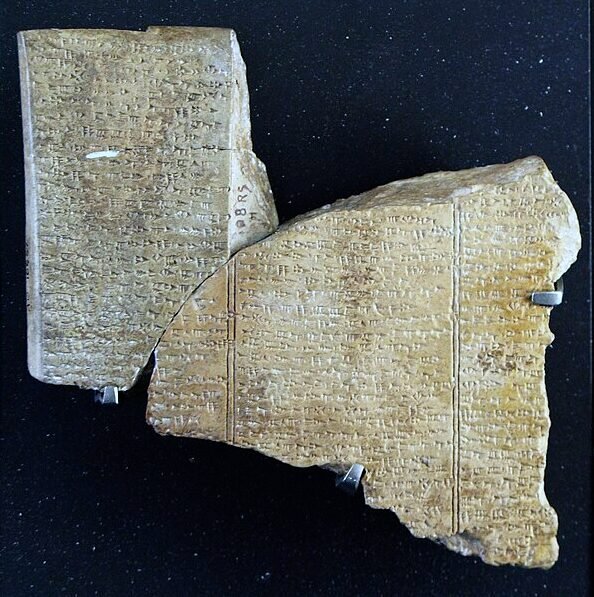
Pieces of tablets with the “Baal Cycle” written on them give us an important glimpse into Canaanite religion, including its portrayal of Death (Mot).
The Conflict Between Mot and Ba’al
The most prominent myth involving Mot is his rivalry with Ba’al, symbolizing the cyclical struggle between life and death. In this myth:
Ba’al instructs his messengers to approach Mot cautiously. He warns them not to get too close to Mot, who is described as voracious and dangerous.
Mot responds by proclaiming his insatiable appetite, likening it to lions in the wilderness or dolphins in the sea. He threatens to consume Ba’al, asserting his dominance over life.
Mot seemingly kills Ba’al. The goddess Shapash (the sun deity) and Ba’al’s sister Anat bury him. This act plunges the world into chaos, symbolized by the cessation of rain and fertility.
Anat, Ba’al’s fierce sister, retaliates against Mot. She defeats him in a violent encounter, cutting him apart, grinding his remains, and scattering them across the land.
El dreams of Ba’al’s survival and instructs Shapash to resurrect him. The world regains its vitality as Ba’al returns to life.
After seven years, Mot confronts Ba’al again, demanding retribution. The conflict escalates but ultimately ends when Shapash intervenes, warning Mot of El’s wrath.
Phoenician Interpretations of Mot
Phoenician mythology also acknowledged Mot, though details about his role are limited. A key source for Phoenician beliefs is the historian Sanchuniathon, whose works were paraphrased by Philo of Byblos and later preserved by Eusebius.
Mot as a Son of El
In Sanchuniathon’s account, Mot is described as one of the sons of El and Rhea. After Mot’s death, El deifies him, giving him a divine status akin to that of Thanatos (Greek for “Death”) or Pluto (associated with the underworld).
Philosophical Creation Myth
In an earlier creation myth attributed to Sanchuniathon, Mot emerges from a primeval substance—often interpreted as mud or decayed matter. This interpretation diverges from the violent depiction in Ugaritic myths, presenting Mot as part of the generative forces of the universe:
- Mot arises from a fusion of wind and water, representing putrescence.
- From Mot comes the germ of life, leading to the creation of intelligent beings called “Zophasemin” (“observers of heaven”).
- Mot is connected to the celestial order, including the sun, moon, stars, and constellations.
Mot in Hebrew Scriptures
In Hebrew scriptures, the concept of death (māweṯ/mavet) is occasionally personified. This linguistic personification aligns with Mot’s depiction in Ugaritic and Phoenician mythology. For example:
- Habakkuk 2:5: Death is portrayed as insatiable, much like Mot’s characterization in Ugaritic texts.
- Job 18:13: Death is a consuming force, emphasizing its destructive power. While Mot does not appear as a deity in the Hebrew Bible, the linguistic similarities suggest a shared cultural heritage and familiarity with Canaanite motifs.
Symbolism and Cultural Significance
Mot’s role as the god of death carries profound symbolic meaning. His mythology reflects:
The rivalry between Ba’al and Mot mirrors the seasonal cycles of fertility and drought. Ba’al’s death and resurrection symbolize the rains that sustain life, while Mot’s presence signifies periods of barrenness.
The interaction between Ba’al and Mot encapsulates the balance between life and death, a theme prevalent in many ancient religions.
Mot’s insatiable hunger serves as a cautionary tale about unchecked greed and destruction, while Ba’al’s resurrection offers hope and renewal.

A statue portraying Baal, located at Exhibit in the Oriental Institute Museum, University of Chicago, Chicago, Illinois, USA.
Influence on the Passover Tradition
Some scholars have proposed that the Jewish festival of Passover may have origins in Canaanite myths, particularly the story of Mot and Ba’al. This theory suggests that:
- Ba’al’s death and resurrection inspired rituals celebrating life and renewal.
- The agricultural themes of the myth align with the timing of Passover, a spring festival marking the harvest and liberation. However, most modern scholars dispute this connection, emphasizing that the Passover narrative in the Hebrew Bible serves as a subversion of Canaanite myths. It reframes the story within a monotheistic framework, with Yahweh replacing Ba’al as the divine provider.
Comparative Analysis with Other Mythologies
Mot shares similarities with death deities in other ancient cultures:
- Thanatos (Greek Mythology): Both represent death personified, though Thanatos lacks Mot’s dynamic narrative of conflict.
- Osiris (Egyptian Mythology): Like Mot, Osiris is associated with death and the underworld, though Osiris is also a symbol of resurrection.
- Hades (Greek Mythology): Hades, like Mot, rules over the underworld. However, Hades is a more neutral figure, while Mot embodies destruction.
Legacy of Mot in Later Traditions
Mot’s mythology influenced subsequent cultures and religious traditions.
His depiction as a consuming force persisted in later literary and theological concepts of death.
The cyclical themes of life, death, and renewal in his myth find echoes in agricultural festivals and seasonal rituals.
Frequently Asked Questions

What are the origins of the name Mot?
The name derives from a Semitic root meaning “death,” with cognates in languages such as Hebrew, Arabic, Akkadian, and Aramaic.
What is the main source of information about Mot?
The primary source is Ugaritic texts, supplemented by fragments from Philo of Byblos’s Greek translation of Sanchuniathon’s writings.
How is Mot described in Ugaritic mythology?
Mot is a son of El, residing in a pit called Mirey. He is depicted as insatiable, devouring like lions and dolphins. He battles and seemingly defeats Ba’al but is ultimately overpowered by Ba’al’s sister, Anat.
What role does Mot play in the Ba’al cycle?
Mot kills Ba’al, causing drought and chaos. Ba’al is later resurrected by Shapash and El, leading to a renewed confrontation that ends in Mot’s submission.
How is Mot connected to the Phoenician tradition?
Philo of Byblos’s account identifies Mot as a son of El, deified after death and associated with Thanatos and Pluto.
What is the symbolic role of Mot in creation myths?
In Sanchuniathon’s philosophical account, Mot emerges as a primordial element linked to mud and watery putrescence, contributing to the creation of life and the cosmos.
Is there a connection between Mot and Hebrew scriptures?
In Hebrew texts, Maweth is sometimes personified, as seen in poetic or metaphorical references like Habakkuk 2:5 and Job 18:13.





