Ai Khanum: History, Foundation, & Major Facts
Ai Khanum, also spelled Ai-Khanoum, was one of the most significant cities of the Greco-Bactrian kingdom and played a key role during the reign of Eucratides I (r. 170–145 BCE). This city, whose name means “Lady Moon” in Uzbek, was located in modern-day Afghanistan, near the confluence of the Oxus (Amu Darya) and Kokcha rivers. Its strategic position made it an important center of Hellenistic culture in Central Asia.
The Foundation of Ai Khanum
Ai Khanum was likely founded in the 4th century BCE during the conquests of Alexander the Great, as part of his broader Hellenistic expansion. The region of Bactria, which included much of present-day northern Afghanistan, was a key frontier in Alexander’s empire, and several cities were established to spread Greek culture and maintain control over this vital region. While some debate exists about the exact date of Ai Khanum’s foundation, it is widely accepted that it emerged as a critical Hellenistic urban center.
The city’s layout, architecture, and culture reflected a mix of Greek and local influences, creating a unique fusion that characterized the Greco-Bactrian period. Ai Khanum became a symbol of the broader Greco-Bactrian Kingdom’s ambition to blend Eastern and Western traditions.
Eucratides I and the Greco-Bactrian Kingdom
Eucratides I, one of the most prominent rulers of the Greco-Bactrian Kingdom, ascended to the throne around 170 BCE. His reign marked a period of significant expansion and consolidation for the kingdom. He fought against rival Hellenistic kingdoms in the region, including the Indo-Greeks to the southeast, and successfully expanded his domain to encompass much of Bactria and northern India.
Ai Khanum, as the capital of Eucratides’ empire, was central to his ambitions. The city served not only as a military base for campaigns but also as a cultural hub, promoting Hellenistic art, architecture, and philosophy in the heart of Central Asia. Eucratides’ efforts to strengthen Greek culture in Bactria are reflected in the city’s infrastructure and design.
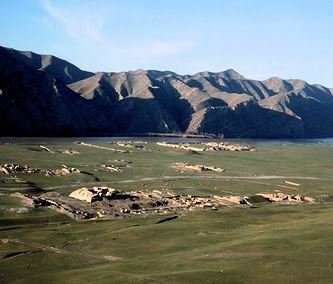
Ai Khanum, under the reign of Eucratides I, was a flourishing center of Hellenistic culture in Central Asia, blending Greek and local traditions in a unique and remarkable way. Image: A picture of the Ai Khanum’s archaeological site.
The Layout and Architecture of Ai Khanum
Ai Khanum’s urban plan closely followed the Greek grid system, with streets laid out in a regular, orthogonal pattern. This planning style was typical of Hellenistic cities and can be traced back to the city-building principles of Hippodamus of Miletus. The city was divided into distinct districts, including a residential area, administrative buildings, temples, and a theater.
Key Architectural Features
The Palace Complex: One of the most impressive structures in Ai Khanum was the royal palace, located in the city’s southwestern area. This massive complex covered several hectares and featured a blend of Greek and local architectural styles. The palace had large courtyards, colonnaded halls, and reception rooms, demonstrating the influence of classical Greek architecture.
The Gymnasium: As a symbol of Greek culture, the gymnasium in Ai Khanum was used for physical training, education, and social gatherings. It was one of the largest known gymnasiums in the Hellenistic world, underscoring the importance of Greek traditions in the city. The presence of this structure highlights the role of Ai Khanum as a center for Greek education and physical culture in the region.
The Theater: Like other Hellenistic cities, Ai Khanum had a theater where dramas and comedies were performed, following the Greek tradition. The theater could accommodate several thousand spectators, and its presence suggests that Greek cultural practices, such as theatrical performances, were popular among the city’s inhabitants.
Temples and Religious Structures: The city housed several temples dedicated to Greek gods, as well as a few that likely blended Greek and local religious practices. The main temple in Ai Khanum, which was dedicated to Zeus, followed the design of classical Greek temples, with a colonnaded façade and an altar for sacrifices.
The Agora: The city’s marketplace, or agora, was another hallmark of Greek urban design. It served as a center of commerce and public life, where citizens gathered to trade, discuss politics, and engage in civic activities. The agora was surrounded by stoas, or covered walkways, which provided shade and shelter for merchants and shoppers.
Cultural and Intellectual Life
Ai Khanum was not only a center of political and military power but also a hub for Hellenistic culture and intellectual exchange. The city boasted a library, evidence of which was discovered through inscriptions that referred to books and philosophical works. Scholars and philosophers likely visited Ai Khanum, attracted by its cosmopolitan atmosphere and the patronage of rulers like Eucratides I.
One of the most significant discoveries at Ai Khanum was an inscription attributed to the philosopher Clearchus of Soli. The inscription, found near the gymnasium, quoted the Delphic maxims, a set of moral precepts that were inscribed at the Temple of Apollo in Delphi. This suggests that the city was closely connected to the broader Hellenistic world and participated in its intellectual traditions.
Greek art and culture were dominant in Ai Khanum, but they coexisted with local traditions. The fusion of Greek and Eastern artistic styles is evident in sculptures, pottery, and coins from the city. This cultural synthesis reflects the broader Greco-Bactrian experience, where Greek rulers and settlers adapted to their new environment while maintaining their Hellenistic heritage.
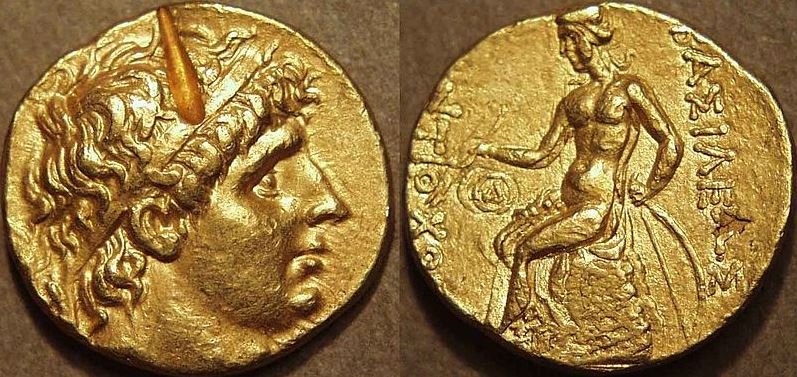
Image: Golden coin of Antiochos I.
The Decline and Fall of Ai Khanum
Despite its grandeur, Ai Khanum’s prosperity was relatively short-lived. The Greco-Bactrian Kingdom faced increasing pressure from nomadic invasions, particularly from the Yuezhi, a Central Asian people who migrated westward in the 2nd century BCE. These invasions disrupted the stability of the region and weakened the Greco-Bactrian Kingdom.
Around 145 BCE, Ai Khanum was abandoned, likely as a result of the Yuezhi invasion. The city’s fall marked the end of Greek rule in Bactria and the decline of Hellenistic influence in Central Asia. While some local rulers continued to hold power in the region, the golden age of Ai Khanum as a Hellenistic city had come to an end.
Archaeological excavations in the 20th century revealed much about Ai Khanum’s history and significance. French archaeologist Paul Bernard led the most important excavations at the site between 1964 and 1978, uncovering the city’s remains and shedding light on its role in the Greco-Bactrian Kingdom. These discoveries have been crucial in understanding the spread of Greek culture beyond the Mediterranean and into Central Asia.
Legacy and Importance
Ai Khanum is a key example of the Hellenistic world’s reach and its ability to blend with local cultures. The city represents the furthest extent of Greek influence in the East and offers valuable insights into how Greek culture adapted to new environments. The fusion of Greek and Central Asian elements in Ai Khanum’s architecture, art, and daily life is a testament to the city’s cosmopolitan nature and its role as a melting pot of cultures.
The story of Ai Khanum also highlights the fragility of Hellenistic kingdoms in Central Asia, which, despite their achievements, were vulnerable to external pressures and internal strife. The fall of Ai Khanum and the Greco-Bactrian Kingdom was part of the larger decline of Greek power in the East, which paved the way for new empires, such as the Kushans, to rise in the region.
Today, Ai Khanum is an important archaeological site that continues to provide scholars with insights into the complexities of cultural exchange in antiquity. The city’s unique blend of Greek and Eastern influences makes it a symbol of the broader interactions between the Mediterranean and Central Asia during the Hellenistic period.
Did you know…?
The city’s name is uncertain. Some scholars suggest it may have been called Eucratidia, after the Greco-Bactrian king Eucratides, or possibly Oskobora, mentioned by Ptolemy. Others believe it might have been Alexandria on the Oxus, though evidence points to Alexandria being located in Termez.
Frequently asked questions on Ai Khanum
What does the name Ai Khanum mean, and where is it located?
Ai Khanum means “Lady Moon” in Uzbek. It is located in northern Afghanistan, between the Amou-Darya and Kokcha rivers.
When was Ai Khanum founded, and under whose influence?
Ai Khanum was founded in the 4th century BC, following the conquests of Alexander the Great.

Image: A mosaic of Alexander the Great.
Who discovered the ruins of Ai Khanum, and when did excavations begin?
Afghan King Mohammad Zaher Chach discovered the ruins in 1961 while hunting. Excavations began in 1964, led by French archaeologist Paul Bernard.
Why were the excavations at Ai Khanum interrupted, and what happened to the site?
Excavations were interrupted by the Russo-Afghan war, civil conflicts, and the Taliban occupation. The site suffered damage from looting and fighting, though limited archaeological work resumed after 2006.
What was the size of Ai Khanum, and what architectural styles did it feature?
Ai Khanum covered 2 km in length and 1.5 km in width. It featured a blend of Greek and Iranian architectural influences, with Greek-style public buildings and oriental elements.
What significant structures were discovered during the excavations?
Notable structures included the Heroon of Kineas, a shrine likely dedicated to the city’s founder, and temples reflecting both Greek and oriental architecture. A grand palace and a gymnasium with a statue of Hermes were also found.
What do the artifacts found at Ai Khanum indicate about the city’s role?
Artifacts such as coins and jewelry indicate Ai Khanum was a cosmopolitan hub. Coins from Greece, India, and local regions reflect its importance in trade. A pendant with materials from the Mediterranean and Burma underscores its global connections.





