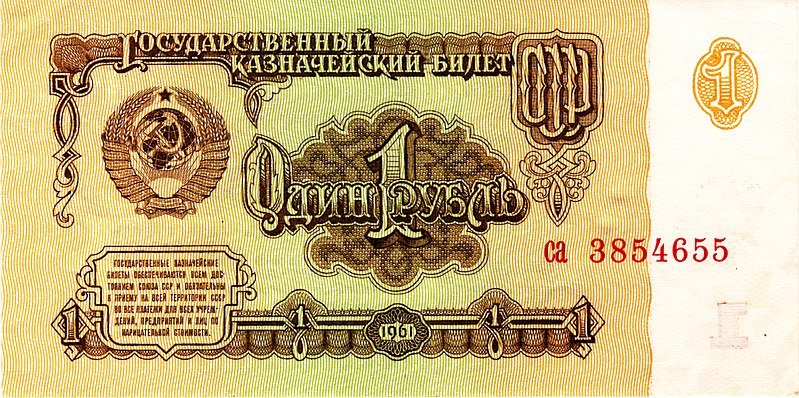
Front side of the 1 rouble banknote (1961).
The ruble served as the currency of the Soviet Union from 1922 to its dissolution in 1991. Divided into 100 kopecks, it replaced the Imperial Russian ruble and underwent various iterations throughout Soviet history. Soviet coins and banknotes were primarily produced by Goznak in Moscow and Leningrad. Beyond cash rubles, the Soviet financial system included convertible rubles, clearing rubles, and cashless rubles used for inter-enterprise accounting within the Comecon framework. Despite its collapse in 1991, the Soviet ruble continued to circulate in post-Soviet states until its replacement by new national currencies by 1993.
Etymology and Historical Roots
The term ruble originates from the Slavic verb rubit’ meaning “to chop,” referring to pieces of silver chopped off a grivna, a measure of weight. The diminutive term kopeck derives from kop’yo (spear) and alludes to the image of a horseman with a spear stamped on early coins. This image evolved over time, with later depictions symbolizing Saint George slaying a serpent, underscoring the currency’s historical and cultural significance.
The Soviet ruble served as the currency of the Soviet Union from 1922 to its dissolution in 1991.
Ruble in the Soviet Union: Design and Multilingualism
Soviet banknotes were inscribed with the ruble’s name in the languages of all 15 Soviet republics, reflecting the USSR’s diverse linguistic landscape. The ruble was locally named according to regional traditions, and some Central Asian states adopted the Soviet ruble’s local names for their post-independence currencies. For example, sum (Tatar) became the official currency name in Uzbekistan.
First Soviet Ruble (1917–1922)
Introduced during the Russian Civil War, the first ruble coexisted with competing currencies issued by White Russian factions and other authorities. Hyperinflation rendered denominations as high as 10 million rubles necessary. Banknotes from this period lacked security features and were often printed on one side.
Gold Ruble (1921–1924)
Under the New Economic Policy, a gold-standard ruble, equivalent to 1/10 of a chervonets, was introduced. Coins minted in 90% gold and silver carried the iconic slogan, “Workers of the World, Unite!” These coins coexisted with depreciated paper rubles but were later discontinued as silver and gold became scarce.
Stabilization and the Fourth Soviet Ruble (1924–1947)
After Lenin’s death, the ruble underwent a major redenomination, with 50,000 old rubles equating to one new ruble. The stabilization enabled a return to coinage in 1924, adhering to Tsarist standards. Silver coins were later replaced by copper-nickel due to resource constraints. This period also saw the introduction of state-issued treasury notes for lower denominations.
Wartime Challenges and Reforms
During World War II, the evacuation of minting facilities disrupted coin production, leading to shortages. Postage stamps and ration coupons temporarily substituted for coins. Following the war, the ruble was redenominated in 1947, with banknotes bearing Lenin’s image replacing older series. This confiscatory reform aimed to stabilize the economy and address inflation but inadvertently worsened economic hardships.
The Sixth Ruble: 1961 Reform and Modernization
In 1961, a further redenomination was implemented, simplifying accounting by introducing a 10:1 exchange ratio. The ruble was pegged to gold at 0.987 grams per ruble but remained inaccessible for public gold exchange. This series saw the introduction of aluminum-bronze coins for small denominations and commemorative rubles celebrating Soviet achievements, such as the 1980 Moscow Olympics.
The Seventh Ruble: Gorbachev’s Final Reform
Under Mikhail Gorbachev’s leadership, the 1991 monetary reform aimed to curtail inflation by replacing 50- and 100-ruble notes with new designs. This reform, known as the Pavlov Reform, included restrictions on cash exchange limits and intensified inflationary pressures. The newly issued coins and banknotes marked a departure from earlier designs by omitting inscriptions in non-Russian languages, signaling the USSR’s fragmentation.
Post-Soviet Transition and the Ruble Zone
Following the Soviet Union’s collapse in 1991, the ruble remained in circulation across former Soviet republics during a transitional “ruble zone.” Efforts to maintain monetary unity failed as independent states introduced national currencies. By 1993, most countries replaced the ruble, with varying conversion rates reflecting their economic conditions. For example:
- Armenia introduced the dram, replacing 200 rubles with 1 dram.
- Kazakhstan adopted the tenge, equating 500 rubles to 1 tenge.
- Russia transitioned to the first Russian ruble (RUR), later redenominated in 1998 to form the modern ruble (RUB).
Economic Role and Exchange Rates
The Soviet ruble functioned differently from market-based currencies due to the planned economy’s reliance on quotas and fixed prices. Consumer goods were subsidized, while shortages and limited availability constrained spending options. The ruble’s international exchange rate diverged significantly from black-market rates, underscoring its limited utility outside the USSR. Officially pegged at $1.35 per ruble during the 1980s, the black-market rate soared to over 100 rubles per dollar by 1991, reflecting the economy’s instability.

Official exchange rates for major world currencies on February 1, 1985.
Commemorative Coins and Numismatic Legacy
Soviet commemorative coins hold historical and cultural significance, celebrating milestones such as Lenin’s birth centenary and the Soviet victory in World War II. Minted in higher-quality alloys, these coins remain valued collectibles. Notable designs include the 1978 series commemorating the Moscow Olympics and various artistic depictions of Soviet achievements.
Replacement Currencies in Former Soviet States
The transition from the ruble to national currencies varied among newly independent states:
- The Baltic states (Estonia, Latvia, Lithuania) quickly adopted new currencies, eventually joining the eurozone.
- Central Asian republics, like Uzbekistan and Turkmenistan, introduced currencies derived from local ruble names.
- Russia maintained the ruble as its national currency, undergoing significant reforms to stabilize its value.