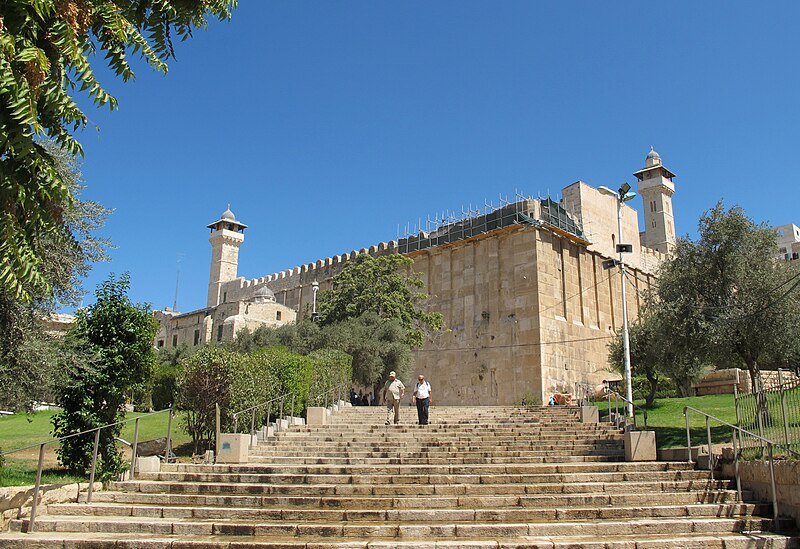
A 2010 view of the Cave of the Patriarchs from the Israeli-controlled side.
The Cave of the Patriarchs, also known as the Tomb of the Patriarchs or the Cave of Machpelah, is a revered site located in Hebron, West Bank, approximately 30 kilometers (19 miles) south of Jerusalem.
Known as Me’arat haMakhpela in Biblical Hebrew and al-Haram al-Ibrahimi in Arabic, the site is sacred in Judaism, Christianity, and Islam.
According to religious tradition, it is the burial site of the biblical patriarchs and matriarchs, purchased by Abraham as a family tomb. While historical and archaeological evidence suggests that the Abraham-Isaac-Jacob narrative is largely mythological, the site remains a focal point of religious devotion and political conflict.

Cave of the Patriarchs
Historical Evolution
The current structure above the cave was built during the reign of Herod the Great (37–4 BCE) and remains the only fully intact Herodian edifice. Initially an open-air enclosure, the structure was later modified and repurposed by successive rulers.
Under Byzantine rule, a Christian basilica was constructed on the site. The Muslim conquest in the 7th century led to the conversion of the structure into the Ibrahimi Mosque. Saladin reconquered Hebron in 1188, reinforcing its status as a mosque.
During the Crusades, the mosque was transformed into a church and later reconverted into a mosque by Saladin. The 12th century saw the first reported discovery of human remains, believed to belong to the biblical patriarchs.
The Ottomans restricted Jewish access to the site, permitting them only as far as the “seventh step” outside the complex. During the British Mandate (1917–1948), restrictions eased slightly, but full Jewish access was still denied.
Modern Political and Religious Conflict
1967 Six-Day War and Israeli Control
Following the 1967 war, Israel occupied the West Bank and took control of Hebron. Jewish worship was permitted inside the mosque, leading to increased tensions with the Muslim population.
Violence and Incidents at the Site
- 1968–1976: Jewish prayer times were expanded, leading to violent confrontations. A grenade attack in 1968 injured 47 Israelis.
- 1980: An attack on Jewish worshippers left 6 dead and 17 wounded.
- 1994 Cave of the Patriarchs Massacre: Jewish extremist Baruch Goldstein killed 29 Palestinian worshippers inside the mosque, triggering widespread violence and leading to a division of the site between Muslims and Jews.
Present-Day Status
Under the 1997 Hebron Protocol, the site was divided, with 81% designated as the Ibrahimi Mosque for Muslims and 19% as a synagogue for Jews. Security remains tight, with Israeli forces controlling access.
Etymology and Interpretation of Makhpela
The term “Makhpela” has been debated among scholars and religious texts. The Talmud suggests two possible meanings:
- A double cave: Either stacked chambers or one chamber behind another.
- A burial place for couples: Abraham and Sarah, Isaac and Rebecca, Jacob and Leah.
Later scholars proposed that Makhpela may refer to the surrounding land rather than the cave itself, supported by biblical phrasing such as “the cave in the field of the Makhpela” (Genesis 49:30).
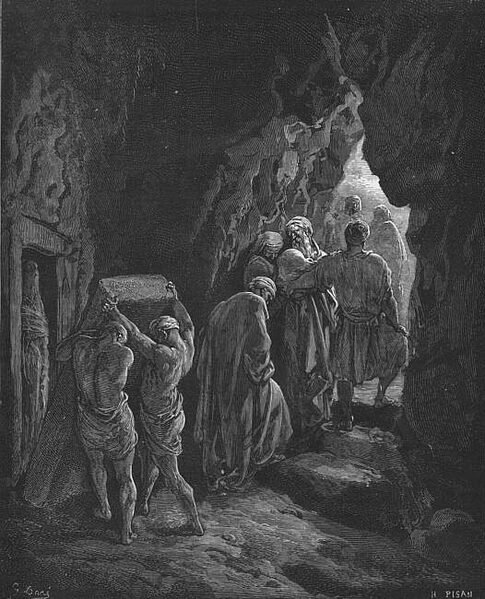
A woodcut by French painter Gustave Doré illustrating Sarah’s burial in the cave.
Biblical Narrative and Extra-Biblical Parallels
Genesis 23 recounts Abraham negotiating with Ephron the Hittite to buy the cave for 400 silver shekels, making it the first recorded land transaction in the Bible. The site later became the burial place of Abraham, Isaac, Jacob, and their wives, except for Rachel, who was buried in Bethlehem.
Ugaritic texts (13th–12th century BCE) record land purchases at a price of 400 silver shekels, suggesting a common valuation method in the region.
Archaeological Findings
In 1981, pottery fragments from the 8th century BCE were discovered in the caves, indicating that the site was venerated in the Iron Age. Excavations have yet to confirm the presence of biblical patriarchs’ remains, but the site remains a crucial religious landmark.
Religious Significance
The site is the second holiest place in Judaism after the Temple Mount. Jewish tradition holds that Adam and Eve are also buried here, and the cave serves as a gateway to the Garden of Eden. The Zohar states that the patriarchs pray for the Jewish people from within the cave.
Muslims regard the site as the burial place of Abraham, an important prophet in Islam. The mosque remains an active place of worship, and Islamic traditions associate it with divine blessings and pilgrimage.
The site is significant in Christian tradition as the burial place of biblical patriarchs, figures revered in both the Old and New Testaments. The Byzantines built a church here, reinforcing its sacred status in early Christianity.
Structure and Architecture
The rectangular enclosure features massive Herodian stone walls. The complex is divided into two sections:
- Northwestern side: Houses cenotaphs of Abraham, Sarah, Jacob, and Leah.
- Southeastern side: Includes cenotaphs of Isaac and Rebecca, along with a mihrab for Muslim worship.
The caves remain largely inaccessible. In 1119, a monk reported finding bones within them. In 1967, an Israeli girl explored a shaft leading to the chamber, but found no conclusive evidence of burials.
UNESCO Designation and Israeli Response
In 2010, Israel included the site in its national heritage preservation plan, sparking international controversy. In 2017, UNESCO declared it a Palestinian World Heritage Site, a decision condemned by Israel.
Religious Access and Security Measures
Israeli forces control entry to the site, restricting Muslim and Jewish worship on specific days. Palestinian access is tightly regulated, with road closures and checkpoints in place.
Frequently Asked Questions
Why is the Cave of the Patriarchs significant in Judaism, Christianity, and Islam?
In Judaism, it is the burial place of the patriarchs and matriarchs. In Christianity, it is connected to Abraham, a central biblical figure. In Islam, it is called the Sanctuary of Abraham and is believed to be visited by Prophet Muhammad during his night journey.
Who built the current structure over the cave?
Herod the Great built the large rectangular enclosure over the cave in the 1st century BCE. It is the only fully intact Herodian structure remaining today.
How did control of the site change over history?
The site was a Byzantine church, later converted into a mosque during Islamic rule. The Crusaders turned it back into a church, but Saladin restored it as a mosque in 1188. After Israel occupied Hebron in 1967, part of the mosque was designated for Jewish worship.
What is the significance of the 1994 massacre at the site?
Baruch Goldstein, an Israeli settler, opened fire on Muslim worshippers during Ramadan, killing 29 people and injuring over 125. The massacre led to increased tensions and security measures.
What does the name “Machpelah” mean?
The name “Machpelah” may mean “double” or “twofold,” referring to either a double cave or the burial of couples (Adam and Eve, Abraham and Sarah, Isaac and Rebekah, Jacob and Leah).
Why do some historians doubt the biblical burial tradition?
Many scholars believe the patriarchal narratives are largely mythological, with no archaeological evidence confirming the burial of Abraham and his descendants at the site.
What restrictions exist today at the site?
Under the current arrangement, Muslims control most of the complex, while Jews are limited to a smaller section. Access is strictly controlled by Israeli security forces, and tensions remain high.





