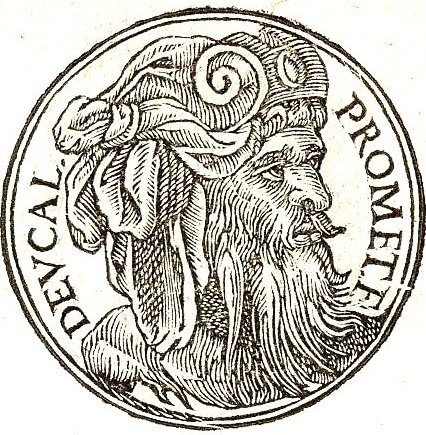
Deucalion, as depicted in the Promptuarium Iconum Insigniorum.
Let’s kick things off by introducing Deucalion, one of Greek mythology’s most enduring figures. He wasn’t a mighty warrior like Achilles or a cunning trickster like Odysseus. Instead, Deucalion is best known as the man who survived a massive flood—an ancient tale with echoes across many cultures. According to the myths, he was the son of Prometheus, the Titan famous for giving fire to humanity. His mother’s identity varies depending on the source—sometimes she’s Clymene, other times Hesione or Pronoia. But it’s his actions, not just his family tree, that earn him a spot among the greats in mythological storytelling.
What’s in a Name?
Deucalion’s name, while it might sound like a fancy spell from a Harry Potter book, actually has roots in Greek words. Some scholars say it might come from deukos, a version of gleukos, meaning “sweet new wine” or “must.” That’s fitting, in a way, given how wine often symbolizes celebration and new beginnings—both of which tie into Deucalion’s story. Another linguistic theory suggests a link to halieus, meaning “sailor” or “fisherman,” which makes sense, given how water becomes such a central theme in his legend.
His wife, Pyrrha, also has a name that paints a vivid picture. It comes from pyrrhós, which means “flame-colored” or “orange.” That fiery imagery contrasts nicely with all the water in their story, doesn’t it?
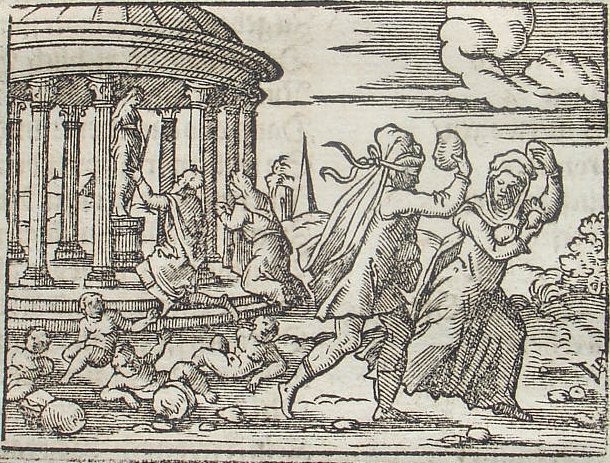
A 1562 edition of Ovid’s “Metamorphoses” depicting Deucalion and Pyrrha.
Deucalion’s Roots and Royal Life
Deucalion hailed from Haemonia, an ancient name for Thessaly in northern Greece. According to the Argonautica, Prometheus fathered Deucalion there, and Deucalion would go on to found cities, build temples, and even rule over humans. He wasn’t just a flood survivor; he was seen as a culture-bringer, someone who shaped early civilization.
Deucalion was the son of the Titan Prometheus, known primarily for surviving a great flood sent by Zeus. He and his wife Pyrrha are mythological ancestors of the Greek people.
Deucalion and Pyrrha had a sizeable family, depending on which version of the myth you consult. Most consistently mentioned is their son Hellen—not to be confused with Helen of Troy. Hellen is actually the legendary ancestor of the Hellenes, or Greeks. Other sources name daughters like Protogeneia, Pandora, and Thyia. Some say he had sons like Amphictyon, Orestheus, and Pronous. In one version, Deucalion also fathered a child named Candybus, who allegedly gave his name to the Lycian town of Candyba.
The Great Flood: A Greek Version
Now to the heart of Deucalion’s myth—the flood. The story begins with Zeus, the king of the gods, getting absolutely fed up with human wickedness. In particular, a king named Lycaon tried to test Zeus’s divinity by serving him a dish made from human flesh. Needless to say, Zeus wasn’t amused. As punishment, he decided to wipe out the human race with a deluge—a literal washing away of the sins of mankind.
Prometheus, ever the helpful Titan, warned his son about the coming disaster. Deucalion acted quickly. Instead of building a massive ship like Noah or a reed boat like Utnapishtim from Mesopotamian lore, he fashioned a large wooden chest. He and Pyrrha climbed inside with enough provisions to survive.
The flood came and lasted for nine days and nights. Everything was submerged: mountains, villages, coastlines—you name it. Eventually, the chest came to rest on a mountaintop. Different accounts name different peaks—Mount Parnassus is the most popular, but some say it was Mount Etna in Sicily or Mount Othrys in Thessaly. Either way, the couple emerged to find they were alone in a brand-new world.
Re-Populating the Earth… with Stones?
Here comes one of the most poetic bits of the myth. Deucalion and Pyrrha, standing in a washed-out world, wanted to know how they could bring humanity back. So they visited an oracle—Themis in some versions—who gave them a rather cryptic message: “Cover your heads and throw the bones of your mother behind your shoulders.”
Now, this wasn’t some bizarre archaeological ritual. The pair eventually interpreted “mother” as Gaia, the Earth, and her “bones” as rocks. So, they picked up stones and tossed them over their shoulders. Magically, the stones thrown by Deucalion became men, and those thrown by Pyrrha became women. This moment essentially reboots the human race, in the most metaphorically rich way imaginable.
Deucalion and Pyrrha don’t just repopulate the earth—they give rise to the future of the Greek people, the Hellenes. That’s a pretty lofty role for a guy who started out as the son of a rebellious Titan.
Regional Variations: Different Takes on Deucalion
As with most Greek myths, there’s no single “canon” version of the Deucalion story. Different ancient authors filled in gaps or tweaked details according to their regional traditions or philosophical interests.
Lucian, for example, wrote about a version where Deucalion brought animals and even his children aboard the chest—something more in line with the biblical Noah. He also described a temple in what’s now Syria, built to commemorate where the floodwaters supposedly drained into the earth. Pilgrims would visit, bringing seawater as offerings. It’s an intriguing example of cross-cultural myth-sharing.
Then there’s Dionysius of Halicarnassus, who doesn’t even mention a flood. For him, Deucalion is more of a military leader who drove invaders from Thessaly. Hecataeus of Miletus, one of the earliest Greek historians, didn’t mention the flood either. His surviving references to Deucalion focus more on genealogical ties, especially with kings like Orestheus.
Pausanias, the ancient travel writer, claimed that Deucalion settled in Locris after the flood and was buried near Athens. Some even say he founded the sanctuary of Olympian Zeus during his stay in the city.
A Mosaic of Myths
Over the centuries, storytellers added more and more elements to the Deucalion myth, borrowing from other traditions. The 19th-century scholar John Lemprière noted how details from the Noah story—sending out birds, rescuing animals—found their way into later versions of the Deucalion tale. But interestingly, all of these themes appear even earlier in the Epic of Gilgamesh from Mesopotamia, which predates the Greek and Hebrew texts.
So, did the Greeks borrow from the Mesopotamians? Or did similar myths spring up independently in different cultures, inspired by real floods or shared human anxieties? We may never know for sure, but what’s clear is that these stories evolve as cultures interact, absorb, and reinterpret the tales they inherit.
Was Deucalion a Real Person?
During the Middle Ages, some Christian scholars treated Deucalion almost like a historical figure. They thought his flood might’ve been a local version of the biblical flood, occurring a few centuries after Noah’s. Based on an ancient timeline known as the Parian Chronicle, Deucalion’s flood was dated to around 1528 BCE. Church fathers like Augustine and Clement of Alexandria even tried to fit Deucalion into their biblical timelines, seeing him as a contemporary of Moses or placing his flood near the time of the mythological burning of Phaethon.
Of course, today we see Deucalion as a mythological figure, but that hasn’t stopped people from continuing to explore the story’s symbolic power or its possible connections to ancient natural disasters.
Ultimately, Deucalion’s story isn’t just about surviving a flood. It’s about rebirth, resilience, and how humans can rebuild even after total devastation.
Frequently Asked Questions
What is the origin of Deucalion’s name?
His name is linked to Greek words for “sweet wine” (deukos) and “sailor” (halieus), symbolizing sweetness and survival through water.
Who was Deucalion’s wife, and what does her name mean?
His wife was Pyrrha, daughter of Epimetheus. Her name means “flame-colored” or “orange,” reflecting her vivid presence in the myth.
Why did Zeus send a flood in Deucalion’s time?
Zeus was enraged by humanity’s wickedness, especially the sacrilegious acts of King Lycaon, and chose to cleanse the world through a devastating flood.
How did Deucalion and Pyrrha survive the flood?
Warned by Prometheus, Deucalion built a large wooden chest. He and Pyrrha survived by riding it through the flood, which lasted nine days and nights.
How was humanity repopulated after the flood?
An oracle told them to throw the “bones of their mother” behind them. Interpreting this as rocks (bones of Gaia, the Earth), they did so, and the stones became new humans.
Where did their chest land after the flood?
Different versions mention Mount Parnassus, Mount Etna, or other peaks, but all agree that they landed safely on a mountaintop after the waters receded.
What is the significance of Deucalion’s myth in broader tradition?
His story parallels other ancient flood myths, such as those of Noah and Gilgamesh, highlighting common themes of destruction, renewal, and divine judgment across cultures.





