Prometheus and the Creation of Man from Clay
In the vast and intricate tapestry of Greek mythology, the story of Prometheus stands out as one of profound significance, shedding light on humanity’s origins and the consequences of defying divine will. A titan known for his cunning and compassion towards mankind, Prometheus played a pivotal role in the creation of humans and, subsequently, in the progression of civilization.

Creation of humanity by Prometheus
Origins of Prometheus

Prometheus (1909) by Otto Greiner
Prometheus was one of the Titans, a primordial generation of deities that predated the Olympian gods. These Titans, the children of Uranus (Sky) and Gaia (Earth), once ruled the cosmos. However, they were overthrown by their own offspring, the Olympian gods, led by Zeus, after a protracted conflict known as the Titanomachy.
Despite being a Titan, Prometheus sided with Zeus and the Olympians during this war. He was renowned for his intelligence and foresight (in fact, his name means “forethought” in Greek). Recognizing the futility of the Titans’ resistance against the younger and more powerful Olympians, Prometheus strategically chose to support Zeus, ensuring his favor and freedom after the Titans’ defeat.
Creation of Man

Prometheus watches Athena endow his creation with reason (painting by Christian Griepenkerl, 1877)
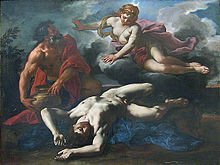
After the establishment of the Olympian order, Prometheus turned his attention to a new project: the creation of man. According to ancient sources, he shaped the first humans from clay, blending earth with water. Every figure he sculpted was crafted in the image of the gods, an imitation of their form but without their divine essence.
This act of creation wasn’t merely an artistic endeavor. Prometheus, in his wisdom, recognized the need for beings to populate the Earth, creatures capable of reverence towards the gods and of cultivating the world around them. These clay figures, once lifeless, were infused with breath, either by Prometheus or by the goddess Athena, depending on the version of the myth, and thus man was born.

Gifts to Mankind
But the creation of their physical form was only the beginning of Prometheus’s gifts to humanity. He also took it upon himself to ensure that these new beings had the knowledge and tools necessary for their survival and prosperity. He taught them architecture, astronomy, mathematics, navigation, medicine, and various other arts and sciences, transforming them from mere animated figures to a thriving civilization.
The Theft of Fire

Prometheus Brings Fire by Heinrich Friedrich Füger. Prometheus brings fire to mankind as told by Hesiod, with its having been hidden as revenge for the trick at Mecone.
However, there was one crucial element that man lacked: fire. This vital element, the symbol of knowledge, warmth, and civilization, was exclusive to the gods. Prometheus, realizing that fire’s transformative power could elevate humans even further, made the audacious decision to steal it.
In an act of defiance against Zeus’s will, he climbed Mount Olympus, lit a torch from the Sun or, in some versions, from the forge of Hephaestus, and brought it down to Earth. With fire, mankind could now fend off the cold, forge tools, cook food, and perform countless other tasks that would propel their advancement.

Zeus’s Wrath and the Punishment of Prometheus
Zeus, already wary of Prometheus’s cleverness and his fondness for humans, was incensed by this theft. As a punishment for humans, he ordered the creation of Pandora, the first woman, endowed with beauty and gifts from every Olympian god but also bringing with her a jar containing all the world’s evils. When the jar (often mistakenly called “Pandora’s Box”) was opened, hardships and sufferings were unleashed upon mankind, leaving only hope inside.
Prometheus’s personal punishment was even more severe. He was chained to a mountain in the Caucasus region, where every day an eagle, a symbol of Zeus’s power, would descend to feast upon his liver. Being an immortal, Prometheus’s liver would regenerate each night, only to be consumed again the next day. This torment was meant to last for eternity.

Image: A 17th century panting by Italian artist Salvator Rosa titled “The Torture of Prometheus”.
Prometheus’s Legacy and Liberation
However, Prometheus’s suffering was not eternal. Many years later, the Greek hero Heracles (Hercules in Roman myths) would come across the chained Titan during one of his labors. Moved by his plight, Heracles slew the eagle and set Prometheus free.
Prometheus’s story, especially his creation of man from clay and his theft of fire, underscores themes of ingenuity, defiance, sacrifice, and resilience. Through his actions, mankind was both elevated and cursed, receiving the boon of knowledge and civilization, but also enduring the wrath of the gods. The myth serves as a powerful reflection on the boundaries of divine and human realms, and the consequences of challenging the established order.

Image: Heracles freeing Prometheus from his torment by the eagle (Attic black-figure cup, c. 500 BC)