Abu Bakr: The First Caliph and Father-in-Law of the Prophet Muhammad
Abd Allah ibn Abi Quhafa, widely known by his kunya Abu Bakr, stands as a monumental figure in early Islamic history. Born around 573 CE in Mecca, Abu Bakr was not only a close companion and father-in-law of the Prophet Muhammad but also the first caliph of the Islamic community. His life and leadership played a pivotal role in shaping the nascent Muslim community, ensuring its survival, unity, and expansion during its formative years.
Early Life and Background
Abu Bakr was born into the affluent Banu Taym tribe, part of the larger Quraysh tribal confederacy in Mecca. His parents, Abu Quhafa and Umm al-Khayr, provided him with a privileged upbringing, enabling him to receive education and develop a keen interest in poetry and commerce. This early exposure to literacy and trade honed his skills as a successful merchant, a profession that would later support his significant contributions to the Muslim community.
From a young age, Abu Bakr was known for his fondness for camels, a trait that earned him the nickname “Abu Bakr,” meaning “father of the young camel.” This nickname not only reflected his personal interests but also his close ties with the Bedouin tribes, fostering strong relationships that would prove beneficial during the early days of Islam.
An illustrative incident from Abu Bakr’s childhood highlights his innate skepticism towards the prevailing idol worship in Mecca. Left alone to pray, he expressed frustration with the idols’ indifference, ultimately rejecting their divinity. This early rejection of idolatry foreshadowed his later embrace of monotheism and unwavering support for the Prophet Muhammad’s message.

Calligraphic seal of Abu Bakr displayed in Istanbul’s Hagia Sophia.
Conversion to Islam
Abu Bakr’s conversion to Islam marked a significant turning point both in his personal life and for the Muslim community. While historical accounts vary, it is widely acknowledged that Abu Bakr was among the earliest converts, possibly the first free man to embrace Islam openly. His immediate acceptance of the new faith underscored his deep conviction and set a powerful example for others.
Abu Bakr’s journey from a wealthy Meccan merchant to the first caliph underscores his profound dedication to Islam and its foundational values.
Abu Bakr’s commitment to Islam extended beyond personal belief. He actively engaged in propagating the faith, particularly among the Mushrikites (polytheists of Mecca). His persuasive efforts were instrumental in the conversion of several key companions of Muhammad, including Uthman ibn Affan, Al-Zubayr, Talha ibn Ubayd-Allah, and Sa’d ibn Abi Waqqas. By leveraging his social standing and eloquence, Abu Bakr played a crucial role in expanding the Muslim community during its vulnerable early stages.
Companion of the Prophet Muhammad
Abu Bakr’s dedication to Islam was epitomized by his unwavering companionship with the Prophet Muhammad. His support was evident in both spiritual and practical aspects of the Prophet’s mission.
The Hijra: Migration to Medina
One of the most significant events in Islamic history, the Hijra, saw Abu Bakr accompany Muhammad from Mecca to Medina. Facing intense persecution, the migration was a perilous journey that underscored the Prophet’s need for support. Abu Bakr’s role as a bodyguard and trusted advisor during this critical period highlighted his steadfastness and loyalty.
Participation in Military Campaigns
Abu Bakr actively participated in all of Muhammad’s military campaigns, demonstrating his valor and strategic acumen. Notably, during the Battle of Badr, he stood as a steadfast protector of Muhammad’s tent, playing a crucial role in the Muslim victory. Similarly, in the Battle of Uhud, Abu Bakr sustained injuries while defending the Muslim community, showcasing his commitment to the cause despite personal risk.
Leadership Roles
Beyond his military involvement, Abu Bakr assumed important leadership roles. In 631 CE, he served as the first amir al-hajj (leader of the pilgrimage), overseeing the Hajj pilgrimage and ensuring its successful execution. Additionally, he took on the responsibility of leading prayers in Muhammad’s absence, further cementing his position as a trusted leader within the community.
The First Caliphate
Following the death of Prophet Muhammad in 632 CE, the Muslim community faced the daunting task of selecting a new leader. The ensuing discussions culminated in Abu Bakr’s election as the first caliph, marking the beginning of the Rashidun Caliphate.
The initial gathering at Saqifa saw key figures like Umar ibn al-Khattab and Abu Ubaidah ibn al-Jarrah supporting Abu Bakr’s candidacy. Despite opposition from figures such as Ali ibn Abi Talib and segments of the Ansar (the local inhabitants of Medina), Abu Bakr was unanimously elected. His election was a testament to his respected status and the trust placed in him by the Muslim community.
Abu Bakr’s ascension to caliphate was immediately tested by the Ridda wars, a series of uprisings by various Arab tribes who either renounced Islam or refused to pay the zakat (alms tax). These rebellions threatened the unity and stability of the newly formed Islamic state.

Image: Calligraphic seal of Umar showcased in Istanbul’s Hagia Sophia.
The Ridda Wars and Consolidation of Power
Nature of the Ridda Wars
The Ridda wars, or “Wars of Apostasy,” were challenges that emerged shortly after Muhammad’s death. Led by various tribal leaders, these uprisings were motivated by both political and religious dissent. Some leaders declared new prophethood, while others sought to maintain their autonomy and reject the central authority of the caliphate.
Abu Bakr’s Response
Demonstrating remarkable leadership and military acumen, Abu Bakr responded decisively to these challenges. He dispatched capable generals, most notably Khalid ibn al-Walid, to suppress the revolts. Abu Bakr’s strategic approach combined military force with diplomatic efforts, including marriage alliances and incentives to reintegrate rebellious tribes. This multifaceted strategy ensured the swift reassertion of control over the Arabian Peninsula.
Outcome and Impact
By the end of the Ridda wars, Abu Bakr had successfully quelled the rebellions, solidifying the Islamic state’s foundation. His ability to maintain unity and suppress dissent was crucial in preserving the integrity and expansion potential of the Muslim community.
Expansion into Neighboring Empires
With internal stability achieved, Abu Bakr turned his attention outward, initiating military campaigns against the formidable Sasanian and Byzantine empires. These early expeditions were foundational in establishing the trajectory of Islamic expansion.
Initial Campaigns
In 633 CE, under Abu Bakr’s directive, Muslim forces launched incursions into Iraq and Palestine, capturing key towns and laying the groundwork for future conquests. These campaigns capitalized on the exhaustion and vulnerability of the neighboring empires, which had been weakened by prolonged conflicts.
Strategic Importance
Abu Bakr’s initiatives against the Sasanian and Byzantine empires were not only military endeavors but also strategic moves to secure the Islamic state against external threats. By initiating these campaigns, Abu Bakr set the stage for the expansive Islamic Empire that would flourish under his successors, ensuring the Muslim community’s influence extended well beyond the Arabian Peninsula.
Legacy of Expansion
Although Abu Bakr did not live to witness the full extent of these conquests, his foresight and strategic planning were instrumental in the subsequent military successes. His actions ensured that the Islamic state was well-positioned for rapid expansion and effective governance, laying a robust foundation for the future caliphs.
Preservation of the Quran
A cornerstone of Abu Bakr’s legacy is his pivotal role in preserving the Quran, the holy scripture of Islam. This effort was crucial in ensuring the continuity and integrity of the Muslim faith.
The Battle of Yamama
In 632 CE, the Battle of Yamama resulted in the deaths of many Quran memorizers, threatening the preservation of the Quranic text. Umar ibn al-Khattab recognized the peril of losing these sacred verses and urged Abu Bakr to take action.
Compilation of the Quran
Initially hesitant, Abu Bakr eventually entrusted Zayd ibn Thabit, a trusted scribe of Muhammad, with the task of compiling the Quran into a single written volume. Zayd meticulously gathered Quranic fragments from various sources, including palm ribs, leather scraps, and stone tablets. These fragments were verified against the memories of Quran memorizers to ensure accuracy.
Creation of the Mus’haf
The resulting compilation, known as the Mus’haf, was presented to Abu Bakr and later passed on to his successor, Umar ibn al-Khattab. This Mus’haf formed the basis for the standardized Quranic text under Caliph Uthman ibn Affan, ensuring the Quran’s preservation and uniformity across the Muslim world.
Succession and Death
Nomination of Umar as Successor
Aware of the potential for leadership disputes, Abu Bakr took proactive steps to ensure a smooth transition of power. Recognizing the growing support and leadership qualities of Umar ibn al-Khattab, he nominated Umar as his successor before his death. This decision aimed to maintain stability and continuity within the Muslim community.
Final Days and Passing
Abu Bakr’s illness in 634 CE led to his passing after a brief but impactful reign of just over two years. His death marked the end of a foundational chapter in Islamic history, leaving behind a unified Arabian Peninsula and a robust framework for future expansion. His funeral was led by Umar, who succeeded him as the second caliph, continuing the legacy of strong and effective leadership.
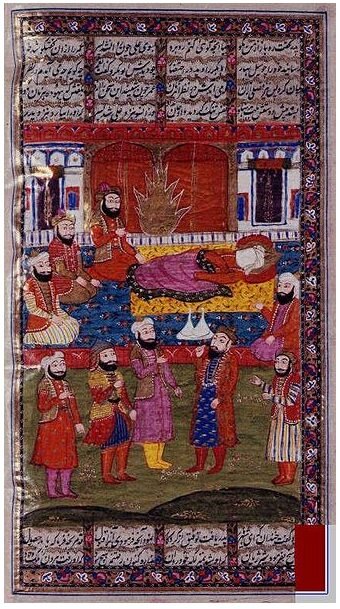
Image: a painting depicting Abu Bakr on his death bed.
Major Works and Contributions
Abu Bakr’s tenure as caliph, though short, was marked by significant achievements that had a lasting impact on the Muslim world.
Military Campaigns and Expansion
Abu Bakr’s initiation of military campaigns against the Sasanian and Byzantine empires set the stage for the expansive Islamic conquests that followed. His strategic foresight ensured that the Islamic state was prepared for external threats, facilitating rapid expansion under his successors.
Preservation of Islamic Texts
His crucial role in preserving the Quran ensured that the Muslim community retained a unified and authentic scripture. This preservation was vital for maintaining the doctrinal integrity of Islam and guiding future generations.
Establishment of Al-Masjid an-Nabawi
Beyond military and religious contributions, Abu Bakr supported the establishment of Al-Masjid an-Nabawi in Medina. This mosque became a central place of worship and community gathering, fostering unity and cohesion among Muslims.
Social Justice and Compassion
Abu Bakr’s commitment to social justice was evident in his actions to free slaves and advocate for their rights. His efforts in freeing slaves, including notable figures like Bilal ibn Rabah, reflected his dedication to Islamic ethics and compassion, reinforcing the principles of equality and justice within the Muslim community.
Legacy and Assessments
Abu Bakr’s legacy is multifaceted, encompassing his roles as a companion of the Prophet, a leader, and a preserver of Islamic doctrine. His impact is viewed differently within Sunni and Shia traditions, reflecting broader theological and historical divergences.
Sunni Perspective
Sunni Muslims revere Abu Bakr as the first of the rightly-guided caliphs, celebrating his close companionship with Muhammad, his unwavering faith, and his exemplary leadership. He is considered a model of piety, wisdom, and administrative prowess. Sunni tradition holds that Abu Bakr’s actions during his caliphate ensured the survival and expansion of the Muslim community, solidifying his esteemed position in Islamic history.
Shia Perspective
In contrast, Shia Muslims present a more critical view of Abu Bakr’s succession. They believe that Ali ibn Abi Talib was the rightful successor as appointed by Muhammad, citing events like Ghadir Khumm where Muhammad is believed to have designated Ali as his successor. Shias argue that Abu Bakr’s election at Saqifa deviated from Muhammad’s intentions and view his actions, such as the refusal to grant Fatimah the land of Fadak, as politically motivated against Ali and the Prophet’s family. This perspective underscores the historical and theological tensions between Sunni and Shia interpretations of Islamic leadership.
Broader Influence
Regardless of these differing views, Abu Bakr’s influence on Islamic governance, military strategy, and religious preservation is undeniable. His decisions laid the groundwork for the Rashidun Caliphate’s subsequent expansion and administrative structures, ensuring that the Islamic state was well-equipped to handle internal and external challenges.
Personal Traits and Characteristics
Abu Bakr is often described as modest, humble, kind, merciful, and just. Historical accounts, particularly those by Al-Tabari, depict him as a man of simple appearance but profound inner strength. His lean face, sunken eyes, and slight build contrasted with his strong moral character and leadership abilities. His demeanor was marked by compassion and a strong sense of justice, traits that endeared him to his contemporaries and earned him lasting respect among future generations of Muslims.
Contributions Beyond Leadership
Beyond his political and military roles, Abu Bakr made significant contributions to the social and religious fabric of the Muslim community.
His support in establishing Al-Masjid an-Nabawi provided a central place of worship and community gathering, fostering unity and cohesion among Muslims in Medina. This institution became a cornerstone of Islamic community life, facilitating religious practices and social interactions.
Abu Bakr’s actions in freeing slaves and advocating for their rights reflected his commitment to social justice and compassion. By purchasing and freeing slaves, he demonstrated the Islamic principles of equality and mercy, reinforcing the ethical foundations of the Muslim community.
Abu Bakr’s strategic acumen, combined with his personal virtues, enabled him to steer the Muslim community through its formative years, ensuring its survival and setting the stage for its future growth.
Abu Bakr’s leadership style and decisions set important precedents for his successors. His emphasis on unity, adherence to Islamic principles, and proactive governance influenced the Rashidun Caliphs who followed, particularly Umar ibn al-Khattab. By laying a strong administrative foundation and initiating key military campaigns, Abu Bakr ensured that the Islamic state was well-positioned for rapid expansion and effective governance.
Influence on Successive Caliphs
Abu Bakr’s tenure as caliph established a model of leadership that his successors would emulate. His ability to navigate internal challenges, engage in strategic military endeavors, and uphold the spiritual tenets of Islam provided a blueprint for effective governance. Caliphs like Umar ibn al-Khattab built upon Abu Bakr’s foundations, expanding the Islamic Empire and refining administrative practices, ensuring the continuity and growth of the Muslim state.
Conclusion
Abu Bakr’s legacy as the first caliph of Islam is enduring and multifaceted. His unwavering support for Muhammad, strategic leadership during tumultuous times, and foundational role in preserving the Quran cement his place as a central figure in Islamic history. While his leadership is celebrated in Sunni traditions as exemplary, Shia perspectives offer a contrasting view centered on issues of rightful succession and political dynamics. Regardless of these differing viewpoints, Abu Bakr’s impact on the early Muslim community and the subsequent trajectory of Islamic civilization remains profoundly significant.
Abu Bakr’s life encapsulates the transition of Islam from a fledgling faith to a formidable socio-political entity. His ability to navigate internal challenges, engage in diplomatic and military endeavors, and uphold the spiritual tenets of Islam exemplifies his comprehensive approach to leadership. As the first Rashidun caliph, his decisions not only preserved the unity of the Muslim community but also laid the groundwork for the expansive Islamic empires that would follow. His commitment to justice, piety, and community welfare continues to inspire Muslims around the world, highlighting his enduring relevance in both historical and contemporary contexts.
Frequently Asked Questions
Who was Abu Bakr and why is he significant in Islamic history?
Abu Bakr, born Abd Allah ibn Abi Quhafa around 573 CE in Mecca, was the first caliph of Islam, ruling from 632 to 634 CE. A close companion and father-in-law of Prophet Muhammad, he played a crucial role in consolidating the Muslim community, suppressing the Ridda wars, initiating military expansions, and preserving the Quran.
How did Abu Bakr earn his kunya “Abu Bakr”?
Abu Bakr earned the kunya “Abu Bakr,” meaning “father of the young camel,” due to his fondness for camels. As a child among Bedouin tribes, he often played with camel calves and goats, which led to this affectionate nickname.
What was Abu Bakr’s role during the Prophet Muhammad’s migration to Medina (Hijra)?
During the Hijra, Abu Bakr accompanied Prophet Muhammad from Mecca to Medina, acting as one of his bodyguards. They took refuge in a cave in Jabal Thawr to escape the Quraysh, with Abu Bakr playing a key role in protecting Muhammad throughout the journey.
How was Abu Bakr chosen as the first caliph after Muhammad’s death?
After Muhammad’s death in 632 CE, Abu Bakr was elected as the first caliph at the gathering in Saqifa. Despite some opposition, including from Ali ibn Abi Talib and certain Ansar members, Abu Bakr was unanimously selected, marking the beginning of the Rashidun Caliphate.
What were the Ridda wars, and how did Abu Bakr address them?
The Ridda wars were a series of uprisings by various Arab tribes who either renounced Islam or refused to pay the zakat (alms tax) after Muhammad’s death. Abu Bakr responded by dispatching capable generals like Khalid ibn al-Walid to suppress these revolts through both military force and diplomatic efforts, successfully reasserting control over the Arabian Peninsula.
What initiatives did Abu Bakr undertake to expand the Islamic state beyond Arabia?
Abu Bakr initiated military campaigns against the Sasanian and Byzantine empires in 633 CE, sending forces into Iraq and Palestine. These early incursions captured key towns and laid the groundwork for the expansive Islamic conquests that would follow under his successors.
How did Abu Bakr contribute to the preservation of the Quran?
After the Battle of Yamama in 632 CE, where many Quran memorizers were killed, Umar ibn al-Khattab urged Abu Bakr to compile the Quran into a written form to prevent its loss. Abu Bakr appointed Zayd ibn Thabit to gather and verify the Quranic verses, resulting in the Mus’haf, which became the foundation for the standardized Quranic text under Caliph Uthman ibn Affan.
Who did Abu Bakr nominate as his successor, and why?
Aware of potential leadership disputes, Abu Bakr nominated Umar ibn al-Khattab as his successor before his death. Recognizing Umar’s growing support and leadership qualities, Abu Bakr sought to ensure a smooth transition and continued stability for the Muslim community.
How is Abu Bakr viewed differently by Sunni and Shia Muslims?
Sunni Muslims revere Abu Bakr as the first of the rightly-guided caliphs, celebrating his close companionship with Muhammad and his leadership qualities. In contrast, Shia Muslims criticize his succession, believing that Ali ibn Abi Talib was the rightful successor as appointed by Muhammad. Shias also view some of Abu Bakr’s actions, such as the refusal to grant Fatimah the land of Fadak, as politically motivated against Ali and the Prophet’s family.
What were some of Abu Bakr’s personal traits and contributions beyond his political and military roles?
Abu Bakr was known for his modesty, humility, kindness, mercy, and strong sense of justice. Beyond his political and military achievements, he supported the establishment of Al-Masjid an-Nabawi in Medina, freed slaves, and advocated for social justice and compassion, reflecting his commitment to Islamic ethics and community welfare.





