Agnodice: History, Midwifery, and Major Accomplishments
Agnodice is a legendary figure in the history of medicine, traditionally regarded as the first female midwife or physician in ancient Athens. Her story, originating from the Roman author Gaius Julius Hyginus in the Fabulae, has been widely referenced in discussions about gender roles in medical professions. While there is little historical evidence supporting her existence, Agnodice’s tale has influenced narratives about women’s struggles and achievements in medicine.
Below, World History Edu explores her life story, the controversy surrounding her historicity, and her impact on medical history.
Agnodice’s Story and Her Medical Training
According to Fabulae, Agnodice lived in ancient Athens at a time when women were prohibited from practicing medicine. Undeterred by these restrictions, she disguised herself as a man, cutting her hair short and adopting male attire to study medicine under the renowned physician Herophilus in Alexandria.
Herophilus was a significant figure in early medical history, particularly in the fields of anatomy and gynecology. Under his tutelage, Agnodice acquired extensive medical knowledge, preparing herself to serve the women of Athens who were reluctant to seek treatment from male physicians.
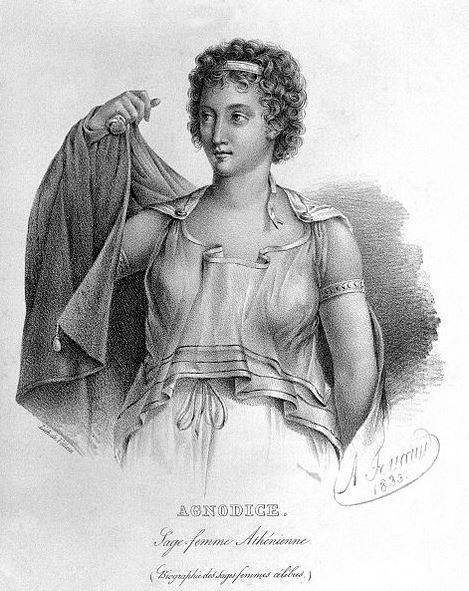
Agnodice, disguised as a male physician, is depicted here not revealing her identity by lifting her tunic but instead parting her outer garment to expose her feminine form.
The legend of Agnodice (Greek: Ἀγνοδῐκη) provides a fascinating glimpse into the historical challenges faced by women in medicine.
Upon returning to Athens, Agnodice continued her deception, presenting herself as a male doctor. Her reputation for successfully treating female patients grew rapidly, as women, trusting her, sought her expertise without fear or hesitation.
The demand for her services soon aroused suspicion among male physicians, who accused her of seducing her patients. This accusation led to her arrest and trial before the Areopagus, the supreme tribunal of Athens.
Trial and Legal Repercussions
During her trial, Agnodice faced serious allegations of violating Athenian law by practicing medicine as a woman. In a dramatic gesture known as anasyrma, she lifted her tunic, revealing her true gender. This revelation shocked the court, as it not only disproved the accusations of seduction but also highlighted the gender-based restrictions in medicine.
Athenian lawmakers were initially inclined to punish Agnodice for practicing medicine illegally. However, a group of influential Athenian women whom she had treated came to her defense. They argued that her medical practice had been essential in saving lives and improving the well-being of women who would otherwise suffer due to the restrictions imposed on female practitioners.
Ultimately, the women’s advocacy led to a significant change in Athenian law. The authorities repealed the prohibition on female physicians, allowing women to practice medicine legally. This legal shift marked a pivotal moment in the history of gender inclusion in medicine, though the extent to which it had a lasting impact on medical practice in Athens remains a matter of debate.
The Question of Agnodice’s Historicity
Despite the compelling nature of her story, modern scholars question whether Agnodice was a real historical figure. The primary issue is the lack of corroborating evidence outside Hyginus’ Fabulae. No Greek or Roman medical texts mention Agnodice, nor is there any archaeological or epigraphic evidence supporting her existence.
Given that Fabulae is largely a collection of myths and fictional tales, many historians consider Agnodice’s story to be more symbolic than factual.
One major point of contention is Hyginus’ claim that there were no midwives (obstetrices) in Athens before Agnodice. This assertion is highly unlikely, as historical and literary sources indicate that midwifery existed in ancient Greece long before the fourth century BCE. The roles of midwives were well documented, with references in works by Hippocrates, Plato, and Aristophanes.
Additionally, the claim that Herophilus trained Agnodice also raises questions. Herophilus lived in the late fourth to early third century BCE and conducted his medical studies in Alexandria, not Athens. If Agnodice was truly his student, she would have needed to travel to Egypt for her education, which is not mentioned in the legend.
Symbolism and Cultural Parallels
Many scholars argue that Agnodice’s story follows a common mythological pattern rather than reflecting a historical reality. The act of a woman disguising herself as a man to enter a forbidden profession appears in numerous ancient narratives.
In Greek mythology, Procris disguised herself as a man to gain Cephalus’ trust, while in historical accounts, female warriors like the Amazons adopted male roles in combat. Agnodice’s act of lifting her tunic is also a recurring motif in Greco-Roman traditions, appearing in myths such as the Lycian women lifting their skirts in Plutarch’s account of the hero Bellerophon.
READ MORE: Major Challenges Women Faced in Greek Mythology
A particularly notable parallel is found in the legend of Saint Eugenia, an early Christian martyr who, like Agnodice, disguised herself as a man to practice medicine. Both stories involve themes of deception, gender barriers, accusations of seduction, and eventual revelation of true identity. This suggests that Agnodice’s story may have been a didactic tale illustrating broader themes of gender and professional access rather than a historical account of a real individual.
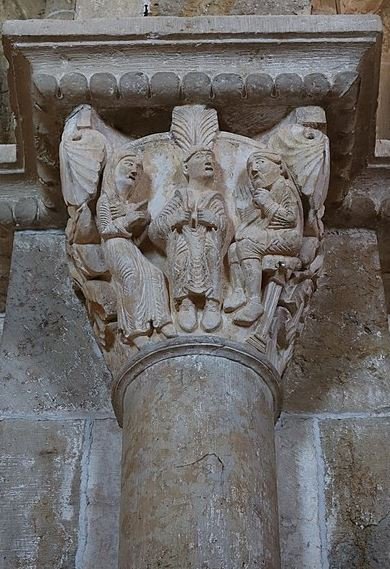
Saint Eugenia Unveiling Her True Identity Before the Judge.
While the lack of corroborating evidence makes it unlikely that Agnodice was a real historical figure, her story remains influential in shaping discussions about gender roles in medical practice.
Agnodice’s Influence on Women in Medicine
Regardless of her historical authenticity, Agnodice’s story has had a profound influence on the discourse surrounding women in medicine.
During the Renaissance and Enlightenment periods, when debates over women’s roles in medical practice intensified, her story was frequently invoked as a precedent for female physicians and midwives.
In the seventeenth century, Elizabeth Cellier, a famous English midwife known as the “Popish midwife,” compared herself to Agnodice when advocating for the professional recognition of female midwives.
During the eighteenth and nineteenth centuries, when men increasingly dominated obstetrics, Agnodice was used both as an argument for and against women’s involvement in medicine.
Some reformers cited her story as evidence that women had historically contributed to medicine and should be allowed to continue doing so.
Others, such as Augustus Kinsley Gardner in 1851, dismissed the legend, claiming that midwifery had made no progress under female practitioners and using Agnodice as an example of why men should control the field.
Agnodice’s tale symbolizes the struggles and triumphs of women who sought to practice medicine despite societal restrictions.
In more recent times, Agnodice has been embraced as a feminist icon. Her story is often referenced in discussions about gender discrimination in medicine, serving as a symbol of women’s perseverance in breaking professional barriers. Whether or not she was a real person, her legacy continues to inspire debates on gender equality in healthcare.
A brief history of Ancient Athens and how it became the birthplace of Western Civilization
Frequently Asked Questions
Why did Agnodice disguise herself as a man?
Athenian laws prohibited women from practicing medicine, so she disguised herself to study under Herophilus and treat female patients.
How did Agnodice prove her identity during her trial?
She lifted her tunic in a gesture known as anasyrma, revealing she was a woman to refute accusations of seduction.
What was the outcome of Agnodice’s trial?
She was acquitted after Athenian women defended her, leading to a legal change allowing women to practice medicine.
Is Agnodice considered a historical figure?
Modern scholars doubt her historicity, as her story comes from a single source, Fabulae, and lacks corroborating evidence.
What parallels exist between Agnodice’s story and other myths?
Her story shares elements with myths like those of Procris and Cephalus, as well as Saint Eugenia, who also disguised herself as a man.
How has Agnodice’s story influenced women in medicine?
Since the 16th century, her legend has been cited to support women’s entry into the medical profession, though some have used it to argue against female midwives.
What role did Agnodice’s teacher, Herophilus, play in her story?
Herophilus, a renowned physician, is said to have trained Agnodice, though it is debated whether he was the famous Herophilus of Chalcedon.





