Amalienborg: The royal palace of Copenhagen
Amalienborg, located in Copenhagen, Denmark, serves as the official residence of the Danish royal family. The complex, known for its harmonious design, comprises four identical palaces with Classical façades and Rococo interiors, arranged symmetrically around an octagonal courtyard called Amalienborg Slotsplads. At the center of this courtyard stands an equestrian statue of King Frederik V. Initially built for noble families, the palaces became the royal residence after Christiansborg Palace burned down in 1794. Over time, it has housed numerous monarchs, including King Frederik X and Queen Mary.
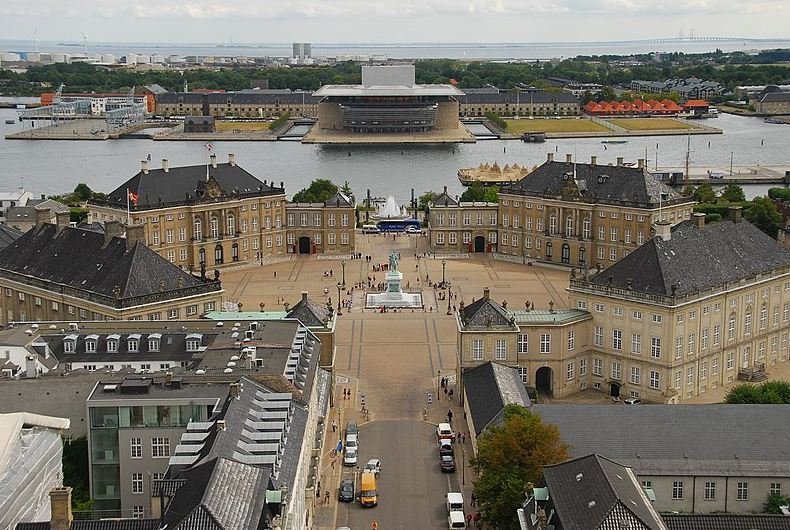
A view of the various palaces of Amalienborg.
Historical Foundations
The history of Amalienborg begins with Sophie Amalienborg, a palace constructed by Queen Sophie Amalie, consort to King Frederick III. Built on land acquired by Christian IV outside the old walled city of Copenhagen in the early 17th century, this palace included gardens and a replacement for the “Queen’s Garden,” destroyed during the 1659 Swedish siege.
Completed in 1673, Sophie Amalienborg stood as a grand residence until it tragically burned down in 1689 during an opera performance celebrating King Christian V’s birthday. The fire, which started from a stage decoration, led to significant loss of life and marked the end of this palace’s era. Efforts to rebuild were abandoned, and the remaining structures were repurposed for other projects, including a garrison church.
King Frederick IV constructed a new palace on the site, featuring a summerhouse, orangeries, and French-style gardens. This structure served as a precursor to the grandeur that would come with the Frederiksstaden district under Frederick V.
The Development of Frederiksstaden
Frederiksstaden, the district surrounding Amalienborg, was established by King Frederick V to celebrate two major events: the Oldenburg family’s 300 years on the Danish throne (1748) and Christian I’s coronation (1749). Spearheaded by architect Nicolai Eigtved, the district featured a grand plan with Amalienborg as its centerpiece.
The design envisioned four identical mansions arranged symmetrically around a central plaza. These were built to house noble families connected to the royal court. Construction began in 1750, and despite Eigtved’s death in 1754, his vision was faithfully executed by Lauritz de Thurah. The four palaces—Christian VII’s Palace, Christian VIII’s Palace, Frederik VIII’s Palace, and Christian IX’s Palace—were completed by 1760, creating the iconic layout seen today.
Transformation into a Royal Residence
Following the devastating Christiansborg Palace fire in 1794, the royal family purchased the four mansions to serve as their new residence. Notable nobles quickly sold the properties, and the palaces were renamed after prominent Danish kings. A colonnade connecting two palaces was added by architect Caspar Frederik Harsdorff, further unifying the complex.
Amalienborg played a significant role during World War II. On April 9, 1940, during the German invasion of Denmark, the palace witnessed a firefight between Danish Royal Life Guards and German forces. The confrontation ended when King Christian X ordered a ceasefire to avoid destruction.
The Four Palaces
Christian VII’s Palace (Moltke’s Palace)
Originally built for Lord High Steward Adam Gottlob Moltke, this southwestern palace is renowned for its luxurious Rococo interiors. Over the years, it has been used for state receptions, entertaining dignitaries, and ceremonial purposes. The palace underwent significant restoration in the late 20th century and occasionally opens to the public.
Christian VIII’s Palace (Levetzau’s Palace)
This northwestern palace was originally constructed for Privy Councillor Christian Frederik Levetzau. Over time, it became the residence of Crown Prince Frederik and later housed several royal family members. Today, it includes a museum showcasing royal apartments and serves as a residence for members of the royal family.
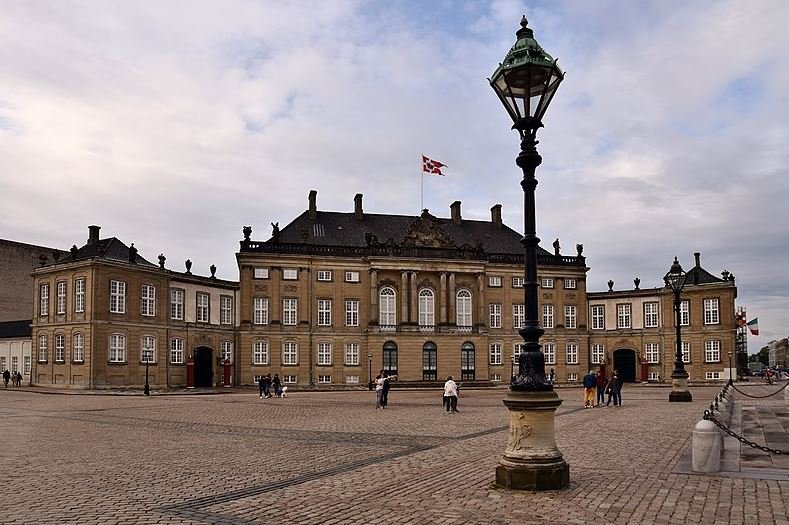
Front view of Christian VIII’s Palace.
Frederik VIII’s Palace (Brockdorff’s Palace)
The northeastern palace was initially built for Count Joachim Brockdorff but became a royal residence in 1765. Renovated multiple times, it served as the home of King Frederik X and Queen Mary. The palace underwent extensive restoration between 2006 and 2010 to accommodate the Crown Prince couple.
Christian IX’s Palace (Schack’s Palace)
The southeastern palace, originally commissioned by Severin Løvenskjold, became the residence of Christian IX in the late 19th century. It served as the primary home of Queen Margrethe II beginning 1967, following significant renovations to modernize the interiors.
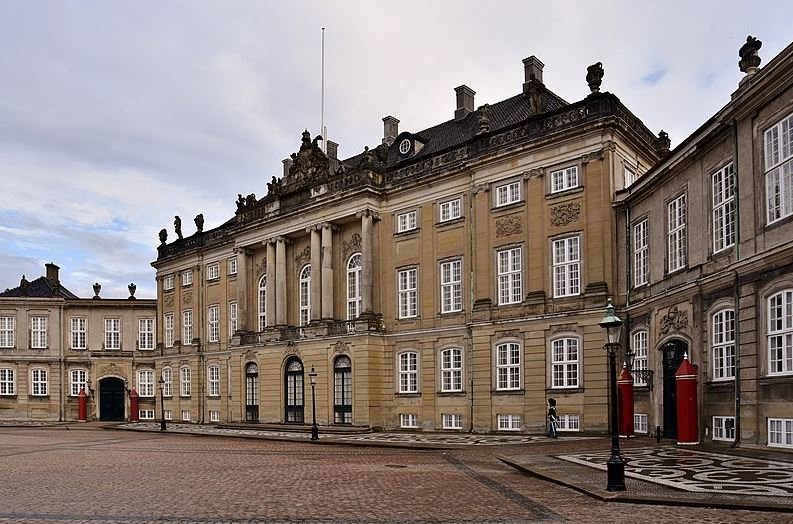
Christian IX’s Palace in 2019.
Key Features of Amalienborg
At the heart of Amalienborg Slotsplads is the iconic equestrian statue of King Frederik V, designed by French sculptor Jacques Saly. Commissioned in 1753, the statue commemorates Denmark’s absolutist monarchy and remains a central focal point of the complex.
Amalienborg is guarded by the Royal Life Guards, whose traditional scarlet uniforms and bearskin caps are reminiscent of the British Foot Guards. The ceremonial changing of the guard occurs daily at noon, drawing visitors from around the world.
With its harmonious design, historical resilience, and ongoing royal presence, Amalienborg remains one of Copenhagen’s most iconic landmarks and a source of national pride.
Adjacent to Amalienborg is Amaliehaven, a modern garden established in 1983. Designed by Belgian architect Jean Delogne and featuring sculptures by Arnaldo Pomodoro, this serene space provides a contrast to the historical grandeur of the palace complex.
Cultural and Historical Significance
Amalienborg is not just a residence but also a symbol of Danish heritage, blending royal tradition with architectural brilliance. From its Rococo interiors to its role in shaping Danish history, the complex represents a continuous thread linking Denmark’s past and present. Visitors can experience this legacy firsthand by exploring the public-access areas and observing the daily royal ceremonies.
Frequently Asked Questions
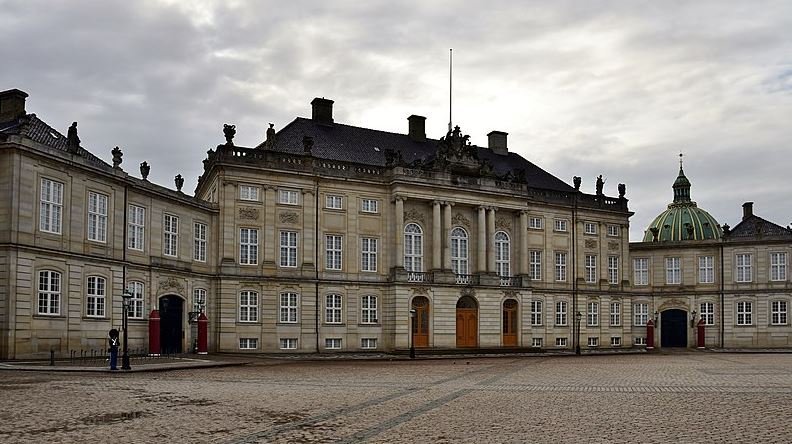
A close view of the Christian VII’s Palace
Who originally built Amalienborg, and for what purpose?
Amalienborg was initially built in the 18th century to house four noble families as part of the Frederiksstaden district, commemorating the Oldenburg family’s rule. It became a royal residence after the Christiansborg Palace fire in 1794.
What are the names of the four palaces at Amalienborg?
The palaces are Christian VII’s Palace (Moltke’s Palace), Christian VIII’s Palace (Levetzau’s Palace), Frederik VIII’s Palace (Brockdorff’s Palace), and Christian IX’s Palace (Schack’s Palace).
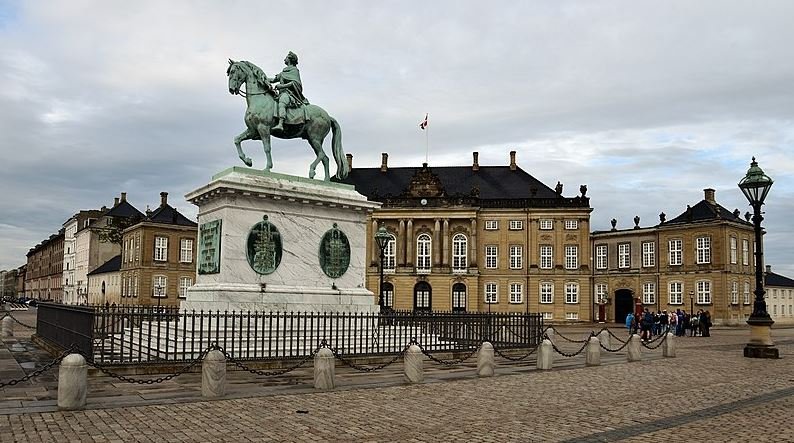
A 2019 photo of Frederik VIII’s Palace.
What is the significance of the equestrian statue in the courtyard?
The equestrian statue of King Frederik V, created by Jacques Saly, symbolizes royal power and absolutism. It was commissioned by Adam Gottlob Moltke and unveiled in 1771.
What is unique about the Royal Life Guards at Amalienborg?
The Royal Life Guards perform daily changing of the guard ceremonies. Their uniforms include scarlet tunics and bearskin caps, and their presence varies based on the residency of the royal family.
What historical events have taken place at Amalienborg?
Amalienborg was the site of a firefight during the German invasion of Denmark in 1940. It also witnessed the transformation of the royal family’s residence after the Christiansborg Palace fire.
What is Amaliehaven?
Amaliehaven is a garden near Amalienborg, established in 1983 as a gift from the A.P. Møller Foundation. It features marble sculptures, a central fountain, and views of the Copenhagen Opera House.





