Ancient Egyptian City of Heliopolis
Heliopolis, known as Iunu in Ancient Egyptian, was a major city in Lower Egypt and a focal point of religious and cultural activity. Located in modern northeastern Cairo, encompassing Ain Shams and El Matareya, it was the capital of the 13th Nome of Lower Egypt. Revered as the “City of the Sun,” Heliopolis played a vital role in shaping Egyptian theology, architecture, and learning. Although most of its structures are lost, its legacy endures through historical accounts and surviving artifacts.
Origins and Early Development
Heliopolis dates back to prehistoric times, making it one of the oldest cities in Egypt. Initially, it grew as a small settlement before expanding into a thriving religious center during the Old and Middle Kingdoms. Its strategic location near the Nile and its role as a religious hub contributed to its prominence.
The Center of Solar Worship
The city was the heart of Egyptian solar worship. It was home to the Great Temple of Ra-Atum, also known as the “House of Atum.” Priests at this temple maintained that Ra-Atum, the sun god, self-created and rose from the primordial waters. Over time, the theology evolved into the Ennead, a group of nine gods centered on Ra-Atum. This doctrine heavily influenced Egyptian cosmology and religious practices.
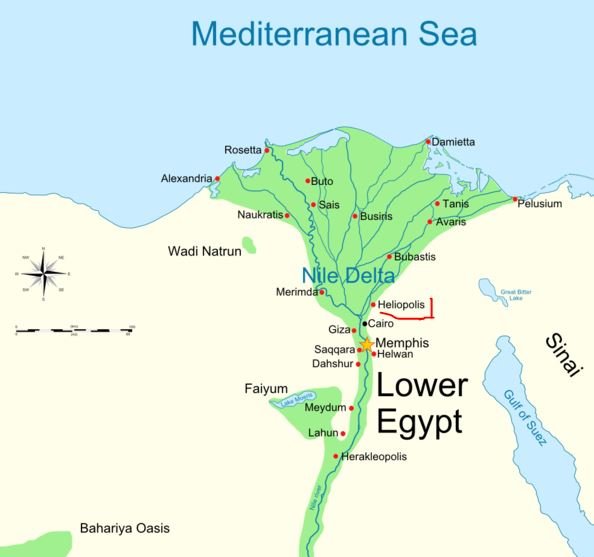
Image: Heliopolis, as seen on the map of Lower Egypt.
Significant Monuments
The most famous relic of Heliopolis is the obelisk of Senusret I, erected during the 12th Dynasty. This red granite obelisk, standing 21 meters tall and weighing 120 tons, is the oldest surviving obelisk in the world. Other obelisks originally from Heliopolis, such as Cleopatra’s Needles in London and New York, and the Obelisk of Montecitorio in Rome, demonstrate its architectural and cultural influence.
Heliopolis in Mythology
Heliopolis played a significant role in Egyptian mythology. It was believed to be the site of creation, where Ra first emerged. The city inspired the myth of the phoenix (bennu bird), which symbolized rebirth and renewal, themes central to the solar cult. Its theological importance resonated across Egypt and beyond.
Role in the New Kingdom
During the New Kingdom, Heliopolis retained its religious prominence. Pharaoh Akhenaten’s shift to Aten worship included constructing a temple named Wetjes Aten (“Elevating Aten”) in Heliopolis. The city was also the center of the Mnevis bull cult, which revered the bull as an earthly representation of the sun. This unique practice further enriched the city’s religious diversity.
Greek and Roman Influence
In the Hellenistic period, Heliopolis became a beacon of learning. It attracted philosophers like Pythagoras and Plato, who studied its astronomy and theology. The city’s priests were highly regarded for their historical and astronomical knowledge, influencing Greek thought. Under Roman rule, Heliopolis transitioned into the province of Augustamnica. However, its prominence waned, overshadowed by Alexandria, the new intellectual and cultural hub.

Image: The Al-Masalla obelisk, a famous monument in Heliopolis.
Decline and Ruins
By the first century BCE, Heliopolis was largely abandoned. Strabo, the Greek geographer, noted its deserted temples and dwindling population. During the Middle Ages, its ruins were scavenged for building materials, contributing to the construction of Cairo’s medieval walls. Today, most of the city lies buried beneath modern neighborhoods, with only a few remnants visible.
Legacy and Archaeological Discoveries
Heliopolis’ influence persists in modern religious and cultural contexts. Its solar worship left a mark on Egyptian and Greco-Roman mythology. Archaeological excavations continue to uncover its treasures, such as tombs and statues. In 2017, parts of a colossal statue of Pharaoh Psamtik I were unearthed, offering further insights into the city’s grandeur.
Frequently Asked Questions

What was Heliopolis known as in Ancient Egyptian?
Heliopolis was called Iunu (𓉺𓏌𓊖), meaning “The Pillars.”
Where was Heliopolis located?
It was situated in the northeastern districts of modern Cairo, including Ain Shams and El Matareya.
Why was Heliopolis significant in ancient Egypt?
Heliopolis was a major religious and cultural hub, serving as the center of solar worship and the capital of the 13th Nome of Lower Egypt.
What is the most iconic surviving relic of Heliopolis?
The obelisk of the Temple of Ra-Atum, erected by Senusret I, which stands 21 meters tall and is the oldest surviving obelisk in the world.
How did Heliopolis influence mythology?
Its solar cult inspired myths such as the phoenix’s resurrection, symbolizing renewal.

Image: Obelisk of Senusret I, another popular monument in Heliopolis.
What role did Heliopolis play in religious history?
It was the center of Ra-Atum worship, where the Ennead, a pantheon of nine gods, was developed.
What did the Greeks call Heliopolis, and why?
The Greeks called it Heliopolis (“City of the Sun”), associating it with their sun god Helios, equated with the Egyptian Ra and Atum.
How did Heliopolis contribute to Greek thought?
Heliopolis was a center of learning visited by Greek philosophers like Plato and Pythagoras, who studied its astronomy and history.
What happened to Heliopolis during the Roman and medieval periods?
Under Roman rule, its obelisks were transported to Rome and other cities. During the Middle Ages, its ruins were scavenged for building materials for Cairo.
What remains of Heliopolis today?
Some remnants, including parts of city walls, the Al-Masalla obelisk, and blocks bearing Ramesses II’s name, survive beneath Cairo’s Al-Matariyyah and Ain Shams neighborhoods.





