Most Famous Artworks from Ancient Egypt
Ancient Egypt’s artistic legacy is one of the most enduring and influential in human history. Spanning over three millennia, Egyptian art is renowned for its remarkable consistency, symbolic depth, and monumental grandeur. The following are ten of the most famous artworks from Ancient Egypt, each exemplifying the civilization’s artistic prowess and cultural significance.
READ MORE: Major Events in the History of Ancient Egypt
The Great Sphinx of Giza
The Great Sphinx of Giza is a colossal limestone statue with the body of a lion and the head of a pharaoh, believed to represent Pharaoh Khafre. Standing at approximately 73 meters (240 feet) long and 20 meters (66 feet) high, it is one of the largest and oldest monumental statues in the world.
Significance
- Symbol of Power: The Sphinx embodies the strength and wisdom of the pharaoh, serving as a guardian of the Giza Plateau and the pyramids.
- Architectural Marvel: Its precise carving from a single block of limestone showcases the advanced engineering and artistic skills of Ancient Egyptian civilization.
- Cultural Icon: The Sphinx has become an enduring symbol of Egypt, representing the mystery and grandeur of its ancient past.

Image: The Great Sphinx of Giza.
The Pyramids of Giza
The Pyramids of Giza, including the Great Pyramid of Khufu, the Pyramid of Khafre, and the Pyramid of Menkaure, are monumental tomb structures built during the Fourth Dynasty of the Old Kingdom. The Great Pyramid is the largest, originally standing at 146.6 meters (481 feet) tall.
Significance
- Architectural Achievement: The pyramids demonstrate the Egyptians’ exceptional knowledge of mathematics, astronomy, and engineering.
- Pharaonic Legacy: They served as grand tombs for pharaohs, reflecting their divine status and ensuring their immortality.
- Cultural Heritage: As one of the Seven Wonders of the Ancient World, the Pyramids of Giza continue to captivate and inspire awe worldwide.

Image: the Pyramid of Giza
The Bust of Nefertiti
The Bust of Nefertiti is a stunning limestone and stucco sculpture dating to around 1345 BC. It depicts Queen Nefertiti, the Great Royal Wife of Pharaoh Akhenaten, with exquisite detail and vibrant colors highlighting her regal beauty.
Significance
- Artistic Excellence: The bust is celebrated for its realistic portrayal and intricate craftsmanship, showcasing the advanced sculptural techniques of the Amarna Period.
- Symbol of Beauty: Nefertiti’s bust epitomizes the idealized beauty standards of Ancient Egypt, emphasizing symmetry and grace.
- Cultural Significance: It serves as a powerful symbol of female royalty and the religious reforms introduced by Akhenaten, reflecting the era’s unique artistic and cultural shifts.

Image: Bust of Nefertiti.
The Mask of Tutankhamun
The funerary mask of Pharaoh Tutankhamun is an exquisite gold mask inlaid with semi-precious stones, including lapis lazuli and turquoise. Discovered in the young pharaoh’s nearly intact tomb in 1922, it measures about 54 centimeters (21 inches) in height.
Significance
- Symbol of Royalty: The mask represents the divine status of the pharaoh, adorned with traditional symbols like the nemes headdress and false beard.
- Craftsmanship: Its intricate detailing and use of precious materials highlight the high level of artistry and technical skill in Ancient Egyptian funerary practices.
- Archaeological Treasure: The mask’s discovery provided invaluable insights into Egyptian burial customs, art, and the wealth of the New Kingdom.

Mask of Tutankhamun’s mummy.
The Narmer Palette
The Narmer Palette is a ceremonial engraving on a siltstone slab, dating to around 3100 BC. It depicts the unification of Upper and Lower Egypt under King Narmer, featuring intricate scenes of warfare, religious rituals, and symbolic iconography.

Image: Front and back view of the Narmer Palette.
Significance
- Historical Document: The palette is one of the earliest known examples of hieroglyphic writing and offers a glimpse into the political and religious life of early dynastic Egypt.
- Artistic Innovation: It showcases the development of artistic conventions, such as the composite view and hierarchical proportions, which became staples of Egyptian art.
- Symbol of Unity: The Narmer Palette symbolizes the consolidation of power and the establishment of the pharaonic state, marking the beginning of a unified Egyptian civilization.
The Seated Scribe
The Seated Scribe is a life-sized statue from the Old Kingdom (circa 2613–2494 BC), made of painted limestone and inlaid quartz. It portrays a scribe in a relaxed, seated position, holding a papyrus scroll, with meticulous attention to detail in the facial features and clothing.
Significance
- Realism: Unlike the idealized figures common in Egyptian art, the Seated Scribe exhibits a high degree of naturalism, capturing the individuality and personality of the subject.
- Social Insight: The statue provides valuable information about the role of scribes in Egyptian society, highlighting their importance in administration and record-keeping.
- Artistic Mastery: Its intricate craftsmanship and lifelike representation demonstrate the advanced sculptural techniques of the time.

Image: The Seated Scribe.
The Temple of Karnak
The Temple of Karnak is a vast religious complex in Luxor, dedicated primarily to the god Amun-Ra. Construction began in the Middle Kingdom and continued into the Ptolemaic period, featuring massive pylons, hypostyle halls, and intricate reliefs and statues.
Significance
- Religious Hub: Karnak was the center of worship for Amun-Ra, reflecting the religious and political significance of the Theban region in Ancient Egypt.
- Architectural Grandeur: The temple’s colossal structures and elaborate decorations exemplify the grandeur and complexity of Egyptian temple architecture.
- Artistic Legacy: The reliefs and statues at Karnak provide rich depictions of pharaonic power, religious rituals, and interactions with gods, serving as a visual record of Egyptian beliefs and society.

Karnak Temple Complex
The Book of the Dead
The Book of the Dead is a collection of funerary texts containing spells, prayers, and incantations intended to guide the deceased through the afterlife. Illustrated with vibrant paintings on papyrus scrolls, it dates from the New Kingdom (circa 1550–1070 BC).
Significance
- Religious Importance: The Book of the Dead reflects the complex Egyptian beliefs about death, the afterlife, and the journey of the soul, emphasizing the need for protection and guidance.
- Artistic Expression: The elaborate illustrations combine text and imagery, showcasing the artistic skills involved in creating these sacred documents.
- Cultural Insight: It offers profound insights into the rituals, values, and cosmology of Ancient Egypt, highlighting the civilization’s enduring concern with immortality and divine order.

The Obelisk of Hatshepsut
The Obelisk of Hatshepsut is a towering granite monument originally erected in the Temple of Karnak during the reign of Pharaoh Hatshepsut (circa 1479–1458 BC). Standing approximately 29 meters (95 feet) tall, it features inscriptions celebrating the queen’s divine rule and accomplishments.
Significance
- Symbol of Divinity: Obelisks were symbolic of the sun god Ra, representing his rays and serving as a link between the heavens and the earth.
- Monumental Achievement: The construction and transportation of such a massive stone structure demonstrate the organizational and engineering capabilities of Ancient Egypt.
- Political Propaganda: The inscriptions glorify Hatshepsut’s reign, reinforcing her legitimacy and the divine approval of her rule, especially significant as a female pharaoh in a predominantly male-led society.
The Temple of Abu Simbel
The Temple of Abu Simbel comprises two massive rock-cut temples in Nubia, southern Egypt, built during the reign of Pharaoh Ramses II (circa 1279–1213 BC). The larger temple is dedicated to Ramses II himself, while the smaller one honors his wife, Queen Nefertari.
Significance
- Architectural Marvel: The temples are renowned for their colossal statues of Ramses II and intricate carvings, showcasing the grandeur of New Kingdom architecture.
- Political Statement: Abu Simbel was constructed to display Ramses II’s power and divine status, and its relocation in the 1960s to save it from the rising waters of the Aswan High Dam underscores its global cultural importance.
- Cultural Heritage: The temples symbolize the reach and influence of Ancient Egypt, serving as a testament to its enduring legacy and artistic excellence.
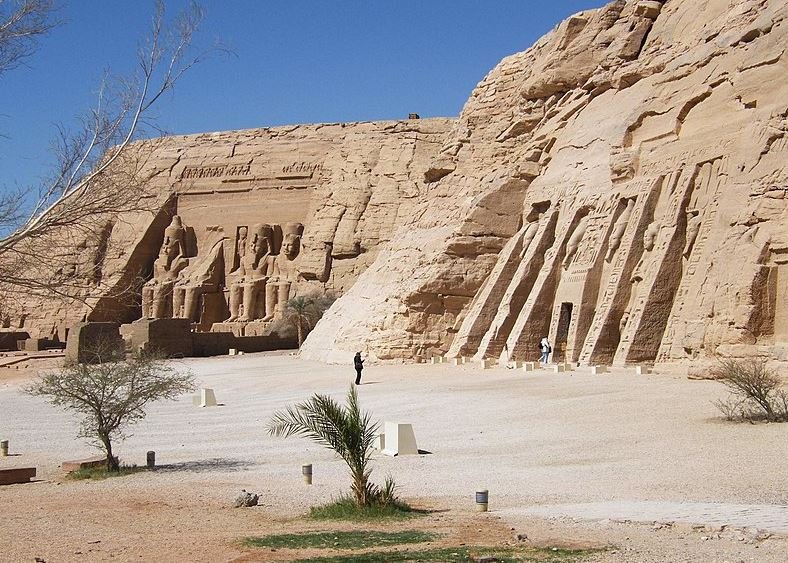
Image: The Great Temple of Ramesses II (left) and the Small Temple dedicated to Hathor and Nefertari (right).
Conclusion
The artworks of Ancient Egypt are a testament to the civilization’s sophisticated artistic techniques, profound religious beliefs, and enduring cultural legacy. From monumental sculptures and architectural wonders to intricate funerary texts and lifelike statues, each masterpiece offers invaluable insights into the lives, values, and achievements of the ancient Egyptians.
Frequently Asked Questions
What were the primary purposes of Ancient Egyptian art?
Ancient Egyptian art served both practical and religious purposes, primarily aimed at ensuring the well-being of the deceased in the afterlife and glorifying the gods and pharaohs.
How did colors function symbolically in Ancient Egyptian art?
Colors held specific meanings:
- Blue: Symbolized the heavens and fertility.
- Green: Represented rebirth and vegetation.
- Gold: Denoted divinity and eternity.
- Red: Associated with power and chaos.
What are common icons and motifs in Ancient Egyptian art?
Common symbols included:
- Ankh: Symbol of life.
- Scarab Beetle: Symbol of resurrection.
- Lotus Flower: Symbol of creation.
What are the conventional forms used in depicting figures in Ancient Egyptian art?
- Composite View: Figures are shown with heads and legs in profile while torsos and eyes face forward.
- Hierarchical Proportions: The size of a figure indicates its importance, with gods and pharaohs typically larger than other figures.
What materials and techniques were commonly used in Ancient Egyptian art?
- Stone: Limestone, granite, and alabaster for statues and temple carvings.
- Wood and Ivory: Used for furniture, small statues, and intricate carvings.
- Faience and Glass: Glazed materials for jewelry, amulets, and decorative objects.
- Metals: Gold, silver, and copper crafted into jewelry and ceremonial items.
- Painting: Applied vibrant colors to walls, statues, and coffins using natural pigments, often combining relief and flat painting techniques.
What are the key elements of funerary art in Ancient Egypt?
- Tombs and Coffins: Decorated with scenes depicting the afterlife to aid the deceased’s journey and well-being.
- Canopic Jars: Used to store internal organs removed during mummification, each guarded by a specific deity.
- Ushabti Figures: Small statuettes placed in tombs to serve the deceased in the afterlife.
How did Ancient Egyptian art evolve over time and influence later traditions?
- Evolution Over Time:
- Old Kingdom: Focused on monumental architecture like pyramids and developing the canonical artistic style.
- Middle Kingdom: Introduced increased realism and more individualized figures.
- New Kingdom: Expanded artistic styles influenced by interactions with neighboring cultures, including the distinctive Amarna period.
- Late Period and Beyond: Incorporated foreign influences while maintaining traditional Egyptian motifs and styles.
- Influence and Legacy:
Ancient Egyptian art profoundly influenced later artistic traditions, including Greek and Roman art, and continues to inspire modern artists and architects with its emphasis on symbolism, formality, and the divine.