Ancient Greek City of Pella: History & Major Facts
Pella, an ancient city in the northern region of Greece, specifically in Central Macedonia, has a legacy intertwined with the rise of the Macedonian Empire and the broader story of ancient Greece.
Known as the birthplace of Alexander the Great and once the capital of Macedon, Pella played a critical role in the political, cultural, and military landscape of the ancient world.
Over centuries, it evolved from a strategically placed port town to a thriving cultural and economic hub, only to fall into decline with the advent of Roman rule and later events. Today, archaeological discoveries continue to illuminate Pella’s vibrant history and its contributions to ancient Greek civilization.

Known as the birthplace of Philip II and Alexander the Great, the city of Pella flourished before declining after the Roman sack in 168 BC.
Origins of Pella and Etymology
Pella’s name is believed to originate from the ancient Greek word “pella” (πέλλα), meaning “stone” or “rock,” a term commonly associated with geographical landmarks and potentially rooted in pre-Greek or Indo-European language origins. This naming reflects a pattern seen in other ancient sites across Greece and Europe, where place names often reference physical features of the land.
Linguistically, “pella” shares ties with various Indo-European words for stone or cliff, found in Greek, Pashto, Illyrian, and Germanic languages. Some historians propose that Pella’s name might indicate an indigenous or pre-Hellenic origin, which aligns with the theory that the area had established settlements even before Macedonian expansion.
Geographic and Strategic Significance
Initially, Pella was strategically located near the Thermaic Gulf, which provided it access to maritime trade routes. An inlet connected it to the Gulf, making Pella an ideal port for trading and transportation. Over centuries, sedimentation filled in this inlet, and the ancient port is now inland.
The city’s favorable position contributed to its development as a commercial center, and its ability to engage with other Greek city-states and kingdoms in Asia Minor, as well as facilitating cultural exchange across the Mediterranean.
Foundation and Development as Macedonian Capital
While Pella’s earliest years are not thoroughly documented, it is widely believed that King Archelaus I (reigned 413–399 BC) officially established it as the capital of Macedon. This transition from the old capital of Aigai to Pella marked an important shift in Macedonian power and influence.
Archelaus, noted for his reforms and support of the arts, envisioned Pella not only as a political center but also as a cultural and commercial hub that could stand alongside the great Greek city-states. By moving the capital to Pella, he centralized the kingdom’s governance, facilitated trade, and drew intellectual and artistic talent to the city.
King Archelaus was instrumental in transforming Pella into a center of cultural and artistic importance. He invited renowned figures like the painter Zeuxis and the playwright Euripides to his court, and the latter is believed to have completed his famous play Bacchae here. Pella quickly earned a reputation as a center for arts and literature, attracting Greek intellectuals and artisans. This cultural flourishing set the stage for future Macedonian rulers, who continued to expand and beautify the city.

Image: Ruins of bathtubs in the public baths at Pella.
Rise Under Philip II and Alexander the Great
Pella’s prominence grew under Philip II (382–336 BC), a leader known for his military and diplomatic prowess. Philip was born in Pella and, upon becoming king, he further enhanced the city’s infrastructure, fortifications, and administrative importance. He expanded the city’s layout, emphasizing both its defense and its aesthetic appeal. During his reign, Pella became a critical location for state functions, royal ceremonies, and the training of soldiers. Philip’s investments in Pella laid the groundwork for his son, Alexander the Great, to inherit a strong and united kingdom.
Alexander the Great, born in Pella in 356 BC, is perhaps the city’s most famous native. After Philip’s assassination, Alexander ascended to the throne and launched a series of military campaigns that established one of history’s largest empires, extending from Greece to Egypt and as far as the Indus Valley. Pella’s reputation grew with Alexander’s fame, as the city became the birthplace of a king who significantly shaped world history. Although Alexander spent little time in Pella after beginning his conquests, his achievements brought lasting fame to his hometown.
Urban Planning and Infrastructure
Pella’s architectural and urban planning elements set it apart from other cities of its time. It was designed according to the principles of Hippodamian planning, named after the architect Hippodamus of Miletus, who is often credited with pioneering the grid plan. This layout, which featured wide, intersecting streets that formed rectangular blocks, was highly advanced for its time. The grid system allowed for efficient movement within the city and created a visually appealing, organized urban space. Archaeological findings indicate that Pella’s blocks were uniform, measuring roughly 45 meters in width and varying between 111 and 152 meters in length.
In the city’s center was the agora, a large public square and marketplace occupying approximately ten blocks. The agora was surrounded by colonnaded buildings that served commercial and administrative purposes, reinforcing Pella’s role as a trade and political center. Additionally, Pella’s infrastructure included an impressive water supply and drainage system, a rarity in the ancient world. The city’s advanced engineering ensured a reliable supply of fresh water and effective waste management, reflecting the administrative and public health priorities of its leaders.
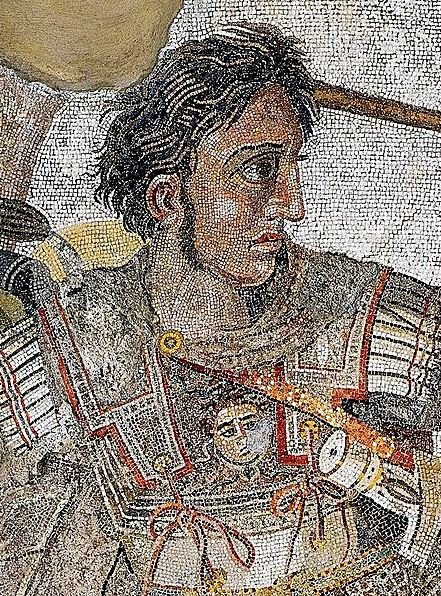
Image: Alexander the Great
Religious and Cultural Life
Religious structures and artworks in Pella further highlight its cultural vibrancy. Temples dedicated to various deities, including Aphrodite, Cybele, and Demeter, indicate the polytheistic practices that shaped daily life and societal values in the city. These temples were places of worship and social gathering, underscoring the role of religion in the communal life of ancient Pella.
Pella was also known for its beautiful mosaics, which adorned the floors of wealthy homes. These mosaics depicted scenes from mythology, such as Dionysus riding a panther or a lion-griffin attacking a stag, and were made from small, intricately arranged pebbles. Known for their vivid detail and craftsmanship, Pella’s mosaics reflect a high level of artistry and are some of the earliest examples of this art form in Greece. Many of these mosaics can be seen today in the Archaeological Museum of Pella, where they offer insight into the artistic styles and cultural symbolism of the time.
Decline and Roman Conquest
Pella remained a significant city through the Hellenistic period, especially under the rule of Cassander and Antigonus II, who continued to enhance its architecture and economic activity. However, the city’s fortunes shifted during the Macedonian Wars, a series of conflicts between Macedon and the rising power of Rome. By 168 BC, during the Third Macedonian War, the Romans decisively defeated King Perseus of Macedon, effectively ending Macedonian independence.
In the aftermath, Roman forces sacked Pella, looting its treasury and stripping it of its political and economic importance. The Roman general Lucius Aemilius Paulus described Pella’s fortifications and strategic location, especially noting its “Phacus” citadel, built on a marshy island that provided natural defense against invaders. Despite these defenses, Pella could not withstand the military superiority of Rome.
Following the Roman conquest, Pella was absorbed into the province of Macedonia. Although it became the capital of the region’s third administrative division and remained a stop along the Via Egnatia—a major Roman road connecting Dyrrachium to Thessalonica—Pella never regained its former prestige. A significant earthquake around 90 BC further devastated the city. Though rebuilt, Pella gradually declined, overshadowed by nearby cities like Thessalonica, which became the new center of Roman administrative power in the region.

Image: A map of Greece showing the exact location of Pella.
Archaeological Discoveries and Legacy
The decline of Pella continued for centuries, yet its significance remained embedded in historical records. In the modern era, archaeological excavations have revealed a wealth of information about Pella’s urban layout, architecture, and daily life. Excavations began in the 20th century, uncovering substantial portions of the city, including residential quarters, the agora, and lavishly decorated homes with pebble mosaics.
One of the most significant finds in Pella is the “Pella curse tablet,” discovered in 1986. This artifact is inscribed with a curse written in the Doric Greek dialect, a variant of the North-Western Greek family, supporting the hypothesis that ancient Macedonian was a dialect of Greek. The Pella curse tablet provides linguistic evidence of local dialects and offers a glimpse into the cultural and social practices of Pella’s inhabitants.
Archaeologists have also discovered over a thousand tombs in Pella, some dating back to the early Macedonian period. These tombs contain a range of artifacts, including pottery, jewelry, and weaponry, indicating the wealth and sophistication of Pella’s residents. Recent findings have continued to enrich our understanding of the city’s history, revealing intricate details about its social structure and artistic achievements.
The architectural ruins of Pella also highlight its urban sophistication. In addition to the grid layout, archaeological efforts have reconstructed parts of the city’s agora, revealing how Pella’s economic and social life was organized. These excavations have also identified the remains of a large palace complex on a hill north of the city, which served as both a royal residence and an administrative center. Spanning approximately 75,000 square meters, this palace was built during Philip II’s reign and expanded by subsequent rulers, underscoring Pella’s role as a political and cultural seat.
Cultural Revival and Tourism
Today, Pella stands as an important archaeological site that draws visitors interested in ancient Greek and Macedonian history. The Archaeological Museum of Pella, located near the ancient city, houses a collection of artifacts recovered from the site, including statues, pottery, and the famous pebble mosaics. Visitors can explore the remains of the ancient city, including parts of the palace complex, residential quarters, and public spaces, gaining insight into life in one of ancient Greece’s most influential cities.
The site of Pella is also connected to contemporary cultural events, such as the Alexander the Great Marathon, which begins near the ancient city and commemorates the legacy of its most famous resident. This annual event underscores the ongoing influence of Pella’s history and its enduring connection to Greek cultural identity.
Architectural Influence and Lasting Significance
Pella’s architectural legacy had a lasting impact on Greek and later Roman urban planning. The grid system used in Pella influenced city designs throughout the Hellenistic world, and the emphasis on infrastructure, such as water supply systems, inspired similar developments in Roman cities. Pella’s advanced planning and cultural achievements reflect the broader Hellenistic ideals of civic beauty, public accessibility, and organized urban space.
Additionally, Pella’s role as a cultural center established it as a model for subsequent cities in the Macedonian and broader Greek world. The city’s emphasis on art, intellectual life, and architectural elegance showcased the Macedonian court’s commitment to fostering a society that valued both governance and culture. Through its mosaics, temples, and public spaces, Pella offers a window into the artistic and spiritual lives of its people, reflecting a fusion of Greek and Macedonian traditions that shaped the Hellenistic era.
Conclusion
The ancient city of Pella remains a testament to the ingenuity and cultural richness of ancient Greece and Macedonia. From its establishment as the capital of Macedon under Archelaus I to its prominence during the reigns of Philip II and Alexander the Great, Pella embodied the spirit of the Macedonian Empire. Its contributions to urban planning, art, and language continue to be relevant, as modern archaeological discoveries shed new light on its historical significance.
While Pella ultimately fell to Roman dominance and experienced a gradual decline, its cultural and historical legacy lives on through the artifacts preserved in the Archaeological Museum of Pella and the ruins that attract visitors today. The city serves as a reminder of Macedonia’s influential role in shaping ancient Greek civilization and the wider Mediterranean world, as well as a symbol of the lasting impact of Greek ideals on architecture, governance, and culture.
Frequently Asked Questions
What is the likely origin of the name “Pella”?
The name “Pella” likely derives from the ancient Greek word “pella” (πέλλα), meaning “stone,” with similar linguistic connections across Indo-European languages, possibly reflecting pre-Greek indigenous influences.
What was Pella’s geographical significance in ancient times?
Initially, Pella was a strategic port connected to the Thermaic Gulf by a navigable inlet, though over time sedimentation left it inland.
Who are the two historical figures associated with Pella’s founding as a capital?
King Archelaus I likely established Pella as Macedon’s commercial capital, possibly replacing Aigai, although Amyntas III might also have contributed to its construction.
Which cultural figures did Archelaus I invite to Pella?
Archelaus I invited painter Zeuxis and playwright Euripides, who completed Bacchae in Pella in 408 BC, establishing the city as a cultural center.
How did Pella rise to prominence under Philip II and Alexander the Great?
Pella became particularly significant as Philip II (born there in 382 BC) and Alexander the Great (born in 356 BC) expanded Macedon’s influence, with Pella’s fortified design enhancing its stature and security.

Image: Philip II
When did Pella reach its peak prosperity, and under whose rule?
Pella flourished most under the rule of Cassander and Antigonus II, who promoted significant architectural and artistic developments.
What role did Pella play during the Macedonian Wars?
Pella remained a power center under Macedonian kings Philip V and Perseus, although it was sacked by the Romans in 168 BC, initiating its decline.
How did Roman incorporation affect Pella’s status?
The Romans made Pella the capital of Macedonia’s third administrative region. It continued as a regional hub, but an earthquake around 90 BC devastated the city, and it never achieved full Roman legal privileges.
What archaeological discoveries have been made in Pella?
Excavations have revealed residential blocks, colonnaded houses, mosaic floors, and over 1,000 tombs with artifacts, highlighting Pella’s rich history.

What cultural artifacts were found in Pella’s houses?
Houses such as the “House of Helen” and “House of Dionysus” contained pebble mosaics with scenes like Dionysus on a panther, showcasing sophisticated Greek painting styles.
Where was Pella’s palace located, and what was its purpose?
Pella’s palace, spanning 75,000 square meters, was on a hill north of the city, serving as both a royal residence and a center of Macedonian governance and administration.
What is the significance of the Pella curse tablet?
Discovered in 1986, the Pella curse tablet, inscribed in Doric Greek, supports the theory that Macedonian was a dialect of North-Western Greek, offering valuable insights into the language.
What is the current status of Pella’s archaeological site?
Ongoing excavations have revealed much of the ancient city, including the palace, which is set to open to the public in 2024. The Archaeological Museum of Pella displays numerous artifacts, preserving its historical legacy.





