Anne Hutchinson: The Puritan Spiritual Advisor and Religious Reformer
Anne Hutchinson was a prominent and influential Puritan spiritual advisor in early colonial America. Known for her strong religious convictions and opposition to the established Puritan leadership in the Massachusetts Bay Colony, Hutchinson became a central figure in the Antinomian Controversy—a theological and political dispute that greatly affected the Puritan community in New England from 1636 to 1638.
Her challenges to the male-dominated religious establishment, along with her ability to attract followers, made Hutchinson a symbol of religious freedom and early resistance to institutional authority. Her story is also significant for its role in highlighting the limitations imposed on women in colonial society and the consequences for those who dared to defy them.
Early Life in England
Anne Marbury Hutchinson was born in July 1591 in Alford, Lincolnshire, England. She was the daughter of Francis Marbury, an Anglican clergyman and teacher who advocated for the education of women. Francis Marbury’s own confrontations with the church, along with his belief in the importance of a thorough education, significantly shaped Anne’s worldview. Unlike most women of her time, Anne received a robust education, learning to read, write, and study the Bible. Her father’s strong convictions and assertiveness likely influenced her, contributing to her later outspokenness and determination.
In her early adulthood, Anne moved to London, where she met and married William Hutchinson, a prosperous merchant and a fellow Puritan from her hometown. Together, they followed the teachings of John Cotton, a renowned Puritan preacher whose emphasis on a “covenant of grace” over a “covenant of works” resonated deeply with Anne. Cotton’s message aligned with her belief that salvation was a gift from God’s grace rather than something earned through good deeds or adherence to strict religious practices. When Cotton was forced to emigrate to Massachusetts in 1633 due to religious persecution, Anne and her family followed him the next year, settling in Boston, Massachusetts.
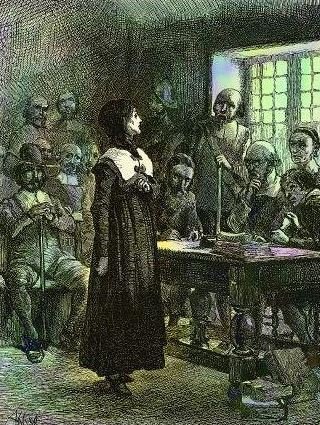
Image: Edwin Austin Abbey’s depiction of Anne Hutchinson on Trial.
Religious Influence in the Massachusetts Bay Colony
In Boston, Hutchinson quickly integrated into the Puritan community and became active in religious life. She assisted her neighbors as a midwife and began to host gatherings at her home, where she shared her interpretations of the weekly sermons and discussed theological ideas. These gatherings attracted a growing following, and her deep knowledge of scripture and charismatic leadership quickly made her an influential figure in the community.
Initially, her gatherings were primarily for women, but as word of her insights spread, men began to attend as well. Even Henry Vane, the young governor of the Massachusetts Bay Colony, attended her meetings. Hutchinson’s popularity and her critiques of the local clergy soon created tension, particularly as she began accusing ministers of teaching a “covenant of works” rather than a “covenant of grace.” She argued that many ministers’ emphasis on good behavior and obedience to religious law contradicted the fundamental Puritan belief that salvation came solely through God’s grace.
The Antinomian Controversy
The theological dispute initiated by Hutchinson’s teachings came to be known as the Antinomian Controversy. This conflict wasn’t merely a theological debate; it also posed a significant challenge to the Puritan power structure. The leaders of the Massachusetts Bay Colony, mostly ministers, felt that her assertions undermined their authority and threatened the stability of the religious community. Hutchinson’s criticisms suggested that the majority of Puritan ministers were misleading their congregations, leading many to question the legitimacy of their spiritual guidance.
Hutchinson’s views on “free grace,” or the belief that salvation was God’s alone to grant without regard for an individual’s deeds, directly contradicted the prevalent belief in the importance of adherence to religious law. Her teachings gained her a dedicated following, but they also deeply alarmed the colony’s religious and political leadership. They saw her growing influence as divisive and believed it could lead to social instability, as her ideas undermined the hierarchy that kept the Puritan community unified.
The Antinomian Controversy reached a climax in 1637 when Hutchinson was formally charged with sedition and brought to trial. She faced intense scrutiny from the male-dominated court, where the judges sought to discredit her and her ideas. Hutchinson defended herself articulately and confidently, quoting scripture and questioning the legitimacy of the charges against her. Despite her strong defense, she was ultimately convicted of heresy and sedition. The court ordered her to be banished from the Massachusetts Bay Colony, marking a significant turning point in her life and in the history of the colony.
Banishment and Founding of Portsmouth
After her conviction, Hutchinson, her family, and many of her followers sought refuge in Rhode Island, where Roger Williams, another advocate of religious freedom, had established a colony that welcomed dissenters. With Williams’ encouragement, Hutchinson and her supporters founded the settlement of Portsmouth in 1638, where they could practice their beliefs without interference. Portsmouth became part of what would eventually be known as the Rhode Island Colony, which was characterized by its commitment to religious tolerance and separation from the Massachusetts Bay Colony’s strict Puritan orthodoxy.
Hutchinson’s life in Portsmouth was a fresh beginning, though it was not without challenges. She continued to influence religious thought and community life, establishing her role as a pioneer for religious freedom in New England. However, her time in Rhode Island was cut short by personal tragedy.
After her husband William’s death in 1642, Hutchinson feared that Massachusetts might attempt to annex Rhode Island, bringing her once again under the control of the colony that had exiled her. To avoid this, she moved further away, settling with her remaining children near the Bronx in New Netherland, then under Dutch control.
Tragic Death and Legacy
Hutchinson’s life came to a tragic end in 1643 when she and several of her children were killed during Kieft’s War, a conflict between Dutch settlers and local Native American tribes. Only one of her children, Susanna, survived the attack, though she was taken captive by the Siwanoy Native Americans. This violent end added a layer of martyrdom to Hutchinson’s story, further solidifying her place in history as a courageous figure who had sacrificed much for her beliefs.
Though her life was brief and ended violently, Anne Hutchinson’s legacy endured. Her challenges to the Puritan clergy and her assertion of the right to question religious authority made her a symbol of religious freedom and tolerance. She has been celebrated as an early advocate for the rights of individuals to interpret scripture for themselves, regardless of gender, and she is often seen as a precursor to later movements advocating for women’s rights and individual liberty.
Historical Significance and Recognition
Hutchinson’s story has inspired generations of Americans who value religious freedom and the separation of church and state. Her willingness to defy the established religious order to follow her conscience resonates as a powerful example of personal courage. Over time, her legacy has been honored in various ways, including a monument in Massachusetts that describes her as a “courageous exponent of civil liberty and religious toleration.” Her life and work serve as a reminder of the important role of dissent and freedom of thought in shaping American society.
Anne Hutchinson’s story also sheds light on the complex dynamics of power, authority, and gender in early colonial America. Her trial and banishment revealed the limitations placed on women and the strict boundaries set by Puritan leadership. As a woman who dared to challenge the status quo, Hutchinson faced severe consequences, yet her actions left an indelible mark on American history. Historians like Michael Winship, who have studied her life extensively, view Hutchinson as one of the most significant English women in colonial America, and her story continues to captivate readers today.
Conclusion
Anne Hutchinson’s life as a Puritan spiritual advisor and religious reformer reflects both the promise and peril of early American ideals. Her advocacy for religious autonomy and her resistance to authoritarian control made her a transformative figure, and her story has been preserved as an example of resilience and conviction. Although she faced intense opposition and suffered a tragic end, Hutchinson’s ideas lived on, influencing the evolving discourse on religious freedom and individual rights in America.
Hutchinson’s contributions remain vital to understanding the struggles for religious freedom, gender equality, and individual rights in the American colonies. Her life exemplifies the courage required to stand against prevailing norms, and her story serves as a powerful reminder of the enduring impact of those who challenge established authority in the name of personal belief. Through her trials and the communities she helped found, Anne Hutchinson set a precedent for religious tolerance and independence that became foundational to American values. Her legacy is a testament to the strength of individual conviction and the importance of defending one’s beliefs, even in the face of overwhelming opposition.
Frequently Asked Questions about Anne Hutchinson
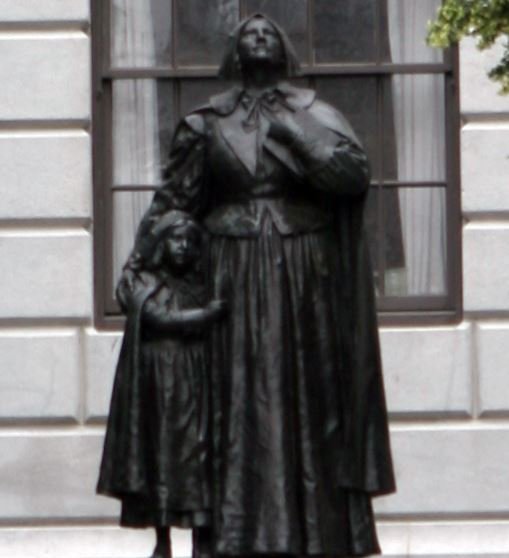
Image: Cyrus Edwin Dallin’s Statue of Hutchinson at the Massachusetts State House
Who was Anne Hutchinson and why is she significant in colonial American history?
Anne Hutchinson was a Puritan religious leader, midwife, and key figure in colonial American history known for her role in the Antinomian Controversy. She challenged the established religious doctrines of the Massachusetts Bay Colony, ultimately leading to her trial, conviction, and banishment. Her actions made her a symbol of religious freedom and an early advocate for gender equality in a male-dominated society.
Where was Anne Hutchinson born, and how did her upbringing influence her later life?
Hutchinson was born in Alford, Lincolnshire, England. Her father, Francis Marbury, was an Anglican clergyman who provided her with an unusually strong education for a girl of her time. This background helped her develop confidence in religious matters, which later fueled her leadership and reformist tendencies in the Massachusetts Bay Colony.
What role did John Cotton play in Hutchinson’s religious development?
John Cotton was a Puritan preacher whose teachings greatly influenced Hutchinson. He promoted a “covenant of grace” over a “covenant of works,” which emphasized that salvation was a gift of God’s grace rather than earned by good deeds. When Cotton emigrated to Massachusetts, Hutchinson and her family followed him, settling in Boston in 1634.
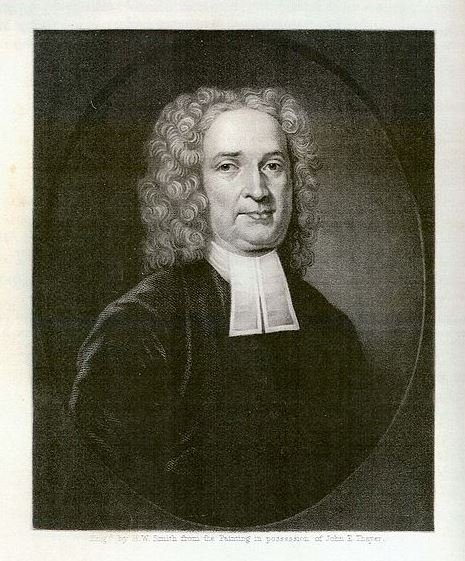
Image: John Cotton
How did Anne Hutchinson’s gatherings in Boston contribute to her influence?
She hosted gatherings in her home where she shared her religious views, initially with women and later with men as well. These meetings grew popular, attracting influential figures, including Henry Vane, the young governor of the Massachusetts Bay Colony. Her gatherings eventually became controversial as she openly criticized local ministers for promoting a covenant of works.
What was the Antinomian Controversy, and how did Hutchinson become involved?
The Antinomian Controversy was a theological conflict in the Massachusetts Bay Colony, largely instigated by Hutchinson’s criticism of the Puritan clergy. She accused most ministers of preaching a covenant of works, which opposed her belief in a covenant of grace. Her outspoken views sparked a major religious and political crisis in the colony.
What were the main accusations against Hutchinson during her trial in 1637?
During her trial, Hutchinson was accused of spreading beliefs that caused division and promoted heresy. Her contemptuous remarks about the Puritan clergy and her challenges to their authority led to her conviction. This trial ultimately resulted in her banishment from the Massachusetts Bay Colony.
Where did Hutchinson go after her banishment, and what did she establish?
After her banishment, Hutchinson and her supporters settled in Rhode Island, a colony founded by Roger Williams that welcomed religious dissenters. With his encouragement, she and her followers established the settlement of Portsmouth in 1638, where Hutchinson continued to contribute to religious and community life.
What circumstances led Hutchinson to leave Rhode Island and where did she go next?
Following her husband’s death, Hutchinson feared that Massachusetts might try to annex Rhode Island, so she relocated further from its influence. She moved with her younger children to an area under Dutch control near the modern-day Bronx in New York, hoping to avoid interference from Massachusetts authorities.
How did Hutchinson’s life end, and what impact did her death have on her legacy?
In 1643, Hutchinson and several of her children were killed by Siwanoy Native Americans during Kieft’s War, with only her nine-year-old daughter Susanna surviving. Her tragic death added a layer of martyrdom to her story, solidifying her as a religious and social pioneer.
What is Hutchinson’s legacy in the context of American history?
Hutchinson is celebrated as a significant figure in the history of religious freedom and women’s rights in colonial America. Her trial and banishment underscored the tension between individual religious beliefs and institutional authority, and she became an emblem of courage and independence.
How is Anne Hutchinson commemorated in Massachusetts?
The Massachusetts State House honors Hutchinson with a monument, which describes her as a “courageous exponent of civil liberty and religious toleration,” reflecting her lasting impact on the values of religious freedom and civil rights in America.
What does historian Michael Winship say about Hutchinson’s place in colonial history?
Historian Michael Winship, who has written two books about Hutchinson, describes her as “the most famous—or infamous—English woman in colonial American history.” His statement highlights her influence and the complex legacy she left in early American society.