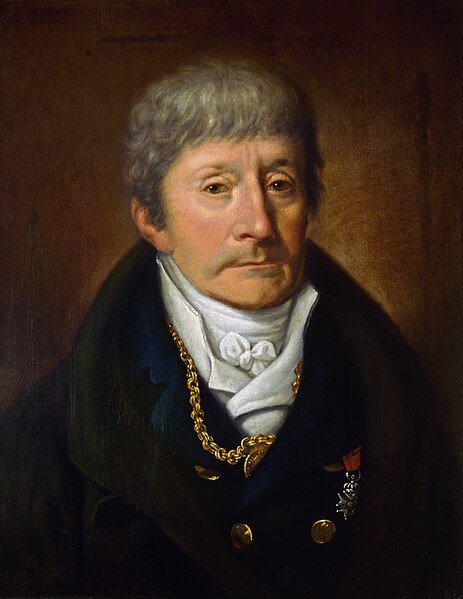
Portrait of Salieri, painted in 1815 by Joseph Willibrord Mähler.
Antonio Salieri (18 August 1750 – 7 May 1825) was an Italian composer and teacher of the Classical period. Born in Legnago, south of Verona in the Republic of Venice, Salieri spent his adult life and career within the Habsburg monarchy. A pivotal figure in the evolution of late 18th-century opera, Salieri’s influence extended across Europe, both as a composer and a mentor to some of the era’s most notable musicians. His legacy, though obscured for much of the 19th and early 20th centuries, saw renewed interest through cultural depictions and music revivals.
Early Life and Musical Beginnings (1750–1770)
Antonio Salieri was born to Antonio and Anna Maria Salieri in Legnago. Early musical instruction came from his brother Francesco and cathedral organist Giuseppe Simoni. After the deaths of his parents, Salieri was placed under the care of Giovanni Mocenigo, a Venetian nobleman, who facilitated his continued musical education. Salieri’s talent caught the attention of composer Florian Leopold Gassmann, who brought him to Vienna in 1766. There, Salieri received formal training in harmony, counterpoint, and vocal composition, using Johann Fux’s Gradus ad Parnassum as a foundation.
Rise in Vienna: The Operatic Debut (1770–1778)
Salieri’s operatic career began in Vienna with the modest success of Le donne letterate (1770). He quickly gained recognition with subsequent works like L’amore innocente and Don Chisciotte alle nozze di Gamace. These early operas displayed his penchant for blending operatic genres and innovating within established forms. In 1771, Armida, based on Torquato Tasso’s Jerusalem Delivered, marked Salieri’s entry into serious opera, establishing him as a composer capable of combining dramatic intensity with musical innovation.
Imperial Patronage and International Acclaim (1778–1788)
By 1774, Salieri was appointed director of Italian opera in Vienna. This period saw him compose significant works such as La scuola de’ gelosi and La fiera di Venezia. His collaboration with Christoph Willibald Gluck and librettist Lorenzo Da Ponte led to a synthesis of styles that expanded the boundaries of opera.
Salieri’s portrayal in Amadeus revived interest in his music and life. This renewed attention led to performances of his operas and recordings of his works.
Salieri’s reputation extended beyond Vienna to Paris, where his opera Les Danaïdes (1784) achieved great acclaim. Originally attributed to Gluck, the opera’s success cemented Salieri’s status in the reformist opera tradition. His ability to adapt to diverse cultural tastes showcased his cosmopolitan artistry.
Vienna’s Kapellmeister and Teaching Legacy (1788–1804)
In 1788, Salieri became the Kapellmeister of the Imperial Chapel, overseeing music for the court and its associated institutions. His compositional focus shifted towards sacred music, with works like his Requiem in C minor. As his operatic output waned, Salieri dedicated himself to teaching. His pupils included luminaries such as Ludwig van Beethoven, Franz Schubert, Franz Liszt, and Franz Xaver Wolfgang Mozart.
Decline and Retirement (1804–1825)
After retiring from opera composition in 1804, Salieri concentrated on religious and instrumental music, including his Twenty-Six Variations on La Folia di Spagna. Personal tragedies, including the loss of his wife and son, marked his later years. Despite his retreat from public life, Salieri continued to influence Vienna’s musical culture through his teachings and performances.
The Mozart-Salieri Rivalry: Myth and Reality
The alleged rivalry between Salieri and Wolfgang Amadeus Mozart has long fascinated historians and audiences. Contemporary letters from Mozart and his father suggest professional tensions, but there is no concrete evidence of malicious intent. The myth of Salieri poisoning Mozart emerged posthumously, fueled by Alexander Pushkin’s 1831 play Mozart and Salieri and further popularized by Peter Shaffer’s Amadeus (1979).
While Salieri’s influence in Vienna may have limited Mozart’s opportunities, their relationship included moments of mutual respect, such as their joint composition of the cantata Per la ricuperata salute di Ofelia (1785).
Salieri’s Musical Innovations and Contributions
Salieri composed 37 operas, spanning genres from opera buffa to tragédie lyrique. His works, such as Armida and Axur, re d’Ormus, displayed dramatic depth and orchestral ingenuity.
Antonio Salieri wrote operas in multiple languages and trained notable musicians like Beethoven and Schubert.
Salieri’s sacred output included masses, vespers, and cantatas, emphasizing his versatility beyond the operatic stage.
While less prolific in this area, Salieri’s instrumental works, such as his piano concertos and variations, reflect his compositional skill and adaptability.
Frequently Asked Questions
Where was Antonio Salieri born and where did he work?
Salieri was born in Legnago, Republic of Venice, in 1750 and spent most of his career in Vienna under the Habsburg monarchy, serving as Imperial Kapellmeister and director of Italian opera.
What was Salieri’s relationship with Wolfgang Amadeus Mozart?
Though often rumored to have been rivals, historical evidence shows they were professional peers with moments of collaboration. The narrative of Salieri poisoning Mozart, popularized by fiction, has been thoroughly debunked.
What were Salieri’s key contributions to music?
Salieri advanced operatic compositional techniques, wrote over 35 operas, and influenced both sacred and instrumental music. He also played a pivotal role in transitioning opera to new stylistic forms.
Why did Salieri’s music fall into obscurity?
His works declined in popularity after his death due to changing musical tastes and were overshadowed by Romantic composers. Interest in his music revived in the late 20th century, partly due to fictional portrayals.
What are some of Salieri’s famous works?
Notable operas include Les Danaïdes, Tarare, Axur, re d’Ormus, and Falstaff. His instrumental compositions include La Folia di Spagna variations and concertos for various instruments.
How did Salieri influence his students?
As a sought-after teacher, Salieri mentored composers like Beethoven, Liszt, and Schubert, shaping Vienna’s musical landscape and passing on his knowledge of vocal and operatic composition.
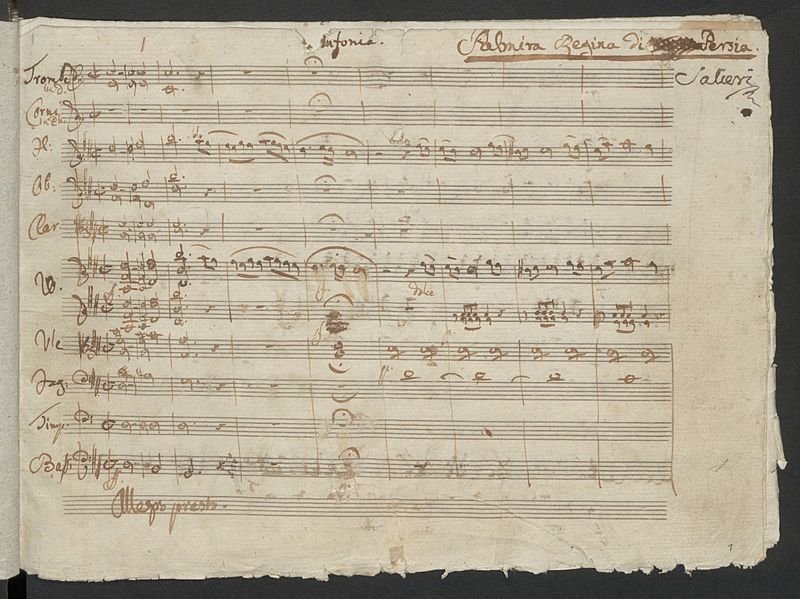
The opening of Salieri’s opera “Palmira, Regina di Persia”.





