Victor Hugo: Life, Political Career, & Major Works
Victor-Marie Hugo (1802–1885) is one of the most celebrated figures in French literature and politics. Renowned for his mastery across genres, his contributions to Romanticism, and his advocacy for social justice, Hugo’s legacy transcends his literary achievements, making him a cultural icon in France and beyond.
Early Life and Background
Victor Hugo was born on February 26, 1802, in Besançon, France, into a family with contrasting political ideologies. His father, Joseph Léopold Sigisbert Hugo, was a general in Napoleon Bonaparte’s army and a staunch republican, while his mother, Sophie Trébuchet, was a royalist with Catholic leanings. This ideological dichotomy influenced Hugo’s early worldview, as he grappled with the conflicting ideals of monarchy and republicanism.
Hugo spent much of his childhood moving with his family due to his father’s military postings. These frequent relocations exposed him to diverse cultural and political environments, enriching his later literary work with vivid descriptions of landscapes and historical settings.
Hugo’s academic talents were evident early, and he excelled in both classical studies and writing. By his teenage years, Hugo had decided to pursue a literary career. His early writings were deeply influenced by his mother’s conservative views, and his first published works, such as Odes et poésies diverses (1822), reflected a royalist ideology.
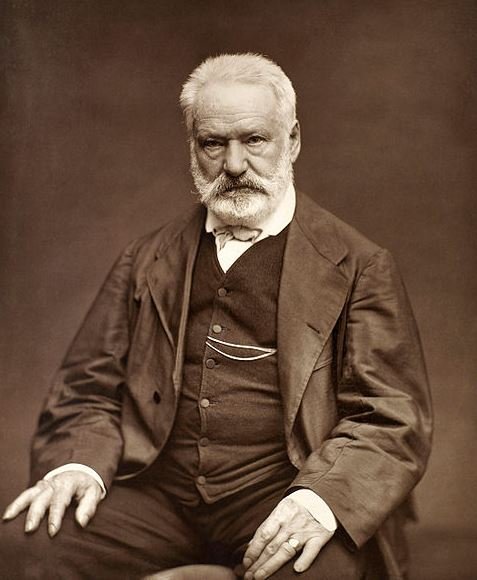
Image: An 1875 portrait of Victor Hugo by French artist Étienne Carjat.
Rise to Literary Fame and Romanticism
Hugo’s early works established him as a promising young poet. However, it was his embrace of Romanticism that catapulted him to fame. Romanticism, with its emphasis on emotion, individuality, and rebellion against classical constraints, resonated with Hugo’s evolving ideals.
Cromwell and the Manifesto of Romanticism
Hugo’s 1827 play Cromwell marked a turning point in his career. Though the play itself was not performed, its preface became a manifesto for the Romantic movement. In this influential essay, Hugo rejected the rigid classical rules of literature and advocated for artistic freedom. He argued for a blend of the sublime and the grotesque, emphasizing the importance of depicting human experience in its entirety.
Hernani and the “Battle of Hernani”
Hugo’s 1830 play Hernani ignited the “Battle of Hernani,” a cultural clash between traditionalists and Romanticists. The play’s defiance of classical norms sparked heated debates but ultimately established Hugo as a leader of the Romantic movement.
Major Literary Works
Victor Hugo’s literary output is vast, encompassing novels, poetry, plays, and essays. His works often explore themes of love, justice, social inequality, and the human condition.
Notable Novels by Victor Hugo
The Hunchback of Notre-Dame (Notre-Dame de Paris, 1831)
This Gothic novel brought renewed attention to the architecture of the Notre-Dame Cathedral and highlighted the plight of marginalized individuals. Set in 15th-century Paris, the story revolves around the tragic lives of Quasimodo, the hunchbacked bell-ringer, and Esmeralda, a Romani dancer. Themes of love, fate, and societal prejudice dominate the narrative, making it a timeless classic.
Les Misérables (1862)
Considered Hugo’s magnum opus, Les Misérables is a sweeping tale of redemption, revolution, and resilience. Set in post-revolutionary France, it follows the journey of Jean Valjean, a reformed convict, as he seeks to rebuild his life while grappling with societal oppression. The novel’s exploration of justice, mercy, and human dignity has inspired countless adaptations, including the renowned musical.
Other Notable Novels
- Toilers of the Sea (1866): A tribute to the people of the Channel Islands, where Hugo lived during his exile.
- The Man Who Laughs (1869): A critique of aristocratic privilege and human exploitation.
- Ninety-Three (1874): A historical novel set during the French Revolution.
Poetry
Hugo is celebrated in France primarily as a poet. His collections, such as Les Contemplations (1856) and La Légende des siècles (1859), showcase his lyrical brilliance and philosophical depth. His poetry reflects a range of themes, from personal loss and nature’s beauty to profound meditations on humanity and spirituality.
Plays
In addition to Cromwell and Hernani, Hugo wrote several other plays, including:
- Ruy Blas (1838): A story of love and political intrigue.
- Marion de Lorme (1831): A Romantic drama set during the reign of Louis XIII.
Political Career and Activism
Victor Hugo’s political journey mirrored his literary evolution. Initially a royalist, he gradually embraced republicanism and became a vocal advocate for social reform.
Early Political Involvement
Hugo’s royalist leanings in his youth stemmed from his mother’s influence. However, as he matured, he became disillusioned with monarchy and shifted toward liberal and republican ideals. In 1845, King Louis-Philippe appointed Hugo to the Chamber of Peers, marking his formal entry into politics.

Image: An 1861 photo of Hugo.
Opposition to Napoleon III
Hugo’s political activism intensified during the rise of Louis-Napoleon Bonaparte (later Napoleon III). Hugo vehemently opposed Napoleon III’s coup d’état in 1851 and the establishment of the Second Empire. His criticism of authoritarianism led to his exile in the Channel Islands, where he spent nearly 20 years.
Exile and Literary Output
During his exile, Hugo wrote some of his most politically charged works, including:
- Les Châtiments (1853): A scathing poetic condemnation of Napoleon III.
- Histoire d’un crime (1877): A detailed account of the coup d’état.
Exile allowed Hugo to refine his ideas on democracy, social justice, and freedom, which became recurring themes in his writings.
Return to France and Later Political Career
Hugo returned to France in 1870 after the fall of the Second Empire. He continued to champion republican ideals, serving as a deputy and later a senator during the Third Republic. He advocated for universal suffrage, the abolition of the death penalty, and social welfare reforms.
Artistic Talents
In addition to his literary accomplishments, Victor Hugo was a talented artist. He produced over 4,000 drawings, often featuring imaginative and surreal themes. His artwork, initially created as a private hobby, has since gained recognition for its originality and creativity.
Legacy and Influence
Victor Hugo’s influence extends far beyond his lifetime. His works have inspired countless adaptations, including operas like Verdi’s Rigoletto and musicals such as Les Misérables and Notre-Dame de Paris. His themes of justice, resilience, and love continue to resonate with audiences worldwide.
Honors and Recognition
Hugo’s death on May 22, 1885, was marked by an unprecedented outpouring of public grief. Over two million people attended his state funeral, making it the largest in French history. He was interred in the Panthéon in Paris, cementing his status as a national hero.
Global Impact
Hugo’s literary innovations, particularly his contributions to Romanticism, have left an indelible mark on global literature. His advocacy for human rights and social justice has inspired generations of writers, activists, and political leaders.

As a writer, Hugo pushed the boundaries of literature, blending artistic freedom with profound social commentary. As a politician, he stood firmly for justice and human dignity. Image: A lithograph of Hugo by Achille Devéria.
Frequently Asked Questions

When and where was Victor Hugo born?
Victor Hugo was born on February 26, 1802, in Besançon, France.
What influenced Victor Hugo’s early life and political beliefs?
Hugo was the son of a general in Napoleon’s army, and his family’s frequent moves exposed him to diverse cultural and political influences. Initially a royalist, his political views evolved over time, and he became a passionate supporter of republicanism.
What was Victor Hugo’s first published work?
His first published work was Odes et poésies diverses (1822), a collection of poetry that showcased his mastery of classical poetic forms and a conservative political stance.
How did Victor Hugo contribute to the Romantic literary movement?
Hugo’s play Cromwell (1827) and its preface became a manifesto for Romanticism, advocating for artistic freedom and the rejection of rigid classical forms. His 1830 drama Hernani sparked the “Battle of Hernani,” a cultural clash between Romanticists and traditionalists.
What are Victor Hugo’s most famous novels?
His most famous novels are:
The Hunchback of Notre-Dame (1831): A story of love, fate, and social injustice set in 15th-century Paris.
Les Misérables (1862): A sweeping narrative of redemption, revolution, and the human condition set in post-revolutionary France.
What are some of Victor Hugo’s notable poetry collections?
Hugo’s notable poetry collections include Les Contemplations (1856) and La Légende des siècles (1859), which explore themes of love, nature, spirituality, and social change.
What role did Victor Hugo play in politics?
Hugo became an outspoken advocate for republicanism and social reform. He opposed Napoleon III’s authoritarian regime, campaigned for the abolition of capital punishment and slavery, and used his writings to promote social justice.

Victor Hugo is celebrated as a national hero in France for his literary achievements and advocacy for social justice. His works remain influential, inspiring generations of readers, writers, and artists. Image: A statue of the head of Hugo in Copenhagen. Artwork by French sculptor Auguste Rodin.
Why was Victor Hugo exiled, and where did he live during this period?
He was exiled in 1851 for opposing Napoleon III’s authoritarian regime. He lived in Guernsey and Jersey for nearly 20 years, during which he continued to write prolifically.
What were some of Victor Hugo’s artistic contributions outside of writing?
He was a skilled artist, producing over 4,000 drawings that often featured imaginative and surreal themes. These works have since been recognized for their originality.
What impact did Victor Hugo have on music and popular culture?
Hugo’s works inspired operas like Verdi’s Rigoletto and popular musicals such as Les Misérables and Notre-Dame de Paris. His themes of justice and resilience continue to resonate with audiences worldwide.
When did Victor Hugo die, and how was his death commemorated?
Victor Hugo died on May 22, 1885, at the age of 83. His state funeral was attended by over two million people, the largest in French history, and he was interred in the Panthéon in Paris.





