Ariovistus: The Germanic Leader who fought Julius Caesar
Ariovistus stands out as a pivotal figure in the late 1st century BC, embodying the complex interactions between the Germanic tribes and the expanding Roman Republic.
As a formidable leader of the Suebi and their allied Germanic groups, Ariovistus played a central role in the tumultuous events in Gaul, ultimately challenging the might of Rome under Julius Caesar.
His life and military endeavors offer invaluable insights into the dynamics of power, cultural integration, and resistance against imperial expansion during this period.

Ariovistus was a prominent leader of the Suebi and allied Germanic tribes in the early 1st century BC. Image: Ariovistus’s meeting with Caesar before the battle.
Early Life and Origins
Ariovistus originated from the Suebi, a prominent Germanic tribe known for their strength and martial prowess. The Suebi inhabited regions that are part of modern-day Germany, and their society was characterized by a warrior elite and a network of allied tribes.
Ariovistus’s rise to leadership within the Suebi suggests a combination of personal capability and strategic alliances. Unlike many of his contemporaries, Ariovistus demonstrated a remarkable ability to bridge cultural divides, evidenced by his fluency in Gaulish. This linguistic skill indicates not only personal adaptability but also a broader strategy of integration and influence within the diverse and fragmented landscape of Gaul.
Rise to Leadership
Ariovistus’s ascent to leadership was marked by both internal consolidation and external alliances. Within the Suebi, he likely emerged as a leader through a combination of hereditary claims and demonstrated military success.
His leadership style was pragmatic, focusing on uniting various Germanic tribes under a common cause while respecting their individual identities and traditions. This approach was essential in a region where tribal affiliations were strong, and unity was often fragile.
By forging alliances through marriage and diplomacy, Ariovistus expanded his influence beyond the Suebi, positioning himself as a key player in the regional power dynamics.
Integration and Cultural Adaptation
Ariovistus’s fluency in Gaulish is a testament to his deep integration into Gallic society. This cultural adaptation was strategic, allowing him to navigate the complex social and political landscape of Gaul effectively.
By understanding the language and customs of the Gauls, Ariovistus could form alliances, negotiate with local leaders, and mobilize support among the Celtic tribes. This cultural fluency set him apart from other Germanic leaders who might have remained insular, thereby enhancing his ability to lead a diverse coalition of tribes in their endeavors against common enemies.
Military Campaigns and Alliances
Ariovistus’s military campaigns were characterized by strategic alliances and tactical prowess. Prior to Julius Caesar’s governorship of Gaul, Ariovistus allied with the Arverni and Sequani tribes in their conflict against the Aedui, a significant Celtic group. The Aedui, positioned around the upper Loire River, were strategically located between the Sequani to the northeast and the Arverni in the Massif Central. The conflict likely centered on control over the Doubs River valley, a crucial trade route that facilitated movement and economic exchange.
Ariovistus’s military exploits in the Gallic Wars helped secure victories, allowing his forces to settle extensively in the conquered Gallic territories, particularly in the Alsace region.
By assisting the Arverni and Sequani, Ariovistus not only extended his influence but also demonstrated his military capabilities. His leadership in the Battle of Magetobriga, where he commanded a force of approximately 15,000 men, resulted in the subjugation of the Aedui and the imposition of tribute. This victory was significant, as it established Ariovistus as a dominant military leader in the region and facilitated the settlement of Germanic tribes in conquered Gallic territories.
Settlement and Colonization in Gaul
Following his military successes, Ariovistus orchestrated the settlement of around 120,000 Germans in a third of Aeduan territory, particularly in the Alsace region. This large-scale migration was a strategic move to establish a strong Germanic presence in Gaul, thereby securing his control over the newly acquired lands. The settlement process involved navigating challenging terrain near Belfort and utilizing the Ognon river valley to approach the Aedui. By placing the Sequani between his forces and the Jura Mountains, Ariovistus ensured a strategic advantage, preventing potential threats from the west and securing his rear.
The colonization of Alsace was not merely a demographic shift but also a means to integrate Germanic settlers into the existing Gallic framework. This integration aimed to create a buffer zone that could withstand external pressures and serve as a base for further expansion if necessary. Ariovistus’s settlement strategy reflected a keen understanding of both military logistics and socio-political dynamics, ensuring that his Germanic forces were well-entrenched and capable of sustaining their presence in Gaul.
Diplomatic Relations with Rome
Ariovistus’s relationship with Rome was complex and multifaceted. By 59 BC, the Roman Senate had officially recognized him as both “king and friend,” indicating a diplomatic acknowledgment of his authority and a desire to maintain amicable relations.
This recognition likely stemmed from Rome’s broader strategy of managing external threats through alliances and diplomatic means rather than direct confrontation.
However, the nature of this friendship was precarious, especially given the shifting alliances and the inherent mistrust between Rome and the Germanic tribes.
The recognition by the Roman Senate did not equate to unconditional support. The Roman concept of “king” was fluid, and its application to Ariovistus may have been more honorary or functional rather than indicative of genuine sovereignty.
The Senate’s acknowledgment was a strategic maneuver to placate a potential threat while maintaining flexibility in their dealings. This diplomatic relationship was further complicated by the alliances Ariovistus forged with the Arverni and Sequani, positioning him as a significant power broker in the region.
Tensions and Conflict with Rome
The stability of Ariovistus’s position began to wane as tensions with Rome escalated. In 58 BC, Diviciacus, a senior magistrate of the Aedui, appealed to Julius Caesar for intervention against Ariovistus, highlighting the Germanic leader’s cruelty and the threat he posed to Roman allies. This appeal was a critical turning point, as it directly involved Caesar in the conflict, shifting the dynamics from regional power struggles to a confrontation with the might of Rome.
Ariovistus’s refusal to comply with Caesar’s diplomatic overtures exacerbated the situation. When Caesar sent ambassadors to negotiate, Ariovistus insisted that any discussion must involve Caesar’s physical presence or require him to marshal his army for negotiations. This refusal was a clear signal of defiance, indicating that Ariovistus was unwilling to adhere to Roman diplomatic protocols and was prepared to confront Rome militarily if necessary.
In response, Caesar issued formal demands: Ariovistus was to halt further incursions across the Rhine, return hostages taken from the Aedui, and pledge not to wage war against them. Ariovistus’s rejection of these terms, coupled with his dismissive remarks about Rome’s ability to protect its allies, solidified his position as an adversary. This standoff set the stage for an inevitable military confrontation, with both leaders firmly entrenched in their respective positions.

In 58 BC, Julius Caesar confronted Ariovistus’s expanding power. At the Battle of Vosges, Caesar’s disciplined Roman legions decisively defeated Ariovistus. Image: Bust of Julius Caesar.
The Battle of Vosges
The culmination of escalating tensions was the Battle of Vosges, a decisive military engagement that would determine the balance of power in Gaul. At the time, Julius Caesar was consolidating his authority in the region, having recently achieved victories against the Helvetii and other Celtic tribes near Bibracte. Ariovistus saw an opportunity to secure his hold over the Doubs valley by targeting Vesontio, a strategically fortified town controlling access along the Doubs River.
However, Caesar’s strategic foresight and possibly intelligence about Germanic movements allowed him to preemptively establish a defensive position near Belfort. This positioning effectively countered Ariovistus’s maneuvers, setting the stage for a confrontation where Roman discipline and tactical ingenuity would be put to the test.
A critical moment during the battle arose when Caesar’s forces experienced internal panic, likely due to fears of being overwhelmed by the superior numbers and ferocity of the Germanic warriors. Demonstrating exceptional leadership, Caesar delivered a stirring speech that reinstated discipline and morale among his legions. He emphasized loyalty, the dire consequences of failure, and the honor of serving Rome, thereby galvanizing his troops into steadfast action. This speech had a profound impact, particularly on the 10th Legion, which earned the nickname Equestris (“mounted”) due to their demonstrated valor and cohesion during the ensuing combat.
As the battle commenced, the Germanic forces advanced with significant momentum, encountering well-prepared and strategically positioned Roman legions. Despite being outnumbered, Caesar employed the triplex acies formation, a sophisticated Roman battle tactic that maximized both defensive and offensive capabilities. This formation allowed the Romans to adapt to various combat scenarios, maintaining flexibility and resilience against the Germanic onslaught.
A decisive maneuver occurred when Publius Licinius Crassus, a cavalry officer, independently directed the third line of battle to support the Roman left flank. This unexpected and bold action exploited a temporary weakness in the Germanic lines, tipping the balance in favor of the Romans. The disciplined Roman soldiers, leveraging their superior training and tactical positioning, engaged the Germanic warriors in close combat, gradually wearing them down.
The loss at Vosges forced Ariovistus and his followers to retreat back over the Rhine River, diminishing their influence in Gaul and reinforcing Roman dominance in the area.
The aftermath of the Battle of Vosges was swift and decisive. Ariovistus’s forces were driven back across the Rhine River, with many Germanic warriors either fleeing or being pursued and killed by the relentless Roman cavalry. The defeat significantly diminished the Germanic threat in Gaul, reinforcing Roman supremacy in the region. Ariovistus himself likely lost his standing among the Suebi, as subsequent historical records do not mention him after this defeat. By 54 BC, reports suggest that he had died, leaving the Suebi without his leadership and preventing any resurgence of his earlier influence.
Aftermath and Regional Implications
The expulsion of Ariovistus had profound implications for the political and demographic landscape of Gaul. With his removal, Julius Caesar was granted unchallenged authority on the left bank of the Rhine, allowing him to pursue further military campaigns against other Gallic tribes, notably the Belgae. This unopposed authority enabled Caesar to implement strategic settlements and administrative reforms, consolidating Roman control over the region.
The power vacuum left by Ariovistus’s defeat led to significant demographic and political shifts in Alsace. The Romans strategically settled mixed Germanic and Celtic populations in the region, creating a buffer zone against future Germanic incursions. These populations likely integrated into a Romano-Celtic society, contributing to the formation of the province of Germania Superior. This integration facilitated the blending of cultures, languages, and administrative practices, fostering a stable and cohesive Roman frontier.
The establishment of Roman authority and the formation of new administrative regions ensured that any future threats from Germanic tribes could be swiftly addressed. The strategic importance of the Rhine River as a frontier remained a critical factor in Roman military and political strategy, serving as both a barrier and a conduit for trade, movement, and military logistics. The Rhine’s role as a natural boundary reinforced Rome’s ability to project power and maintain control over its northern territories.
Death and Legacy
Ariovistus’s death marked the end of his direct influence over the Suebi and the broader Germanic tribes in Gaul. By 54 BC, reports indicate that his demise caused significant indignation among the Germans, highlighting his importance as a leader. His absence created a leadership void within the Suebi, preventing any immediate resurgence of Germanic resistance against Rome.
Despite his defeat, Ariovistus’s legacy endured in the annals of history as a symbol of Germanic resistance against Roman expansion. His military campaigns and strategic settlements demonstrated the potential for Germanic tribes to challenge Rome’s dominance, serving as a precedent for future conflicts between Rome and the Germanic world. Ariovistus’s life also underscored the complexities of leadership in a region marked by diverse cultures, shifting alliances, and the overarching influence of imperial powers.
Etymological Insights
The name Ariovistus has intrigued scholars due to its possible origins and meanings. Most linguists agree that it likely derives from the Gaulish elements ario- meaning “noble,” “free,” or “advanced,” and uid-, uidi-, or uissu- meaning “perception” or “knowledge.” This combination suggests a meaning akin to “Noble Sage” or “He Who Knows in Advance,” reflecting a leader of wisdom and foresight.
Alternatively, some scholars propose a Proto-Germanic origin, combining harjaz (“army” or “host”) and fristaz (“lord” or “ruler”), translating to “army-ruler.” This interpretation aligns with other Germanic names such as Harjawaldaz (meaning “army ruler”) and Waldaharjaz (“battle ruler”), reinforcing Ariovistus’s identity as a military leader. The segmentation of Ariovistus’s name into Ario- and -vistus is widely accepted, though earlier theories linking Ario- to the German word “Ehre” (meaning “honor”) have been dismissed due to a lack of linguistic evidence.
Modern etymological analyses, including those by Julius Pokorny, suggest that the name cannot be definitively linked to the concept of “Aryan” and may instead derive from a Celtico-Germanic root, exemplified by similar names like Ariomanus or Ariobindus. William Smith’s Dictionary of Greek and Roman Biography offers another perspective, suggesting that Ario- could represent the Germanic “Heer” (host) and -vistus the Germanic “Fürst” (prince). This interpretation emphasizes Ariovistus’s role as a military leader or general, possibly indicating that his name was a title rather than a personal name.
Strategic and Military Analysis
Ariovistus’s military strategies were marked by both traditional Germanic warfare and adaptive tactics suited to the Gallic terrain. His ability to command a substantial force of 15,000 men during the Battle of Magetobriga demonstrates his capacity to mobilize and lead large-scale military operations. This mobilization was facilitated by his alliances with the Arverni and Sequani, which provided the necessary support and resources to sustain prolonged campaigns.
The settlement of Germanic tribes in conquered Gallic territories required not only military might but also logistical planning and an understanding of local geography. Ariovistus’s choice of the Alsace region, with its strategic location between the Rhine and the Jura Mountains, provided a defensible position that could serve as a springboard for further operations. This strategic placement ensured that his forces could control key trade routes and maintain a defensive buffer against potential Roman advances.
In the Battle of Vosges, Ariovistus faced the disciplined and strategically adept Roman legions. Despite his numerical advantage, the effectiveness of Roman military tactics, such as the triplex acies formation, and the decisive actions of officers like Publius Licinius Crassus, ultimately led to his defeat. This battle highlights the challenges faced by Germanic leaders when confronting the highly organized and strategically flexible Roman military apparatus.
Cultural and Social Implications
Ariovistus’s interactions with both the Gallic tribes and the Romans reflect the broader cultural and social dynamics of the period. His fluency in Gaulish and strategic marriages illustrate a level of cultural integration and adaptability that was essential for leadership in a multicultural environment. By engaging with local customs and forging alliances through marriage, Ariovistus was able to navigate the complex social hierarchies and tribal affiliations that characterized Gaul.
The settlement of Germanic tribes in Alsace under Ariovistus also had significant social implications. This migration led to the blending of Germanic and Celtic cultures, contributing to the formation of a Romano-Celtic society that would define the region’s identity for centuries. The integration of these populations facilitated economic exchange, cultural intermingling, and the establishment of a stable social order that could resist external threats more effectively.
Political Maneuvering and Diplomacy
Ariovistus’s political maneuvers were crucial in his rise to power and his attempts to consolidate control over Gaul. His recognition by the Roman Senate as “king and friend” was a calculated diplomatic effort to secure legitimacy and maintain a favorable relationship with Rome. This recognition, however, was fragile and contingent on Ariovistus’s ability to align his interests with those of Rome, which ultimately failed as tensions escalated.
The diplomatic standoff between Ariovistus and Caesar exemplifies the delicate balance of power and the complexities of Roman-Germanic relations. Ariovistus’s refusal to comply with Caesar’s demands and his dismissal of Rome’s protective capabilities were strategic choices that aimed to assert his independence and challenge Rome’s authority. However, these choices also set the stage for inevitable conflict, as Rome was unwilling to tolerate persistent threats to its allies and interests in Gaul.
Influence on Future Roman-Germanic Relations
Ariovistus’s conflict with Rome had lasting implications for future interactions between the Roman Empire and the Germanic tribes. His defeat reinforced the effectiveness of Roman military tactics and the importance of disciplined legions in maintaining imperial dominance. Additionally, the Roman strategy of settling mixed populations and creating buffer zones in Alsace set a precedent for managing frontier regions and mitigating future threats.
The legacy of Ariovistus also influenced subsequent Germanic leaders and their approaches to dealing with Rome. The recognition of Rome’s military superiority and the strategic importance of diplomatic alliances became key considerations for Germanic tribes in their future engagements with the Roman Empire. Ariovistus’s attempts to resist Roman expansion highlighted the challenges faced by Germanic leaders in balancing autonomy with the realities of confronting a powerful and resourceful adversary.
Julius Caesar’s Conquest of Gaul: History, Significance & Other Important Facts
Conclusion
Ariovistus’s life and military exploits exemplify the intricate interplay between leadership, cultural integration, and military strategy in the context of Roman-Germanic relations. As a leader of the Suebi and allied Germanic tribes, Ariovistus demonstrated both the potential for significant resistance against Roman expansion and the challenges inherent in such efforts. His ability to unite diverse tribes, adapt to Gallic culture, and execute large-scale military campaigns underscored his prowess as a formidable leader.
Frequently Asked Questions
Which tribe did Ariovistus belong to, and what was notable about his language skills?
Ariovistus hailed from the Suebi, a prominent Germanic tribe. Notably, he was fluent in Gaulish, demonstrating his deep integration and understanding of the local Gallic culture and language.
What are the primary sources documenting Ariovistus’s actions, and why might their reliability be questioned?
The primary source documenting Ariovistus’s actions is Julius Caesar’s Commentarii de Bello Gallico. The reliability of Caesar’s account is often questioned because it is partly political and may present a self-serving perspective. Additionally, later historians like Dio Cassius have expressed skepticism about Caesar’s motives.
How did Ariovistus consolidate his power through marriage?
Ariovistus maintained two marriages to consolidate his power. His first marriage was with a woman from his homeland, and his second was a strategic alliance through marriage to the sister of King Voccio of Noricum. This second marriage helped him forge alliances beyond his immediate tribe.
What title did Caesar use to describe Ariovistus, and what are the possible interpretations of this title?
Caesar referred to Ariovistus as rex Germanorum, commonly translated as “king of the Germans.” However, the Latin term lacks a definite article, allowing it to be interpreted as “king of Germans,” which does not necessarily imply sovereignty over all Germanic tribes.
What was the extent of Ariovistus’s authority among the Germanic tribes?
Ariovistus’s authority was likely confined to the Germans who had settled in Gaul rather than extending over the entire Germanic populace. Germania was fragmented into numerous tribal and political entities, each governed by their own leaders.
How did the Roman Senate recognize Ariovistus, and what uncertainties remain about this recognition?
The Roman Senate officially recognized Ariovistus as a king and a friend. However, it remains uncertain how closely this Roman title matched his actual social status among the Germans or what the Senate precisely meant by “rex” at that time.
What role did Ariovistus play in the conflicts between the Arverni, Sequani, and Aedui tribes?
Before Caesar’s governorship of Gaul in 58 BC, Ariovistus assisted the Arverni and Sequani tribes in their war against the Aedui. His military support led to the subjugation of the Aedui and the imposition of tribute, significantly altering the power dynamics in the region.
What was the Battle of Magetobriga, and what were its outcomes?
The Battle of Magetobriga was a decisive engagement where Ariovistus commanded a force of 15,000 men against the Aedui. The victory resulted in the Aedui becoming tributary to the Sequani, and Ariovistus settled approximately 120,000 Germans in a third of Aeduan territory, establishing a significant Germanic presence in Alsace.
How did Ariovistus’s relationship with Rome change by 58 BC, leading to tensions?
By 59 BC, Ariovistus was recognized by the Roman Senate as both “king and friend.” However, tensions arose when Diviciacus, a senior Aeduan magistrate, petitioned Caesar to intervene against Ariovistus due to his cruelty and threat to Roman allies. Ariovistus’s refusal to comply with Caesar’s diplomatic demands further strained the relationship.
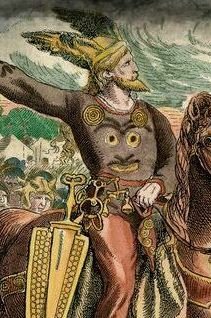
Despite his strengths, Ariovistus ultimately succumbed to the superior tactics and strategic acumen of Julius Caesar and the Roman legions.
What strategic actions did Caesar take in response to Ariovistus’s aggression, leading to the Battle of Vosges?
Caesar responded to Ariovistus’s aggression by sending ambassadors to negotiate, which were rebuffed. Subsequently, upon learning of Germanic movements and disturbances among his allies, Caesar mobilized his troops and established a defensive position near Belfort. His strategic leadership and tactical maneuvers culminated in the Battle of Vosges.
What were the key tactics and outcomes of the Battle of Vosges?
During the Battle of Vosges, Caesar employed the triplex acies formation and leveraged disciplined Roman tactics against the Germanic forces. A decisive maneuver by Publius Licinius Crassus, who commanded the third line of battle, led to the breaking and retreat of the Germanic lines. The aftermath saw Ariovistus’s forces driven back across the Rhine, significantly reducing the Germanic threat in Gaul and reinforcing Roman dominance.
References
- Caesar, Commentarii de Bello Gallico.
- Dio Cassius, Roman History.
- Tacitus, Germania.
- Pliny the Elder, Natural History.
- Cicero, Letters.
- Strabo, Geographica.
- Julius Pokorny, Indogermanisches Etymologisches Wörterbuch.
- William Smith, Dictionary of Greek and Roman Biography and Mythology.





