Art from the European Upper Paleolithic Period
The European Upper Paleolithic period (approximately 40,000 to 10,000 years ago) marked a pivotal time in human prehistory, characterized by significant cultural, technological, and artistic developments.
Among the most remarkable achievements of this era is the creation of rock art, which includes paintings, engravings, and carvings found in caves and on open-air surfaces across Europe.
These artistic expressions have captivated scholars and the public alike, prompting extensive debate over their meaning, purpose, and significance.
While the precise meaning of Upper Paleolithic rock art remains elusive, it is generally understood to reflect a rich tapestry of symbolic, social, and cognitive functions within prehistoric communities.
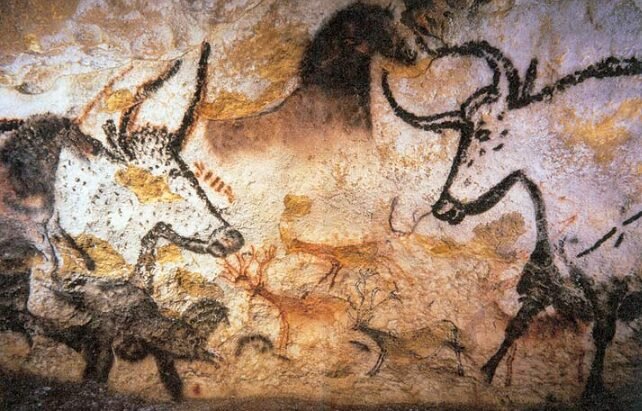
Lascaux cave painting, 15,000 BC, a UNESCO World Heritage Site
The Context and Characteristics of Upper Paleolithic Rock Art
European Upper Paleolithic rock art is predominantly found in regions like France, Spain, and Italy, with famous sites including the caves of Lascaux, Chauvet, and Altamira. These works encompass a variety of subjects, with depictions of animals such as bison, horses, mammoths, and deer being the most common. Human figures, abstract symbols, and handprints are also represented, though they are less frequent.
The techniques employed to create this art include painting with mineral pigments like ochre and charcoal, engraving into stone surfaces, and sculpting reliefs. The choice of location—deep within caves or exposed on open rock faces—adds to the intrigue, suggesting intentionality in placement. The isolation of many cave sites implies that their creators sought specific environments for their work, possibly imbued with spiritual or symbolic significance.
Theories on the Meaning of Upper Paleolithic Rock Art
Scholars have proposed various theories to explain the meaning and purpose of this art, ranging from practical and communicative functions to complex symbolic and ritualistic interpretations. Below are the main perspectives that have shaped our understanding:
Hunting Magic and Shamanism
One of the earliest interpretations of Upper Paleolithic rock art, proposed by French prehistorian Abbé Henri Breuil, posits that it served as a form of “hunting magic.” According to this theory, depictions of animals were intended to influence real-world hunting outcomes by capturing the essence of the prey and ensuring a successful hunt. This perspective emphasizes a direct connection between the art and the survival needs of Paleolithic communities.
A related theory is that the art represents shamanic practices, in which individuals entered altered states of consciousness to communicate with the spiritual world. The depiction of hybrid creatures—part human, part animal—supports this idea, as such figures may symbolize transformations experienced during shamanic trances. In this context, caves may have been viewed as liminal spaces where the physical and spiritual worlds intersected.
Social and Territorial Markers
Another interpretation suggests that rock art served as a means of social communication, marking territories or asserting group identity. The recurring motifs and stylistic similarities observed across regions could indicate shared cultural traditions or alliances among different groups. The placement of art in prominent or difficult-to-reach locations may have signaled ownership of resources or sacred spaces.
Ritual and Initiation
The theory that rock art played a role in rituals and initiation ceremonies is supported by the spatial arrangement of images within caves. Many artworks are located in deep, dark chambers, accessible only with great effort and often involving crawling or climbing. This suggests that the act of creating or viewing the art may have been part of a transformative experience, possibly linked to rites of passage or spiritual journeys.
Cognitive and Symbolic Expression
Rock art is also interpreted as an expression of the cognitive and symbolic capacities of Upper Paleolithic humans. The ability to create and understand abstract representations signifies advanced mental processes, including imagination, planning, and symbolic thought. The abstract symbols and complex compositions found in some sites indicate that these images were more than simple depictions—they likely carried layered meanings understood within their cultural context.
Storytelling and Mythology
Another perspective views rock art as a medium for storytelling and the transmission of cultural knowledge. The sequential arrangement of images and recurring themes suggest narratives or myths that were integral to the community’s worldview. This aligns with the idea that rock art functioned as a prehistoric “library,” preserving information about the natural world, social norms, and cosmological beliefs.
Challenges in Interpreting Upper Paleolithic Rock Art
Understanding the meaning of Upper Paleolithic rock art is fraught with challenges, primarily due to the absence of written records and the vast temporal and cultural distance separating us from its creators. Key obstacles include:
- Cultural and Temporal Variability Rock art was created over tens of thousands of years across diverse regions, suggesting that its meaning may have varied significantly over time and space. A single explanation is unlikely to encompass the full range of its functions and significance.
- Modern Biases Interpreting prehistoric art is inherently influenced by modern perspectives and cultural assumptions. Researchers must be cautious not to project contemporary values or beliefs onto the past.
- Contextual Ambiguity The lack of contextual information about the creators of the art and their daily lives complicates efforts to determine its purpose. While archaeological evidence provides clues, much of the cultural framework within which the art was produced remains speculative.
Methodologies in Studying Rock Art
To address these challenges, researchers employ a range of interdisciplinary methodologies, including:
Archaeological Contextual Analysis
Examining the archaeological context of rock art—such as associated artifacts, spatial distribution, and stratigraphy—helps to reconstruct the conditions under which it was created. This approach provides insights into the relationship between the art and its creators’ environment.
Comparative Ethnography
Ethnographic studies of contemporary and historical hunter-gatherer societies offer valuable analogies for understanding the possible meanings of rock art. For example, the use of art in ritual or shamanic practices among indigenous groups provides parallels that may inform interpretations of Upper Paleolithic imagery.
Experimental Archaeology
Recreating the techniques and materials used to produce rock art allows researchers to better understand the skills, tools, and effort involved. This can reveal clues about the significance of the art and the intentions of its creators.
Symbolic and Cognitive Analysis
Analyzing the symbolic and cognitive aspects of rock art involves studying patterns, motifs, and compositions to infer their underlying meanings. This approach often draws on theories of cognitive archaeology, which explores the evolution of human thought and symbolic behavior.
Scientific Techniques
Advances in scientific methods, such as radiocarbon dating, pigment analysis, and 3D modeling, have revolutionized the study of rock art. These techniques enable precise dating of artworks, identification of materials, and detailed reconstruction of their original appearance.
Case Studies of European Upper Paleolithic Rock Art
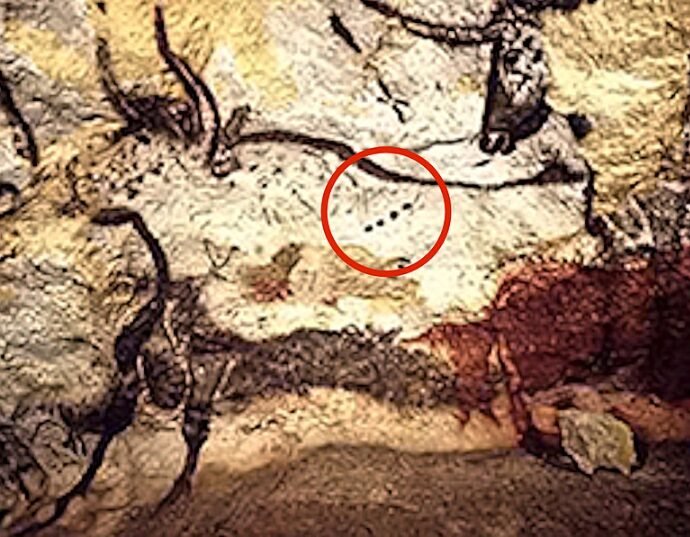
Art of Lascaux, with painted animal, and four dots – likely a notation for Lunar months
Lascaux Cave (France)
The cave of Lascaux, often referred to as the “Sistine Chapel of Prehistory,” features over 600 painted and engraved images, predominantly of animals. The exquisite realism of the depictions and their arrangement on the cave walls suggest a sophisticated understanding of both artistic techniques and animal behavior. Interpretations range from hunting-related symbolism to shamanic or ritualistic purposes.
Chauvet Cave (France)
Chauvet Cave contains some of the oldest known rock art, dating back over 30,000 years. Its images include powerful predators such as lions, bears, and rhinoceroses, as well as abstract symbols. The choice of subjects and their dynamic compositions have led scholars to propose that the art reflects a deep spiritual or cosmological significance.
Altamira Cave (Spain)
The polychrome paintings of Altamira, created around 20,000 years ago, are renowned for their vivid colors and intricate detail. The images, primarily of bison, are thought to have been created in a ritualistic context, possibly linked to fertility or seasonal cycles.
El Castillo Cave (Spain)
El Castillo features some of the oldest known symbolic art, including hand stencils and abstract red dots. These works, dating back over 40,000 years, highlight the early development of symbolic behavior in humans and possibly Neanderthals.

30,000-year-old cave lion and woolly rhinoceros painting found in the Chauvet Cave, France
Conclusion
The meaning of European Upper Paleolithic rock art remains an enduring enigma, reflecting the complexity and diversity of human thought during this formative period. While no single interpretation can fully encompass its significance, the art undoubtedly served as a medium for symbolic expression, social cohesion, and spiritual exploration. Through interdisciplinary research and continued discovery, we gain ever-deeper insights into the lives and minds of our prehistoric ancestors, bridging the gap between the ancient past and the present.
Frequently asked questions
What is rock art, and what forms does it include?
Rock art, also called parietal art, refers to prehistoric artistic expressions such as finger markings on soft surfaces, bas-relief sculptures, engraved symbols, and painted images on rock surfaces. Cave paintings, in particular, have drawn significant attention due to their visual complexity and widespread presence.
Where is rock art found, and when did it first appear in Europe?
Rock art is found worldwide, including in Africa, the Americas, Asia, Australia, and Europe. In Europe, the earliest rock art dates back about 36,000 years, reaching its peak around 18,000 years ago after the Last Glacial Maximum.
What factors contributed to the flourishing of European Upper Paleolithic rock art?
Improved climatic conditions after the Last Glacial Maximum allowed human populations to thrive, leading to increased artistic activity. The Franco-Cantabrian region, with its rich ecosystems and abundant resources, became a hotspot for this cultural phenomenon.
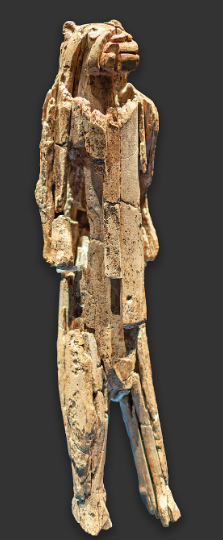
The lion man from the Stadel Cave in Hohlenstein, Lonetal.
What caused the disappearance of Upper Paleolithic rock art?
Upper Paleolithic rock art vanished around 12,000 years ago, coinciding with the end of the Ice Age and the transition to the Mesolithic period, which brought environmental and societal changes.
Why is the Franco-Cantabrian region significant in the study of rock art?
The Franco-Cantabrian region, spanning southeastern France to northern Spain, hosts some of the most significant examples of Upper Paleolithic rock art. Its favorable environment supported dense human populations, which is reflected in the abundance of archaeological material found there.
What is the “art for art’s sake” theory regarding rock art?
This theory suggests that rock art was decorative and lacked deeper psychological or cultural motivations. Early archaeologists viewed Upper Paleolithic humans as primitive, but this interpretation is now widely rejected.
How does the “boundary markers” theory explain rock art?
This theory posits that rock art served as territorial markers for Upper Paleolithic groups, indicating ownership of resources and reducing conflicts. Critics argue that this lacks archaeological support and does not explain the stylistic unity seen in some traditions.
What is the structuralist hypothesis about rock art?
French scholar André Leroi-Gourhan proposed that rock art follows a structured pattern based on binary oppositions, such as male and female identities. While this theory highlighted the cognitive abilities of Upper Paleolithic humans, it failed to account for the unique layouts of individual sites.
What is the hunting magic theory?
The hunting magic theory suggests that rock art was a form of sympathetic magic used to ensure hunting success. Depictions of wounded animals symbolized desired outcomes, and ritual practices likely boosted psychological confidence among hunters.
How does shamanism relate to the creation of rock art?
The shamanism theory proposes that rock art was created during altered states of consciousness, with abstract symbols representing hallucinations experienced by shamans. While compelling, this theory cannot account for the diversity of rock art traditions across Europe.
What evidence suggests a religious or ritualistic purpose for rock art?
The association of rock art with human burials and specific caves suggests ritualistic or ceremonial use. Rock art may represent the material remains of a broader spiritual tradition, much of which has not survived.
What conclusions can be drawn about the meaning of Upper Paleolithic rock art?
The meaning of Upper Paleolithic rock art is multifaceted, encompassing symbolic, social, and practical functions. Its diversity suggests multiple overlapping purposes, and interpretations must remain flexible as new evidence emerges. By studying rock art, we gain insights into the cognitive, cultural, and spiritual lives of our prehistoric ancestors.
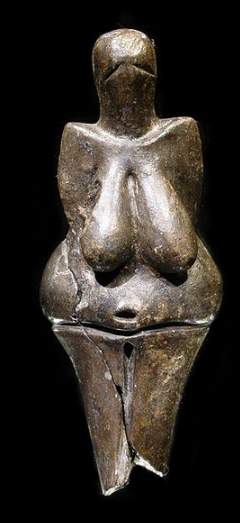
Venus of Dolní Věstonice, the oldest surviving ceramic figurine in the world (29,000 – 25,000 BC)