Assassination of Philip II of Macedon
The assassination of Philip II of Macedon in 336 BC marked a pivotal moment in ancient history. As a transformative leader, Philip II had unified Macedonia and established dominance over much of Greece, laying the foundation for his son Alexander the Great’s future conquests. His sudden death at the hands of Pausanias of Orestis at a public celebration disrupted the trajectory of Macedonian leadership and sparked numerous theories about motives, conspiracies, and the implications of his murder.

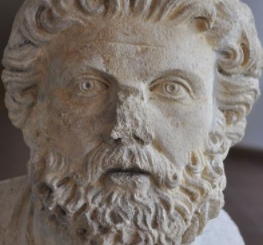
Bust of Philip II.
What event led to the assassination of Philip II? And who was Pausanias of Orestis, and why did he assassinate Philip II?
Below, World History Edu dives into the details surrounding the death of Philip II of Macedon, one of the greatest rulers in the ancient world.
READ MORE: 12 Greatest Ancient Military Commanders
The Event: The Assassination
Philip II was assassinated during the wedding of his daughter, Cleopatra of Macedon, to Alexander I of Epirus. The event, held in Aegae, the ancient capital of Macedonia, was a grand affair attended by many Greek dignitaries, diplomats, and nobles. As Philip entered the theater, unprotected to appear approachable, Pausanias of Orestis, a member of his bodyguard, fatally stabbed him. The assassin attempted to flee, but his escape was thwarted when his horse stumbled, allowing Philip’s other guards to apprehend and kill him.

The Assassin: Pausanias of Orestis
Pausanias of Orestis held the trusted position of royal bodyguard but reportedly harbored a deep personal grievance against Philip. Ancient accounts suggest that Pausanias acted out of a mixture of personal revenge and perceived dishonor. He had been allegedly mistreated after an incident involving Attalus, a powerful Macedonian noble and Philip’s ally. When Pausanias sought Philip’s intervention to restore his honor, the king’s failure to act fueled his resentment. This personal slight, combined with possible broader political motives, culminated in the dramatic act of regicide.
Suspected Motives and Theories
Ancient sources, including Aristotle, provide a straightforward explanation: Pausanias acted due to personal grievances against Attalus and Philip. Attalus had reportedly humiliated Pausanias in a public setting, and Philip’s decision to protect his ally rather than address Pausanias’ complaints may have left the bodyguard embittered.
Later historians, such as Cleitarchus and Justin, introduced theories of broader conspiracies, implicating figures like Queen Olympias (Philip’s wife) and even Alexander the Great. Olympias was said to have had motives to eliminate Philip due to his recent marriage to Cleopatra Eurydice, a union that threatened Alexander’s claim to the throne. The extent of her involvement remains speculative, but her later actions, such as honoring Pausanias after his death, have fueled these suspicions.
Philip’s ambitious plans to invade Persia may have created unrest within the Macedonian court. Some nobles, uneasy about the campaign or fearing marginalization under a prolonged reign, might have had an interest in his removal. Pausanias could have been a pawn in a larger plot, though no concrete evidence supports this claim.
Immediate Aftermath
After stabbing Philip, Pausanias attempted to escape to his waiting accomplices, but his horse stumbled, allowing Philip’s guards to capture and kill him. His abrupt death left many questions unanswered, fueling speculation about his motives and possible co-conspirators.
Philip’s assassination created an immediate power vacuum, but Alexander the Great quickly secured the throne. The Macedonian army and nobility proclaimed him king, ensuring continuity in leadership. Alexander’s decisive actions in consolidating power and eliminating potential rivals helped stabilize the kingdom in the wake of Philip’s death.
After Philip’s death, his assassin was killed during an escape attempt. His son, Alexander the Great, was proclaimed king by the Macedonian army and nobility, securing the Argead dynasty’s continuation.
Three brothers from the influential house of Lyncestis—Arrhabaeus, Heromenes, and Alexander—were implicated in the plot. Arrhabaeus and Heromenes were executed, while Alexander of Lyncestis was spared, reportedly due to a lack of evidence or as a political gesture by Alexander the Great.
The Role of Olympias
Olympias, Philip’s wife and Alexander’s mother, is frequently implicated in conspiracy theories surrounding the assassination. Her motives are often linked to concerns about her son’s succession. Philip’s marriage to Cleopatra Eurydice, a younger noblewoman, and the potential for a rival heir posed a direct threat to Alexander’s claim to the throne. Olympias’ actions after Philip’s death, such as crowning Pausanias’ corpse and ordering annual sacrifices in his honor, have been interpreted as signs of her involvement. However, these actions may also reflect her attempts to solidify Alexander’s position by aligning herself with anti-Philip sentiments within the court.

Olympias
Were there other suspects involved in the assassination?
The three sons of Aeropus of Lyncestis were implicated as accomplices. Two were executed, while the third, Alexander of Lyncestis, was pardoned. Some accounts also implicate Alexander and Olympias, Philip’s wife, in the conspiracy.
Ancient Historians’ Perspectives
Greek polymath Aristotle’s account is the simplest, attributing the assassination solely to Pausanias’ personal grievances. He provides little room for broader conspiracies, focusing instead on the dynamics of honor and loyalty at the Macedonian court.
These later historians embellished the story, suggesting deeper layers of intrigue and adding dramatic elements, such as Pausanias’ jealousy and Attalus’ role in provoking the assassin. Their accounts have shaped much of the narrative but are often criticized for their reliance on hearsay and lack of firsthand evidence.
Justin implicated Olympias and Alexander as potential instigators, drawing attention to their possible political motives. His account has been influential but remains speculative, with modern historians questioning its plausibility.
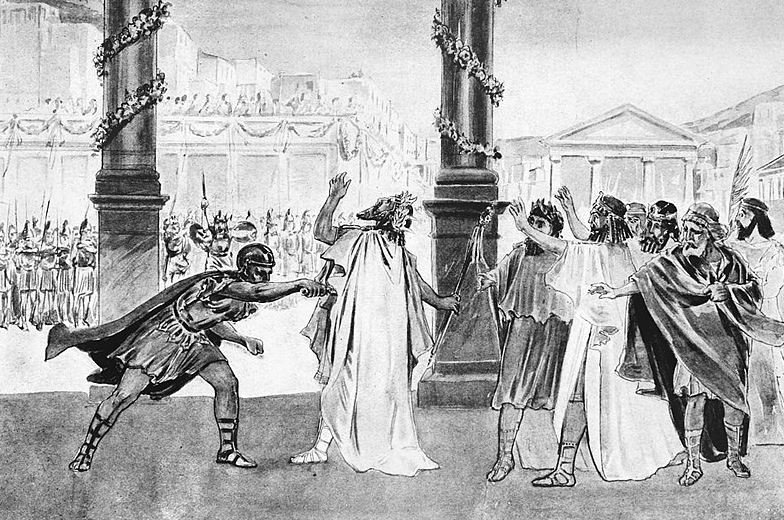
An illustration depicting Philip’s assassination.
Modern Interpretations
Contemporary historians approach Philip’s assassination with a critical eye, examining both ancient accounts and broader historical contexts. Many dismiss outright conspiracies involving Olympias and Alexander, arguing that the risks of such involvement would have been too great. Instead, they emphasize the personal dynamics at play, particularly Pausanias’ grievances and the culture of honor at the Macedonian court.
Archaeological Insights: Tomb II at Aegae
In 1977, archaeologist Manolis Andronikos discovered the royal tombs at Aegae (modern Vergina). One of the tombs, known as Tomb II, is widely believed to contain Philip II’s remains. The artifacts, including a golden larnax and intricate weaponry, suggest a royal burial of immense significance. Skeletal analysis has revealed injuries consistent with Philip’s known wounds, including damage to the right eye and a misaligned tibia. While some scholars have debated the tomb’s occupant, recent evidence strongly supports its identification as Philip’s final resting place.
Broader Implications of Philip’s Death
Philip’s assassination occurred on the eve of his planned campaign against the Achaemenid Empire. His death delayed the invasion but did not derail it, as Alexander the Great adopted and expanded upon his father’s strategy, achieving unprecedented conquests across Asia.
Philip’s death tested the resilience of the Macedonian state, which he had unified and strengthened through military reforms and diplomatic alliances. Alexander’s ability to maintain control and build upon his father’s achievements highlights the stability of the structures Philip had established.
Philip’s death ushered in the reign of Alexander the Great, who built on his father’s foundations to create one of history’s most remarkable empires.
Philip’s assassination altered the trajectory of history, as it placed Alexander in a position to redefine the ancient world. While Philip’s plans might have been more moderate, Alexander’s ambitious campaigns reshaped the Mediterranean and Near East, creating a legacy of Hellenistic culture and influence.
Frequently Asked Questions about Philip II of Macedon and his military campaigns
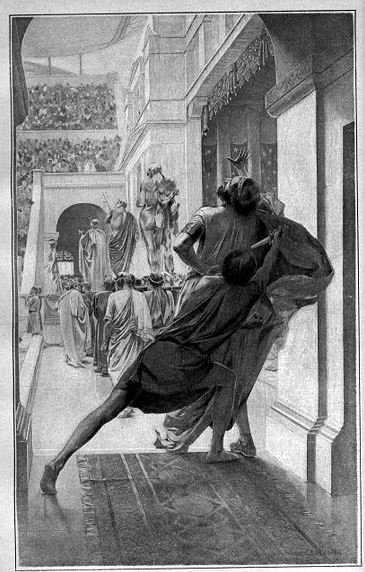
In 336 BC, Philip was assassinated in Aegae by his bodyguard, Pausanias, during his daughter’s wedding to Alexander I of Epirus. His son, Alexander III, was swiftly proclaimed king by the Macedonian army and nobility. Image: The assassination of Philip II by French artist André Castaigne.






Very good source