Bernardino Rivadavia: First President of Argentina
Bernardino Rivadavia was the first President of Argentina, serving from 1826 to 1827, and was a key figure in early Argentine politics, advocating for centralization and modernization.
Early Life and Background
Bernardino de la Trinidad González Rivadavia was born on May 20, 1780, in Buenos Aires, which was then part of the Viceroyalty of the Río de la Plata. He was the fourth son of Benito Bernardino González de Rivadavia, a Spanish lawyer of considerable wealth, and María Josefa de Jesús Rodríguez de Rivadeneyra. His parents, originally from the Galician town of Monforte de Lemos, belonged to the Spanish elite in Buenos Aires.
From an early age, Rivadavia was exposed to the intellectual and political movements shaping the region. He attended the Royal College of San Carlos but did not complete his studies. His career took a turn when he joined the local militia as a Third Lieutenant during the British invasions of the Río de la Plata in 1806 and 1807. His participation in these military campaigns marked his entry into the political and military affairs of the region.
On December 14, 1809, he married Juana del Pino y Vera Mujica, the daughter of Joaquín del Pino, the Viceroy of the Río de la Plata. This marriage further strengthened his ties to influential circles within the colonial administration. Despite his aristocratic connections, he became a strong advocate for change and reform.

Portrait of Bernardino Rivadavia.
Involvement in the May Revolution and the Early Government
Rivadavia played a crucial role in the political events leading up to Argentine independence. During the May Revolution of 1810, he was an active participant in the open cabildo (town meeting) of May 22, where he voted for the removal of Viceroy Baltasar Hidalgo de Cisneros. This event led to the establishment of the First Junta, which was the first step toward self-governance in the region.
By 1811, Rivadavia had risen to prominence within the revolutionary government. He became the dominant figure in the First Triumvirate, serving as Secretary of the Treasury and Secretary of War. His tenure was characterized by efforts to establish a strong central government while balancing relations with Spain and other European powers. However, his administration faced internal opposition, and by 1812, the First Triumvirate was overthrown, marking a temporary setback in his political career.
Diplomatic Mission in Europe
With the restoration of the Spanish monarchy under King Ferdinand VII in 1814, the United Provinces of the Río de la Plata faced significant challenges in securing international recognition.
Rivadavia, along with Manuel Belgrano, was sent to Europe on a diplomatic mission to seek support from both Spain and Britain. The primary objective was to negotiate the potential establishment of a constitutional monarchy under a European prince, specifically Francisco de Paula, son of Charles IV of Spain.
However, the mission failed as European powers, particularly Britain, were reluctant to support the cause of the United Provinces. Rivadavia also visited France before returning to Buenos Aires in 1821, where he resumed his involvement in politics.
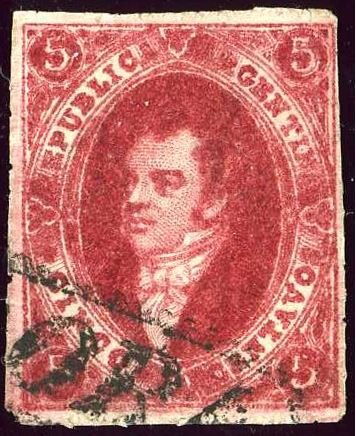
Rivadavia as depicted on stamps in Argentina.
Reforms in Buenos Aires
In 1821, Governor Martín Rodríguez appointed Rivadavia as Minister of Government for Buenos Aires Province. Over the next five years, he implemented a series of ambitious reforms aimed at modernizing the province. Inspired by his experiences in Europe, particularly in Britain and France, he sought to bring industrial, educational, and infrastructural advancements to Buenos Aires.
Some of his key reforms included the establishment of the University of Buenos Aires in 1821, the foundation of the Theatre, Geology, and Medicine Academies, and the creation of the continent’s first museum of natural sciences.
He also oversaw improvements to the city’s infrastructure, including the construction of wide avenues, paved roads, and street lighting. His vision was to transform Buenos Aires into a cosmopolitan city with European influences.
However, his policies often favored Buenos Aires at the expense of the rest of the provinces, which fueled resentment among Federalists who sought greater autonomy for their regions. Additionally, his economic policies, particularly his reliance on foreign loans, would have lasting consequences for Argentina’s financial stability.
The Baring Brothers Loan and Economic Policies
One of the most controversial aspects of Rivadavia’s administration was his decision to secure a foreign loan from the British banking firm Baring Brothers. The loan, amounting to one million pounds, was intended to fund public works projects.
However, much of the borrowed money was mismanaged or lost due to corruption and poor financial oversight. Only £552,700 of the original sum ever reached Buenos Aires, and much of it was loaned to local businessmen who never repaid their debts. This marked the beginning of Argentina’s long history of foreign debt.
The burden of repaying this loan ultimately fell on the nation as a whole, leading to financial difficulties that persisted for decades. The controversy surrounding this decision further divided the political factions within Argentina, with Federalists accusing Rivadavia of prioritizing foreign interests over national well-being.
Presidency and Challenges
In 1826, amidst the ongoing war with Brazil over the territory that would later become Uruguay, the need for centralized leadership led to the creation of the office of President of Argentina. Rivadavia was elected as the country’s first president, though his authority was largely recognized only in Buenos Aires.
During his presidency, he continued his efforts to modernize the nation. He implemented laws that sought to separate church and state, promoted immigration, and attempted to create a unified national identity. However, his administration faced significant challenges. The provinces rejected the centralized government model he advocated for, and his attempt to implement the Constitution of 1826 failed due to strong opposition from Federalist leaders.
The war with Brazil further weakened his position, as military conflicts drained the country’s resources and deepened political divisions. Ultimately, facing increasing opposition, Rivadavia resigned on June 27, 1827. His departure marked the collapse of the centralist project, and he was succeeded by Vicente López y Planes.
Despite the controversies surrounding his administration, Bernardino Rivadavia’s legacy remains an integral part of Argentina’s historical narrative.
Exile and Later Years
Following his resignation, Rivadavia initially attempted to remain in Argentina but faced intense hostility from his political adversaries. In 1829, he went into exile, first traveling to Uruguay and then to Europe.
He returned to Argentina briefly in 1834, hoping to re-enter the political arena, but was immediately forced into exile once more. This time, he traveled to Brazil and later settled in Spain. He spent his final years in Cádiz, where he died on September 2, 1845. Before his death, he requested that his remains never be returned to Buenos Aires. However, in 1857, his remains were repatriated to Argentina and buried in a mausoleum at Plaza Miserere in Buenos Aires, an area later named in his honor.
Legacy and Historical Perspectives
Rivadavia remains a complex and polarizing figure in Argentine history. His contributions to education, culture, and urban development in Buenos Aires are widely acknowledged, as is his role in laying the foundation for a centralized government. However, his policies were often criticized for favoring Buenos Aires over the provinces, leading to lasting divisions between Unitarians and Federalists.
Liberal historians have celebrated Rivadavia as a forward-thinking reformer who sought to modernize Argentina and integrate it into the global economy. They highlight his efforts in education, infrastructure, and governance as essential steps toward nation-building.
On the other hand, revisionist historians have condemned his economic policies, particularly the Baring Brothers loan, as detrimental to Argentina’s financial health. His Anglophilia and preference for European models of governance have also been criticized as being disconnected from the realities of Argentina’s diverse provinces.
Chair of Rivadavia
Today, Bernardino Rivadavia’s influence is still visible in Argentina. The Presidential chair is metaphorically referred to as the “Chair of Rivadavia,” symbolizing his status as the nation’s first president. His image has appeared on Argentine postage stamps since 1864, and numerous streets, schools, and institutions bear his name.
Frequently Asked Questions
What role did Bernardino Rivadavia play in the May Revolution?
He participated in the open cabildo of May 1810, voting for the removal of the viceroy, and later became a dominant figure in the First Triumvirate, focusing on centralizing power.
Why did Rivadavia travel to Europe in 1814?
He was sent on a diplomatic mission with Manuel Belgrano to seek support for the United Provinces from Spain and Britain, but the mission failed to secure international recognition.
What were Rivadavia’s key reforms in Buenos Aires?
He promoted education, founded the University of Buenos Aires, improved infrastructure, and sought to modernize the city based on European models.
Why was the Baring Brothers loan controversial?
The loan was mismanaged, with only a portion reaching Buenos Aires, leading to financial burdens that lasted for decades and criticism of Rivadavia’s economic policies.
What led to Rivadavia’s resignation as President?
Strong opposition from Federalist provinces, failure to implement the 1826 Constitution, and the ongoing war with Brazil weakened his position, forcing him to resign in 1827.
Where did Rivadavia spend his exile and when did he die?
He lived in Uruguay, Brazil, and Spain, where he died in 1845. Despite his request not to be buried in Buenos Aires, his remains were repatriated in 1857.





