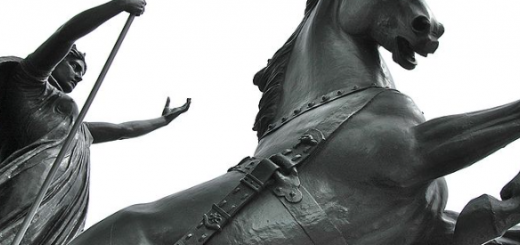
Boudicca’s Revolt, according to Tacitus
Queen Boudicca’s revolt against Roman rule in Britain, which took place around AD 60-61, is one of the most famous and significant uprisings in British history. The Roman historian Tacitus is our principal source for this event, and through his writings, he provides a vivid account of the rebellion led by Boudicca, the queen of the Iceni tribe. Tacitus, who was not only a historian but also the son-in-law of Gnaeus Julius Agricola, the Roman governor of Britain, had access to firsthand accounts and records that helped shape his narrative of Boudicca’s revolt.
In the article below, World History Edu explores Tacitus’ account of Boudicca’s revolt in-depth, focusing on his portrayal of the events, his perspective as a Roman historian, and the wider implications of the revolt for both the Roman Empire and the native Britons.

Image: A map depicting Boudicca’s revolt.
The Context of the Revolt
When the Roman Empire first established its presence in Britain, it did so through a series of military campaigns that gradually extended its control over the local tribes. By the time of the revolt, many tribes had either submitted to Roman rule or had formed client-kingdoms under Rome’s influence. The Iceni, a powerful tribe located in what is now Norfolk, were one such client kingdom. Their king, Prasutagus, had enjoyed a relatively peaceful relationship with the Romans, balancing loyalty to Rome while maintaining some level of independence for his people.
However, upon the death of Prasutagus, the situation changed dramatically. According to Tacitus, Prasutagus had left his kingdom jointly to his two daughters and the Roman Emperor, Nero, in an attempt to safeguard his family’s status and his tribe’s semi-autonomous relationship with Rome. This move, however, was not honored by the Roman authorities. Instead, they sought to directly annex the Iceni territory, seizing land and property, and treating the Iceni people as if they were conquered enemies rather than allies.
Tacitus tells us that the Romans’ brutal treatment of the Iceni, particularly the humiliating public flogging of Boudicca and the rape of her daughters, was a major catalyst for the revolt. The Roman abuse of power and disregard for native customs and leadership created an environment ripe for rebellion.
Boudicca: The Leader of the Revolt
Boudicca, the widow of Prasutagus, emerges as the central figure in the revolt. Tacitus’ portrayal of Boudicca is both sympathetic and heroic, emphasizing her strength and determination. As a woman leading a large-scale uprising in a patriarchal society, Boudicca stood out as an exceptional figure, and Tacitus highlights this by describing her physical appearance and her ability to inspire her followers. According to Tacitus, she was a tall woman with a fierce expression, a mass of tawny hair, and a loud voice that commanded attention.
In his speeches attributed to her, Tacitus presents Boudicca as both a symbol of native resistance and a defender of freedom. She speaks passionately about the oppression of her people and the need to fight for their rights and liberties. While some historians argue that Tacitus may have embellished or even invented these speeches to enhance the drama of his narrative, they nonetheless serve to underscore the broader themes of the revolt: the clash between the Roman Empire’s imperial ambitions and the desire of the native Britons to preserve their autonomy and way of life.
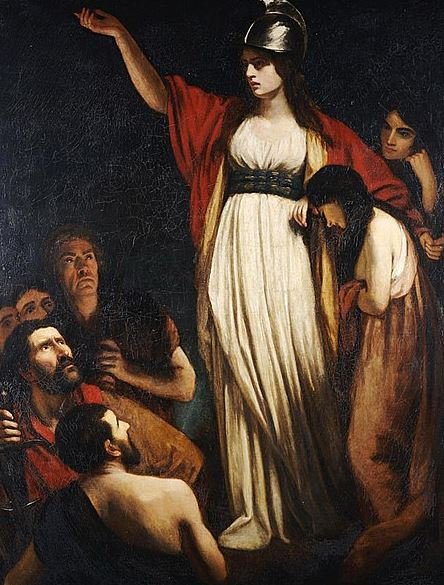
Image: A painting titled “Boadicea Haranguing the Britons” by English painter John Opie.
The Course of the Revolt
Boudicca’s revolt was characterized by a series of violent attacks on Roman settlements and military installations in Britain. The initial stages of the uprising were marked by considerable success. According to Tacitus, the rebel forces first targeted the Roman colony of Camulodunum (modern-day Colchester), which was a symbol of Roman power and domination. The town was poorly defended, and the rebels were able to overwhelm the Roman forces stationed there, slaughtering the inhabitants and burning the town to the ground.
From Camulodunum, Boudicca’s forces moved on to Londinium (modern-day London), which was also sacked and destroyed, followed by the destruction of Verulamium (modern-day St. Albans). The brutality of the revolt, particularly the widespread killing of Roman civilians and the destruction of property, is a prominent feature of Tacitus’ account. He emphasizes the scale of the destruction, describing how entire towns were reduced to ashes and how Roman citizens were massacred without mercy.
At the height of the revolt, Tacitus claims that as many as 70,000 Roman citizens and their allies were killed. This figure, though possibly exaggerated, reflects the sense of chaos and devastation that the rebellion caused in Roman Britain. For a time, it seemed as though Boudicca’s forces might even drive the Romans out of Britain entirely.
Roman Response and the Battle of Watling Street
Despite the initial successes of Boudicca’s revolt, the Roman Empire was not one to be easily defeated. The Roman governor of Britain at the time, Suetonius Paulinus, had been campaigning in North Wales when the revolt began, but he quickly moved to confront the rebels. Tacitus presents Suetonius as a capable and determined commander who, despite being outnumbered, managed to strategically position his forces to face Boudicca’s army in what would become the decisive battle of the revolt.
The exact location of the final battle is not known with certainty, but it is commonly referred to as the Battle of Watling Street. Tacitus describes how Suetonius chose a narrow defile with a dense forest on one side and open terrain on the other, which limited the ability of Boudicca’s much larger force to maneuver effectively. This tactical advantage, combined with the discipline and training of the Roman legions, allowed the Romans to defeat the rebels decisively.
Tacitus’ account of the battle highlights the contrast between the disciplined Roman soldiers and the more chaotic, poorly organized native forces. Despite their numerical superiority, Boudicca’s army was no match for the Roman legions, and the result was a complete rout of the rebel forces. Tacitus claims that as many as 80,000 Britons were killed in the battle, a figure that, like his earlier estimates of Roman casualties, may be exaggerated but nonetheless conveys the scale of the defeat.
Following the battle, Boudicca either took her own life or died of illness, according to different versions of the story. Tacitus prefers the version in which she takes poison to avoid capture, thus maintaining her dignity as a leader and symbol of resistance until the end.
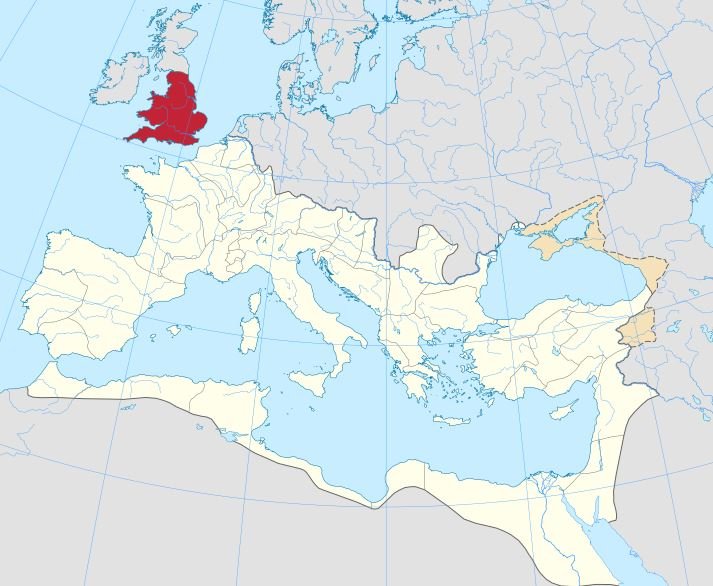
The Roman province of Britain, shown in red, where the revolt occurred, with the Roman Empire depicted in white.
Tacitus’ Perspective and Bias
While Tacitus’ account of Boudicca’s revolt is the most detailed and influential, it is important to recognize the potential biases in his writing. As a Roman historian, Tacitus was writing for a Roman audience, and his portrayal of the events is shaped by his perspective as a member of the Roman elite. His depiction of the Britons as barbaric and uncivilized, in contrast to the disciplined and orderly Romans, reflects the broader Roman view of their empire as a civilizing force in a world of chaos.
At the same time, Tacitus is not uncritical of Roman behavior. He openly acknowledges the role that Roman greed and cruelty played in sparking the revolt, particularly the mistreatment of Boudicca and her daughters and the exploitation of the Iceni people. This critical stance may reflect Tacitus’ broader concerns about the moral decay of the Roman Empire, which is a recurring theme in his works.
Tacitus also uses Boudicca’s revolt as an opportunity to explore larger themes of freedom, tyranny, and resistance to oppression. In many ways, Boudicca is portrayed as a tragic figure, fighting a hopeless battle against an overwhelming and oppressive force. Her rebellion is not just a reaction to specific Roman abuses but a broader struggle for liberty and justice, themes that would have resonated with Tacitus’ Roman readers, who were themselves living under the increasingly autocratic rule of the emperors.

Image: Tacitus’ statue standing outside the Austrian Parliament Building
The Aftermath of the Revolt
The defeat of Boudicca’s rebellion marked the end of large-scale resistance to Roman rule in Britain, although smaller uprisings and skirmishes would continue for many years. In the immediate aftermath of the revolt, Suetonius Paulinus embarked on a brutal campaign of retribution, targeting not only those directly involved in the uprising but also other tribes that had remained neutral or wavered in their loyalty to Rome. Tacitus mentions that whole areas were laid waste and that the severity of Suetonius’ response led to his eventual replacement as governor.
In the longer term, the Roman authorities adopted a more conciliatory approach to governing Britain. Under the subsequent governors, Roman policy in Britain shifted towards integration and consolidation, with efforts to promote Romanization and win the loyalty of the native population. The revolt had demonstrated the dangers of alienating the local tribes, and the Roman authorities were keen to avoid a repeat of such a costly and destructive rebellion.
For the native Britons, the revolt had far-reaching consequences. The destruction wrought by the rebellion and its aftermath disrupted local economies and societies, and the Roman response further entrenched Roman power in the region. However, the revolt also served as a powerful symbol of resistance, and Boudicca herself became a legendary figure, remembered for her courage and determination in the face of overwhelming odds.
Conclusion
Tacitus’ account of Boudicca’s revolt is a compelling and dramatic narrative that offers valuable insights into both the nature of Roman imperialism and the responses of the native populations to Roman rule. While Tacitus’ portrayal of the events is undoubtedly shaped by his Roman perspective, his account nonetheless captures the complexity of the revolt and its significance for both the Romans and the Britons.
Boudicca, as portrayed by Tacitus, is more than just a historical figure; she is a symbol of resistance against tyranny, a defender of freedom, and a tragic hero in a struggle that, while doomed to failure, left a lasting legacy in British history.
The Decline of Roman Britain and the Rise of Anglo-Saxon England
Frequently Asked Questions

Who was Publius Gaius Cornelius Tacitus?
Publius Gaius Cornelius Tacitus (ca. 56 – ca. 117 CE) was a Roman Senator and historian known for his detailed accounts of the Roman Empire. His writings provide one of the most vivid descriptions of Queen Boudicca’s revolt against Rome in 60-61 CE.
What triggered Boudicca’s revolt against the Romans?
The revolt was triggered by the death of Prasutagus, the king of the Iceni tribe, who had willed his wealth to be shared between his two daughters and the Roman emperor. Instead of respecting this will, Roman officials seized his lands, pillaged his property, enslaved his people, flogged his widow Boudicca, and assaulted her daughters. These actions enraged the Iceni and their allies, sparking a rebellion.
Which tribes joined the Iceni in the revolt?
The Trinobantians, along with other neighboring tribes, joined the Iceni in the revolt. These tribes were angered by Roman oppression and eager to fight for their liberty.
How did the Roman veterans in Camulodunum contribute to the revolt?
Roman veterans settled in Camulodunum treated the native Britons cruelly, seizing their lands and calling them slaves and captives. The temple dedicated to Emperor Claudius in Camulodunum also became a symbol of Roman oppression, with its priests exploiting the local population. These actions further fueled the Britons’ anger, making Camulodunum an early target of the revolt.
What ominous signs preceded the revolt, according to Tacitus?
Several ominous signs, including the sudden collapse of the statue of Victory at Camulodunum, women prophesying doom, and strange visions near the Thames, shook the Romans’ confidence. These signs emboldened the Britons, who saw them as indications of their forthcoming victory.
What happened at Camulodunum during the early stages of the revolt?
Camulodunum was poorly defended when the revolt began. The veterans called for reinforcements from Catus Decianus, but he could only send 200 poorly armed men. The Britons overwhelmed the Roman colony, storming the temple after a two-day siege. Petilius Cerealis, commanding the ninth legion, attempted to relieve the colony but was ambushed, resulting in the massacre of his infantry. He fled with his cavalry, and Decianus fled to Gaul in fear.
Why did Suetonius abandon London?
Suetonius Paulinus, the Roman governor, abandoned London due to his limited forces and fear of suffering a similar defeat to Petilius Cerealis. He chose to withdraw and regroup, leaving the city to the mercy of Boudicca’s forces. Those who remained in London were massacred, as were the inhabitants of Verulamium (modern-day St. Albans).

Image: A statue of Boudica at Westminster, London
How many Roman citizens and allies were estimated to have been killed during the revolt?
Tacitus estimates that around 70,000 Roman citizens and allies were killed during the revolt, with no one spared by the Britons, who were driven by a desire for plunder and revenge.
How did Suetonius prepare for the final battle against Boudicca’s forces?
Suetonius regrouped with reinforcements, raising his army to around 10,000 men. He chose a defensible position surrounded by woods, with only one narrow entrance, ensuring that the Britons could only attack from the front. This strategic position gave the Roman forces a significant advantage over the more chaotic and undisciplined Britons.
What did Boudicca say in her address to her army?
Boudicca, addressing her army from a chariot with her daughters, reminded her warriors that they were fighting for freedom, not only for her lost kingdom but for their dignity and liberty. She called for revenge for the wrongs committed by the Romans, especially the abuse of her daughters, and vowed that they would either win glory or die fighting.
How did Suetonius motivate his soldiers before the final battle?
Suetonius urged his soldiers to ignore the Britons’ wild behavior, reminding them of their previous victories over the Britons. He emphasized the importance of discipline and courage, assuring his men that their small, disciplined force could defeat the larger but disorganized Briton army. He told them to focus on victory, knowing it would bring them all they desired.
How did the final battle between the Romans and Boudicca’s forces go down?.
The battle began with the Britons advancing fiercely, but the narrow terrain limited their movements. The Roman forces, in a tight formation, launched a devastating counterattack, pushing forward with their shields and swords. The Britons, caught between the Roman forces and their own wagons, were slaughtered in large numbers. Tacitus claims that 80,000 Britons were killed that day, while Roman losses were minimal.
What happened to Boudicca after the final battle?
After the final battle, Boudicca, facing defeat, took her own life by poisoning herself, according to Tacitus.