British officer John Winslow
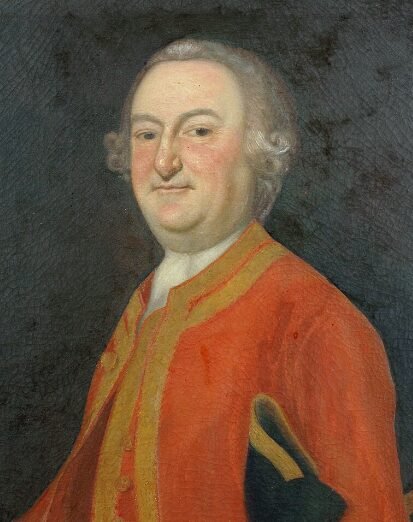
Major-General John Winslow’s life was shaped by the military conflicts and colonial politics of 18th-century North America. Image: A portrait of John Winslow by British painter Joseph Blackburn
Major-General John Winslow (10 May 1703 – 17 April 1774) was a significant figure in colonial American military history, particularly remembered for his role in the Acadian Expulsion during the French and Indian War. A descendant of the prominent Winslow family of Plymouth Colony, he was a member of New England’s elite and served in various military and administrative roles over his long career.
Early Life and Family Background
John Winslow was born on May 10, 1703, in Marshfield, Massachusetts, into a family with deep colonial roots. His father was Isaac Winslow, a great-grandson of Edward Winslow, one of the leaders of the Pilgrims who arrived on the Mayflower and served as a governor of Plymouth Colony. This illustrious lineage ensured that John Winslow grew up with strong ties to the colonial elite and played a significant role in shaping his career.
Despite his family’s prominence, John Winslow’s early life was shaped by the economic and military challenges of New England during the early 18th century, when tensions between the British colonies and the French, as well as with various Indigenous groups, were constantly simmering. Winslow’s military career would emerge from this volatile environment.
Military Career
King George’s War (1744–1748)
Winslow’s military career began in earnest during King George’s War (1744–1748), which was part of the larger conflict known in Europe as the War of the Austrian Succession. The war was primarily a struggle between Britain and France for control of North America, with both sides allying with various Native American tribes. Winslow served as an officer in the Massachusetts militia and participated in the Siege of Louisbourg in 1745, a key British victory that resulted in the capture of the French fortress on Cape Breton Island.
This experience helped establish Winslow as a capable military leader, and his leadership during the siege earned him recognition among his peers and superiors.
The French and Indian War (1754–1763)
Winslow is most famous for his role in the French and Indian War, which was part of the larger global conflict known as the Seven Years’ War. This war saw British and French forces, along with their respective Native American allies, fight for control of North America.
In 1755, Winslow was given command of British colonial forces in the effort to remove the French population from the region of Acadia, which is today part of the Canadian Maritime provinces. The Acadians were a French-speaking, Catholic population who had lived in the region for generations. They were seen as a threat by the British because of their potential to support the French military, even though many Acadians wanted to remain neutral in the conflict.
The Acadian Expulsion (1755)
Winslow’s most controversial and remembered role was his command in the Expulsion of the Acadians, also known as the Great Upheaval or Le Grand Dérangement. In July 1755, under orders from British Governor Charles Lawrence, Winslow oversaw the forced deportation of approximately 7,000 Acadians from their homes in present-day Nova Scotia. This event was part of a broader British strategy to remove French influence from the region.
Winslow was stationed at Grand-Pré, a major Acadian settlement, where he gathered the Acadian men under the pretense of discussing their land and allegiance. Once gathered, Winslow announced that they were to be deported, and he began the process of separating families and confiscating property. Many Acadians were deported to the American colonies, while others were sent to France, the Caribbean, or England. Some fled to the wilderness or were captured and killed during the process.
The expulsion was a traumatic event for the Acadian people, and Winslow’s involvement in it has left a mixed legacy. While he was following orders, some of his diary entries suggest that he was uncomfortable with the harsh measures he had to enforce. Nonetheless, his role in the deportation remains a significant part of his historical reputation.
Later Military Service
Following the expulsion, Winslow continued to serve in various military and administrative capacities. He played a role in the British campaigns against the French in the later stages of the French and Indian War, including serving at Fort William Henry and Fort Edward. However, his active military career began to wind down after the war’s conclusion in 1763.
Personal Life and Legacy
John Winslow married Mary Little, and they had several children. His family continued to hold a prominent position in New England society, with many descendants going on to achieve notable success in politics, business, and the military.
After his military service, Winslow settled back into civilian life in Massachusetts. He held several administrative positions, including serving as a justice of the peace and as a member of the Massachusetts General Court (the colonial legislature).
John Winslow died on April 17, 1774, in Hingham, Massachusetts, at the age of 70. He was buried in Winslow Cemetery in Marshfield, Massachusetts, alongside other members of his distinguished family.
Historical Significance and Legacy
Major-General John Winslow is remembered primarily for his role in the Acadian Expulsion, a complex and controversial chapter in the history of colonial North America. While his military career was marked by service in key conflicts like King George’s War and the French and Indian War, it is his role in the forced deportation of the Acadians that has garnered the most attention from historians.
Winslow’s personal writings, including his diaries, provide valuable insights into his thoughts during these events. Although he carried out his orders with military precision, there are moments in his writings that suggest he was uneasy with the human cost of the expulsion. For example, he lamented the disruption of families and the destruction of homes, even as he oversaw the operation.
His mixed feelings, coupled with the significant impact of the deportation on the Acadian people, have made Winslow a subject of both criticism and sympathy in historical analyses. In Acadian and French-Canadian history, he is often viewed negatively as a symbol of British oppression, while in British and American colonial history, his actions are seen as part of the larger struggle for control over North America.
Today, Winslow’s legacy is remembered in places like Grand-Pré, Nova Scotia, which is now a UNESCO World Heritage site commemorating the Acadian people and their history, including the events of the deportation. His name also endures through his family’s continued prominence in New England, and through his role in some of the most significant military events of colonial American history.

Questions and Answers
Who was Major-General John Winslow?
Major-General John Winslow (1703–1774) was a British Army officer and a descendant of Edward Winslow, one of the original Pilgrims. He was born into the prominent Winslow family in Marshfield, Massachusetts, with deep ties to New England’s colonial history.
What is significant about John Winslow’s family background?
Winslow came from a distinguished family. His great-grandfather, Edward Winslow, and grandfather, Josiah Winslow, both served as governors of Plymouth Colony. This heritage made the Winslows one of the most notable families in early New England.
What happened to John Winslow’s older brother during Father Rale’s War?
Winslow’s older brother, Josiah, was killed by members of the Wabanaki Confederacy in the Northeast Coast Campaign of 1724. In honor of his brother, John named his firstborn son Josiah.
Whom did John Winslow marry, and how many children did they have?
John Winslow married Mary Little in 1725, a descendant of Pilgrim Richard Warren. Together, they had three children: Josiah, Pelham, and Isaac Winslow.
What were John Winslow’s early career roles before he joined the British Army?
Before joining the British Army, Winslow held various local offices in Plymouth, Massachusetts, establishing himself as a prominent figure in the local community.
What military expedition did John Winslow participate in during 1740, and what was the outcome?
In 1740, Winslow was commissioned as a captain in a British expedition to Cuba, which ultimately failed.
What role did John Winslow play in the British Army after his commission?
After the failed expedition to Cuba, Winslow transferred to the British Army and served as a captain in the 40th Regiment of Foot. He was stationed at Annapolis Royal in Nova Scotia and St. John’s in Newfoundland.
Who was Briton Hammon, and what is his connection to John Winslow?
Briton Hammon was one of Winslow’s slaves who later gained attention by publishing a narrative titled The Narrative of the Uncommon Suffering and Surprizing Deliverance of Briton Hammon in 1760, detailing his own life and experiences.
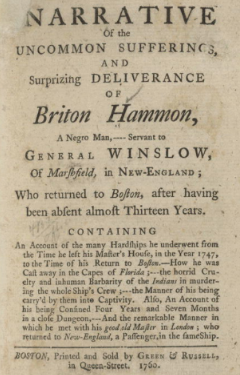
One of John Winslow’s slaves, Briton Hammon, published a memoir in 1760 titled The Narrative of the Uncommon Suffering and Surprizing Deliverance of Briton Hammon, chronicling his extraordinary life experiences





