King George’s War (1744–1748)
King George’s War (1744–1748) was the third in a series of four conflicts between Britain and France in North America, known collectively as the French and Indian Wars. It was the North American theater of the broader European conflict known as the War of the Austrian Succession (1740–1748). The war had significant impacts on colonial society in North America and laid the groundwork for future tensions between the British and French, culminating in the final conflict, the French and Indian War (1754–1763).
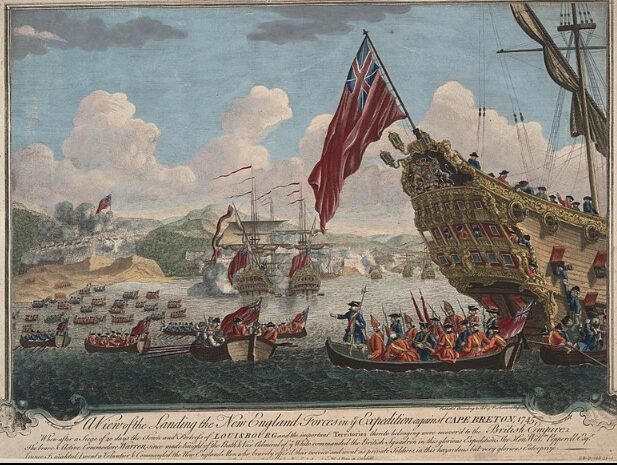
King George’s War, although relatively short, was a crucial episode in the long-running struggle between Britain and France for control of North America. Image: Colored engraving depicting the 1745 Siege of Louisbourg, during which British forces captured the French fortress after a 47-day siege in July.
Background and Context
The war was part of the larger geopolitical struggle between Britain and France for dominance in Europe and the colonies. The War of the Austrian Succession erupted in 1740 over issues of royal succession in Austria after the death of Emperor Charles VI. Britain and France found themselves on opposite sides of the conflict, with France supporting Prussia and Spain against Austria, Britain, and their allies.
In North America, this European conflict translated into direct military engagements between the British and French colonies. New France, located primarily in present-day Canada and the Great Lakes region, clashed with British colonies that stretched along the eastern seaboard of what is now the United States. Both sides sought to expand their influence over the lucrative fur trade and establish dominance over strategic locations, such as Nova Scotia and the Ohio Valley.
Causes of the War in North America
The central causes of King George’s War in North America were rooted in territorial disputes and trade competition. Both the British and the French sought to control key regions that would allow them to dominate North American trade routes and resources, particularly the fur trade.
Control over the fisheries of the North Atlantic, especially around Newfoundland, was also a point of contention. The frontier regions, where British and French interests clashed, were often poorly defined, leading to skirmishes between settlers, Native American tribes, and colonial militias.
The war in North America formally began in 1744, when French forces launched an attack on the British colony of Nova Scotia, specifically targeting the town of Canso. French forces from Louisbourg, a fortified French settlement on Cape Breton Island, captured the British garrison there, marking the beginning of hostilities in the region.
Major Events and Battles
The most notable campaign of King George’s War was the Siege of Louisbourg in 1745. Louisbourg, a key French fortress on Cape Breton Island, was one of the most important strategic locations in New France. It controlled access to the Gulf of St. Lawrence and, by extension, the entire interior of New France. Louisbourg was heavily fortified and served as a base for French naval operations in the North Atlantic.
In 1745, a force of approximately 4,200 colonial militia from New England, under the command of William Pepperrell, launched a daring siege of Louisbourg. Supported by the British Royal Navy, the colonial forces besieged the fortress for several weeks. Despite the odds, they successfully captured Louisbourg in June 1745, dealing a significant blow to French power in the region. The victory at Louisbourg was a source of immense pride for the New England colonies, as it demonstrated their ability to fight effectively without direct assistance from the British Army.
Other notable battles during the war included skirmishes and raids along the frontier, particularly in New York and New England. French and Native American forces often launched attacks on British settlements, while British colonial forces mounted retaliatory raids on French settlements. This form of guerrilla warfare resulted in considerable civilian casualties and fostered a sense of fear and insecurity along the frontier.
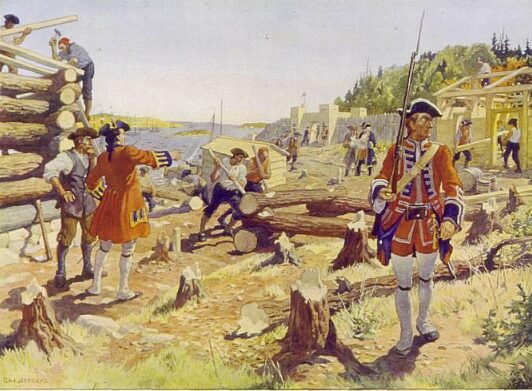
British soldiers guarded Halifax in 1749, as fighting between the British and Acadian and Mi’kmaq militias persisted despite the peace treaty’s signing.
Impact on Native American Tribes
Native American tribes played a significant role in the conflict, often aligning with either the French or the British based on their own interests. The Iroquois Confederacy, a powerful alliance of six Native American nations, generally sided with the British, as they saw the expansion of French influence in the Ohio Valley as a threat to their territory. Other tribes, such as the Abenaki and Mi’kmaq, sided with the French, with whom they had long-standing trading relationships.
For many Native American groups, King George’s War was a continuation of decades of conflicts over land and trade. The shifting alliances and the destruction caused by the war had lasting effects on Native communities, contributing to the erosion of their power in the region as both the French and British continued to expand their territorial claims.
Treaty of Aix-la-Chapelle (1748) and the Aftermath
The war ended with the Treaty of Aix-la-Chapelle in 1748, which restored the territorial status quo ante bellum. This meant that all territories captured during the war, including Louisbourg, were returned to their original owners. The British reluctantly handed Louisbourg back to the French in exchange for the return of the city of Madras in India, which had been captured by the French during the war. This decision angered many colonists in New England, who had sacrificed much to capture Louisbourg and saw its return to France as a betrayal by the British government.
Although the war ended with little territorial change, the conflict had significant consequences. The New England colonies were left heavily in debt from the cost of raising militias and funding the campaign against Louisbourg. The war also heightened tensions between British settlers and Native Americans, as colonial expansion into previously contested territories increased after the conflict.
Most importantly, King George’s War laid the groundwork for the final and most decisive conflict between Britain and France in North America: the French and Indian War (1754–1763). The unresolved tensions and territorial disputes, combined with the ongoing rivalry between Britain and France, would lead to another, more significant conflict just a few years after the end of King George’s War.
Major Facts About King George’s War
- Timeframe: King George’s War lasted from 1744 to 1748.
- Connection to European Conflicts: It was the North American theater of the broader War of the Austrian Succession (1740–1748).
- Key Participants: The war involved British and French colonial forces, supported by their respective Native American allies. Major colonial players included New England, New York, and New France (Canada).
- Main Battle: The Siege of Louisbourg in 1745 was the most important and successful campaign for the British colonists.
- Outcome: The Treaty of Aix-la-Chapelle in 1748 restored territorial boundaries to their pre-war status. Despite the British victory at Louisbourg, the fortress was returned to the French.
- Impact on Colonists: The war left many British colonies, particularly in New England, deeply in debt and frustrated by the British government’s decision to return Louisbourg. It also emboldened the colonists’ sense of their military capabilities, setting the stage for future resistance against British rule.
- Native American Involvement: Native American tribes played crucial roles on both sides of the conflict, with some siding with the French and others with the British. The war had lasting impacts on their land, trade networks, and relationships with European settlers.

King George’s War, marked by major battles like the Siege of Louisbourg, as well as brutal frontier warfare, showcased the growing military capabilities of the American colonies. The unresolved issues of the war, particularly the tensions between Britain and France over North American territories, would soon lead to a much larger and more decisive conflict in the form of the French and Indian War. Image: French and Mi’kmaq forces raided Grand Pré, February 1747, attacking settlements.