Early Life and Apprenticeship
Canaletto was born into an artistic family; his father, Bernardo Canal, was a respected painter, and his mother was Artemisia Barbieri. The nickname “Canaletto,” meaning “little Canal,” highlighted his familial lineage and set him apart in Venice’s artistic circles.
Under the tutelage of his father and alongside his brother, Canaletto apprenticed in theatrical scene painting. This early training involved designing elaborate sets for operas, including those by composers like Fortunato Chelleri, Giovanni Porto, and the renowned Antonio Vivaldi by 1718.
This foundational experience ingrained in Canaletto a keen eye for architectural detail and perspective, skills that would later define his signature style.
Journey to Rome and Artistic Evolution
In 1719, Canaletto journeyed to Rome, where he collaborated with his father on staging two operas by Alessandro Scarlatti: “Tito Sempronio Greco” and “Turno Aricino.” Performed at the Teatro Catranica during the 1720 carnival season, these projects exposed Canaletto to the works of Giovanni Paolo Pannini, a leading Roman vedutista.
Inspired by Pannini’s ability to blend realistic cityscapes with imaginative elements, Canaletto began to explore capturing daily life and vibrant urban scenes, merging authenticity with creative flair. This period was crucial in his transition to topographical painting, laying the groundwork for his future masterpieces.
Return to Venice and Development of Vedute
Upon returning to Venice in 1719, Canaletto focused on developing his distinctive topographical style, specializing in detailed cityscapes known as vedute. His first known signed and dated work, “Architectural Capriccio” (1723), exemplified his talent for seamlessly integrating real and fantastical architectural elements.
Studying under Luca Carlevarijs, a respected urban landscape painter, Canaletto quickly matched his mentor’s acclaim, establishing himself as a leading figure in the Venetian art scene. By 1725, his work had attracted the attention of art collectors like Alessandro Marchesini, who lauded Canaletto’s ability to capture sunlight and vibrancy, positioning him favorably alongside Carlevarijs.
Techniques and Artistic Precision
Canaletto’s early works were predominantly painted en plein air, a method that diverged from the studio-centric practices of his contemporaries. This approach allowed him to achieve remarkable accuracy and realism, particularly in his use of perspective.
His dedication to painting outdoors enabled him to observe and depict Venice’s seasonal changes, such as the city’s submergence in water and ice, with authentic detail.
Although some of his later works exhibit the influence of the camera obscura, resulting in distant figures appearing as blurred color blobs, experts believe Canaletto primarily drew inspiration from the device rather than relying on it for precise tracing.
His keen observational skills and commitment to authenticity ensured that his cityscapes were both accurate and artistically compelling.
Notable Early Masterpieces
Among Canaletto’s early masterpieces, “The Stonemason’s Yard” (circa 1725), housed in the National Gallery, London, stands out for its depiction of a working area in Venice. This painting highlights his ability to portray both grand architectural elements and the quotidian activities of the city’s inhabitants.
As his career progressed, Canaletto expanded his repertoire to include grandiose scenes of Venice’s canals and the Doge’s Palace. His large-scale landscapes were notable for their atmospheric effects and vibrant local colors, qualities that prefigured the Impressionist movement centuries later.
Additionally, his graphic print “S. A. Giustina in Prà della Vale” gained recognition when it was discovered in the 2012 Munich Art Hoard, underscoring the enduring value of his work.
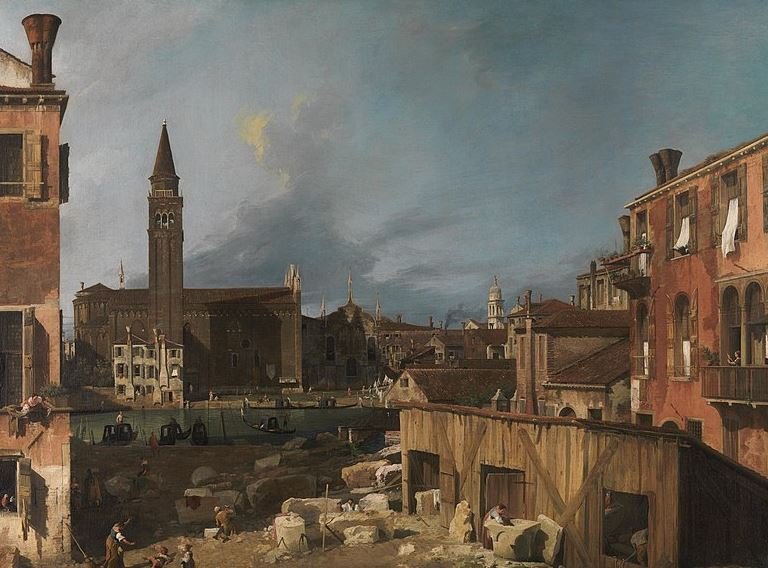
Image: “The Stonemason’s Yard”
Commercial Success and Work in England
Canaletto’s commercial success was significantly enhanced by his relationship with English patrons. In the late 1720s, Owen Swiny, an art dealer, encouraged Canaletto to produce topographical views appealing to Grand Tour tourists visiting Venice. This strategy proved lucrative, establishing a steady market for his detailed vedute.
A pivotal relationship was formed with Joseph Smith, the British Consul in Venice, who became Canaletto’s principal agent and patron. Smith amassed an extensive collection of nearly fifty paintings, one hundred fifty drawings, and fifteen rare etchings by Canaletto, which he later sold to King George III in 1762. This transaction not only secured Canaletto’s international reputation but also cemented his works within prestigious collections.
Relocation to London and Artistic Challenges
The War of the Austrian Succession in the 1740s adversely affected Canaletto’s market by reducing British tourism to Venice. In response, Joseph Smith facilitated the publication of etchings of Canaletto’s “capricci” (architectural fantasies).
However, the financial returns were insufficient, prompting Canaletto to relocate to London in 1746 to remain close to his primary market.
While in England, he resided at 41 Beak Street in Soho and produced numerous views of London, including several of the newly constructed Westminster Bridge.
He also painted portraits of his patrons’ estates, such as Northumberland House and Warwick Castle. Notably, his 1754 painting “Old Walton Bridge” included a self-portrait, illustrating his integration into the English artistic landscape.
Reception and Criticism in England
Despite his initial success in England, Canaletto faced significant challenges. His adherence to the Venetian style was perceived as repetitive and overly mechanical, leading critics like George Vertue to suspect that an impostor was producing his works.
This skepticism was compounded by the presence of his nephew, Bernardo Bellotto, who also used the Canaletto name, and by unscrupulous art dealers selling copies of his paintings.
To defend his reputation, Canaletto advertised an invitation for the public to inspect his latest work in his London studio. However, these efforts were insufficient to fully restore his acclaim, and his reputation suffered during his time in England.
Return to Venice and Later Years
In 1755, Canaletto returned to Venice, resuming his esteemed position within the local art community. In 1763, he was elected to the Venetian Academy and appointed as the prior of the Collegio dei Pittori, reflecting his status and influence.
In his later years, Canaletto continued to produce works, often revisiting old sketches and occasionally creating new compositions with subtle topographical alterations for artistic effect.
His dedication to his craft remained unwavering until his death on April 19, 1768. Canaletto was buried at San Lio, the church where he had been baptized, marking the end of a distinguished career.
Legacy and Influence
Canaletto’s legacy extends beyond his own extensive body of work. He mentored several prominent artists, including his nephew Bernardo Bellotto, Francesco Guardi, Michele Marieschi, Gabriele Bella, and Giuseppe Moretti. His influence also reached Giuseppe Bernardino Bison, a follower of his style, ensuring that his techniques and artistic vision continued to shape Venetian painting long after his death.
Joseph Smith’s sale of Canaletto’s collection to King George III established a significant presence of his works within the Royal Collection, ensuring their preservation and prominence in art history.
Other notable collections include the Wallace Collection and Woburn Abbey in Britain, as well as international institutions like the Museum of Fine Arts in Boston and the National Gallery of Art in Washington, D.C. Despite losses from events such as the 1940 Castle Howard fire, Canaletto’s works remain highly valued. Auction records attest to their enduring appeal, with “View of the Grand Canal from Palazzo Balbi to the Rialto” fetching £18.6 million at Sotheby’s in London in July 2005.
Artistic Techniques and Innovations
Canaletto’s technical prowess was evident in his precise use of perspective and architectural accuracy. His ability to blend realistic elements with imaginative components created a unique aesthetic that set his works apart. While some of his later paintings suggest the use of the camera obscura for tracing, many experts argue that he primarily drew inspiration from the device to enhance his compositions rather than relying on it for exact replication. This blend of direct observation and creative interpretation allowed Canaletto to produce works that were both technically impressive and artistically engaging.
Contribution to Vedute and Capricci
Canaletto’s contributions to the genre of vedute (detailed cityscapes) were substantial. His works captured the grandeur and intricate beauty of Venice’s architecture and waterways, providing a visual documentation of the city’s landscape during the 18th century. Additionally, his capricci, or architectural fantasies, showcased his ability to imagine and construct fantastical urban scenes that still retained a sense of realism. These imaginative works demonstrated his versatility and creative vision, further establishing his reputation as a master of cityscape painting.
Impact on Future Art Movements
Canaletto’s large-scale landscapes, characterized by atmospheric effects and vibrant local colors, anticipated elements of the Impressionist movement that would emerge centuries later. His focus on capturing light and atmosphere, combined with his meticulous attention to detail, influenced subsequent generations of artists who sought to balance realism with expressive techniques. By bridging the gap between precise architectural rendering and artistic interpretation, Canaletto paved the way for more dynamic and varied approaches to landscape painting.
Cultural and Historical Significance
Beyond their artistic value, Canaletto’s paintings hold significant cultural and historical importance. They offer a detailed visual record of 18th-century Venice, Rome, and London, providing insights into the urban development, architectural styles, and daily life of these cities during that period. His works serve as valuable historical documents, preserving the appearance and ambiance of key landmarks and contributing to our understanding of the cultural heritage of these iconic cities.
Conclusion
Giovanni Antonio Canal, or Canaletto, remains a towering figure in the history of art, celebrated for his masterful cityscapes and architectural paintings that captured the spirit and beauty of Venice, Rome, and London.
His dedication to realism, combined with his innovative techniques and artistic vision, ensured his enduring prominence in the art world. Canaletto’s legacy is reflected not only in his extensive body of work but also in the influence he exerted on subsequent artists and the lasting appreciation of his meticulously crafted vedute.
His ability to blend accuracy with creativity, alongside his successful international patronage, solidified his place as a pivotal artist of the 18th century, with his works continuing to command admiration and significant market value centuries after his passing.