Carl Jung: Early Life, Dream Analysis & Other Major Works
Carl Jung, also known as Carl Gustav Jung, was a psychotherapist and psychiatrist in the early 20th century who founded the discipline of analytical psychology to aid individuals in understanding their unconscious minds. Jung is also well-known for his theories regarding how personality traits like extroversion and introversion influence human behavior. He is regarded by many as one of the most significant individuals in psychological history. The realms of psychology, art, literature, philosophy, and religion have all been influenced by Jung’s work.
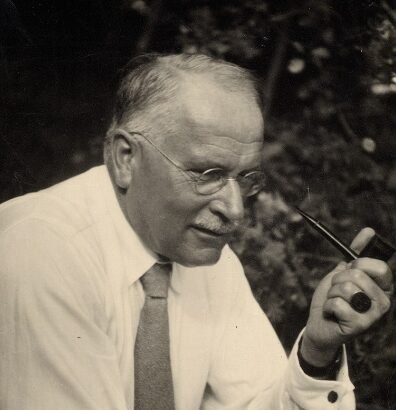
Early Life
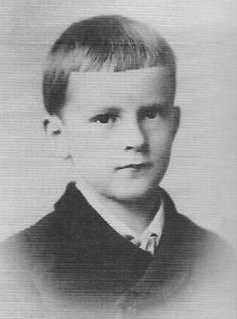
Young Carl Jung, early 1880s
The first surviving child of Paul Achilles Jung and Emilie Preiswerk, he was born in Kesswil, canton of Thurgau, Switzerland, on July 26, 1875.
Carl was born after two stillbirths and a boy named Paul, who was born in 1873 but barely lived for a few days. His mother came from an affluent family, while his father was a Swiss Reformed Church minister. He was brought up in a pious, working-class family.
From an early age, he studied his parents’ and teachers’ behavior and tried to change it. His upbringing was lonely, but it was also filled with fantasy. He wanted to explain to his father his personal encounter with God because he was particularly concerned about his father’s waning religious conviction.
The complexity of his parents had a further impact on his childhood. As he aged, Paul’s faith in religion began to wane. When he was just three years old, his mother Emilie, who had a history of mental illness, left the family to temporarily reside in a psychiatric facility.

Jung’s family c.1895: l to r. father Paul, sister Gertrud, mother Emilie and Carl
Education
Growing up, Carl Jung was expected to become a clergyman, just like his father and many of his other male relatives. He defied convention and enrolled in the University of Basel instead, having started reading philosophy in depth in his teens. Before deciding on medicine, he was exposed to a wide range of academic disciplines there, including biology, paleontology, religion, and archaeology. He received his M.D. from the University of Zurich two years after graduating from the University of Basel in1900.
Career
He relocated to Zürich in 1900 and started working with Eugen Bleuler at the Burghölzli psychiatric hospital. Already in contact with Sigmund Freud, an Austrian neurologist, was Bleuler. His dissertation, “On the Psychology and Pathology of So-Called Occult Phenomena”, was published in 1903. It was based on an examination of his cousin Hélène Preiswerk’s purported mediumship, done under the guidance of Freud’s contemporaries Théodore Flournoy.
In 1902, he also attended a class taught by Pierre Janet in Paris, and in the aftermath, he compared Janet’s ideology to his own theory of the complex.
Carl Jung was hired in 1905 as a permanent senior physician at the hospital and was also made a lecturer Privatdozent in Zurich University’s medical faculty. A year prior to that he co-authored the 1904 publication “Diagnostic Association Studies” with Franz Riklin, a copy of which Freud acquired.
After about four years, he parted company with the mental institution and proceeded to set up a private practice in his Küsnacht residence.
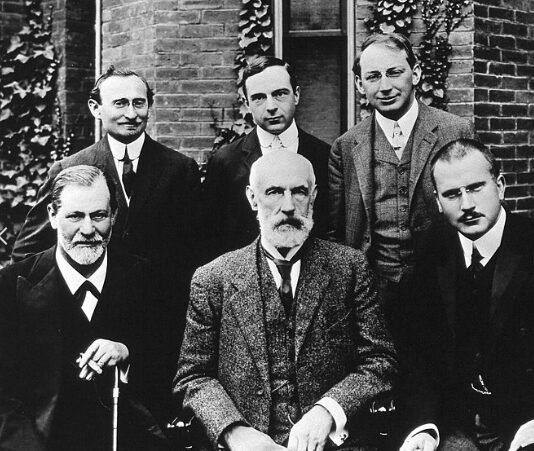
Group photo 1909 in front of Clark University. Front row, Sigmund Freud, G. Stanley Hall, Carl Jung. Back row, Abraham Brill, Ernest Jones, Sándor Ferenczi.
Working with Freud
He first encountered the theories of Freud and then the man himself as a result of his increasing reputation as a psychologist and his work with the subconscious.
He and Freud collaborated closely for five years beginning in 1907, and he was widely regarded as the one who would carry on his legacy. However, differences in outlook and temperament led to the end of their friendship as well as their collaborative efforts. He specifically contested Freud’s views on sexuality as the root of neurosis. He also disputed Freud’s theories, claiming that the veteran psychologist’s research was overly biased.
When he released ” Wandlungen und Symbole der Libido” (Psychology of the Unconscious) in 1912, it was his ultimate breakthrough. He investigated the unconscious mind in it and attempted to decipher its symbolic meaning. The publication also directly attacked some of Freud’s theories in the process. However, severing ties with Freud had repercussions for him. The younger psychologist was excluded from Freud’s inner circle, and other members of the psychoanalytic society ostracized him. He left the International Psychoanalytic Society in 1914 but kept working on his theories unabated.
Personal Life

Carl Jung’s wife – Emma Jung
Carl Jung tied the knot with Emma Rauschenbach in 1903, who was seven years his junior and the eldest daughter of Johannes Rauschenbach-Schenck, a prosperous entrepreneur in eastern Switzerland. The couple had five kids, and the union lasted until Emma’s passing in 1955.
He apparently had adulterous affairs while still married. The most well reported of his purported affairs were with Toni Wolff and Sabina Spielrein. Though it was generally assumed that his relationship with Spielrein included a sexual relationship, Henry Zvi Lothane has contested this notion.
Did you know…?
- Carl Jung served as an army physician during World War I and was shortly appointed commandant of a camp for British officers and soldiers. He strove to make the lives of soldiers trapped in Switzerland better and urged them to enroll in college courses.
- In order to deepen his understanding of the unconscious, he traversed the globe and studied other civilizations. He visited Kenya, Uganda, Egypt, India, and the United States.
Contributions to Psychology
Carl Jung maintained that the soul plays a crucial part in the psyche and that empirical proof is not the sole means to arrive at psychological or scientific facts.
Some of his major contributions include:
Analytical Psychology
He coined the phrase “analytical psychology” and worked hard to further set his work apart from Freud’s. His conceptualization of introverts and extroverts and the idea that people can be classified as either one based on the degree to which they exhibit specific conscious functions were the most significant developments from this early period. Psychological Types,” which he published in 1921, included some of his work in this field. He established several new personality traits, including sensing and intuition as well as thinking and feeling, in addition to introversion and extroversion.
His Theory of Human Psyche
According to his thesis, consciousness exists on three different levels: the conscious mind, the personal unconscious, and the collective unconscious. As illustrations of archetypes, he utilized mothers, women, and men. Despite the fact that we are normally oblivious of the collective unconscious, he believed that we are capable of becoming aware of it, particularly by making an effort to recall dreams, which frequently contain aspects of the collective unconscious.
Jungian Therapy
The goal of Jungian therapy aka analytical therapy, was to help patients comprehend how their unconscious minds may be impacting them. Instead of focusing only on a client’s symptoms or bothersome habits, jungian therapy aims to address the underlying causes of the client’s difficulties.To attain what he called “individuation” is the aim of Jungian therapy. Individuation is the process of integrating all prior experiences, both positive and negative, in order to have a happy, stable existence. Individuation is a long-term objective, and Jungian therapy does not focus on helping patients find a “quick remedy” to their issues. As an alternative, Jungian therapists concentrate on dealing with the underlying causes of issues, assisting clients in understanding themselves better, and assisting people in leading more fulfilling lives.
Later Works and Death
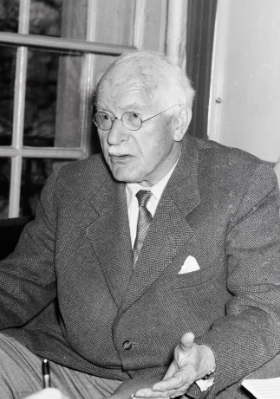
A few of his other notable works include “Über die Psychologie der Dementia Praecox” (1907; The Psychology of Dementia Praecox); “Versuch einer Darstellung der psychoanalytischen Theorie” (1913; The Theory of Psychoanalysis), and “Das Geheimnis der goldenen Blüte” (1929; The Secret of the Golden Flower), A 1933 collection of essays titled “Modern Man in Search of a Soul” included everything from dream interpretation and literature to the psychology of religion, “Psychology and Religion” (1938) and “Psychologie und Alchemie” (1944; Psychology and Alchemy).
His 1914 to 30 work, titled “The Red Book,” (Liber Novus) was translated into English and released in German ( 2009). He himself called it a chronicle of his “confrontation with the unconscious.” His own color illustrations and a narrative of his fantasies, incantations, and hallucinations are included in the work.
In 1943, he was appointed full professor of medical psychology at the University of Basel, but he left after having a heart attack the following year in order to live a more peaceful life. In 1952, his illness returned.
Up until his death, he continued to write and publish books, among them “Flying Saucers: A Modern Myth of Things Seen in the Skies” (1959), which explored the archetypal significance and potential psychological implications of the reported sightings of UFOs.
His final piece was published in 1961 as “Approaching the Unconscious,” a contribution to Man and His Symbols (published posthumously in 1964). A brief illness resulted in his death on June 6, 1961, in Küsnacht in Zürich, Switzerland
Legacy
Despite passing away, his influence on psychology didn’t diminish. Over the years, his research on personality types has been especially significant. He developed the personality types on which the Myers-Briggs Type Indicator was based. The notions of introversion and extroversion are also included in other popular personality tests, albeit they frequently regard them as two opposite extremes of a spectrum rather than as two different personality types.
Awards
honorary doctorates from numerous universities, including Harvard, Oxford, and Geneva.
Frequently asked questions about Carl Jung
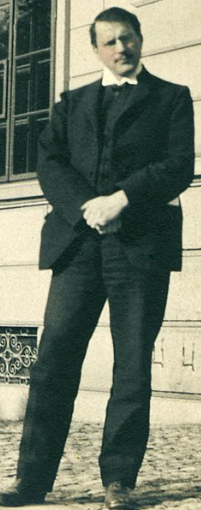
Carl Jung (1875-1961) was a Swiss psychiatrist and psychoanalyst who founded analytical psychology. He is best known for his concepts of the collective unconscious, archetypes, and individuation. Image: Carl Jung outside Burghölzli in 1910
These FAQs provide an overview of Carl Jung’s life, theories, and contributions to psychology, highlighting his enduring impact on the field.
What is the collective unconscious?
The collective unconscious is a part of the unconscious mind that Jung believed is shared by all human beings. It contains archetypes, which are universal, primordial images and ideas that shape human experiences and behavior.
What are archetypes?
Archetypes are innate, universal prototypes for ideas and may be used to interpret observations. They are deeply embedded in the human psyche and manifest in dreams, myths, and symbols. Common archetypes include the Hero, the Mother, the Shadow, and the Anima/Animus.
What is individuation?
Individuation is the process of psychological integration and self-realization, where a person becomes aware of and integrates different aspects of their personality. According to Jung, this is the path to achieving personal wholeness and balance.
How did Jung’s views differ from Freud’s?
Jung differed from Freud on several key points:
- Sexuality: Jung did not agree with Freud’s emphasis on sexuality as the primary driver of human behavior.
- Unconscious: Jung introduced the concept of the collective unconscious in addition to the personal unconscious.
- Spirituality: Jung placed a greater emphasis on spirituality and the role of myths and symbols in psychological development.
- Theory of Development: Jung’s concept of individuation contrasted with Freud’s psychosexual stages of development.
What is the Anima and Animus?
The Anima and Animus are archetypes representing the feminine and masculine aspects within each individual. The Anima is the feminine inner personality in men, and the Animus is the masculine inner personality in women. Integrating these aspects is crucial for psychological balance.
What is the Shadow?
The Shadow is an archetype representing the unconscious, repressed parts of the personality that an individual does not acknowledge. It often contains qualities and desires that are socially unacceptable or hidden. Integrating the Shadow is essential for personal growth and self-awareness.
What is Jungian therapy?
Jungian therapy, also known as analytical psychology, focuses on exploring the unconscious mind through techniques such as dream analysis, active imagination, and the interpretation of symbols and archetypes. The goal is to achieve individuation and psychological wholeness.
How did Jung’s work influence modern psychology?
Jung’s work has significantly influenced various fields, including psychotherapy, art, literature, and religious studies. His concepts of the collective unconscious, archetypes, and individuation have provided new ways of understanding human behavior and the development of the self.
What are some key works by Carl Jung?
Some of Jung’s most influential works include:
- “The Archetypes and The Collective Unconscious”: A collection of essays on archetypes and the collective unconscious.
- “Man and His Symbols”: An accessible introduction to his ideas, particularly on symbolism.
- “Memories, Dreams, Reflections”: An autobiographical work where Jung discusses his life and theories.
- “Psychological Types”: The book where Jung introduces his theory of personality types, which later influenced the development of the Myers-Briggs Type Indicator (MBTI).
What is the significance of dreams in Jungian psychology?
In Jungian psychology, dreams are considered a window into the unconscious mind. They provide insight into the individual’s inner world and can reveal unresolved conflicts, hidden desires, and potential paths for personal growth. Analyzing dreams helps individuals understand and integrate different aspects of their psyche.
What is synchronicity?
Synchronicity is a concept introduced by Jung to describe meaningful coincidences that occur with no causal relationship but seem to be meaningfully related. These events often appear to be connected by an underlying pattern or meaning, reflecting the interconnectedness of the psyche and the external world.
Did Jung have a spiritual or religious background?
Jung had a deep interest in spirituality and religion, though he was not aligned with any particular religious institution. He studied various religious traditions, including Christianity, Buddhism, Hinduism, and Taoism, and integrated their symbols and themes into his psychological theories.
What is active imagination?
Active imagination is a technique developed by Jung for exploring the unconscious. It involves engaging with the images and symbols that emerge from the unconscious mind, often through creative activities such as writing, drawing, or visualization. This process helps individuals connect with and integrate unconscious material.
How did Jung view the role of mythology?
Jung saw mythology as a rich source of archetypal images and themes that reflect the collective unconscious. Myths, according to Jung, provide insight into the universal aspects of human experience and can serve as guides for personal development and understanding.
What is the Myers-Briggs Type Indicator (MBTI), and how is it related to Jung’s work?
The Myers-Briggs Type Indicator (MBTI) is a personality assessment tool based on Jung’s theory of psychological types. It categorizes individuals into 16 personality types based on preferences in four areas: Extraversion/Introversion, Sensing/Intuition, Thinking/Feeling, and Judging/Perceiving. The MBTI was developed by Katharine Cook Briggs and her daughter, Isabel Briggs Myers, to make Jung’s theories accessible and applicable to everyday life.
What did Jung mean by “psychological types”?
Psychological types refer to Jung’s theory that people have different preferred ways of perceiving and interacting with the world. He identified two attitudes (Extraversion and Introversion) and four functions (Thinking, Feeling, Sensing, and Intuition), which combine to form different personality types. This framework helps understand individual differences in behavior and cognition.
What is the significance of symbols in Jungian psychology?
Symbols play a crucial role in Jungian psychology as they represent deeper truths and unconscious processes. They can appear in dreams, myths, art, and religious practices. By interpreting symbols, individuals can gain insights into their unconscious mind and facilitate psychological growth.
How did Jung’s early life influence his theories?
Jung’s early life was marked by experiences that shaped his interest in the unconscious, spirituality, and the human psyche. His exposure to religious and mystical experiences, his solitary nature, and his fascination with dreams and the occult influenced his later work. These personal experiences drove him to explore the depths of the human mind and develop his theories.
How did Jung’s relationship with Sigmund Freud impact his career?
Jung’s relationship with Freud was initially collaborative and mutually influential. Freud saw Jung as his successor, but their differing views on the unconscious, sexuality, and spirituality led to a professional and personal rift. This split allowed Jung to develop his theories independently, leading to the establishment of analytical psychology. Despite their conflicts, Freud’s influence on Jung’s early work was significant and lasting.





