Church of Saint-Germain l’Auxerrois
The Church of Saint-Germain l’Auxerrois, located in the 1st arrondissement of Paris, stands as an enduring symbol of medieval Catholic heritage. Positioned directly opposite the Louvre Palace, the church bears the name of Saint Germanus of Auxerre, a medieval bishop who played a significant role in the spread of Christianity in France. Over the centuries, it has witnessed crucial historical events, undergone numerous architectural transformations, and housed significant artistic works.
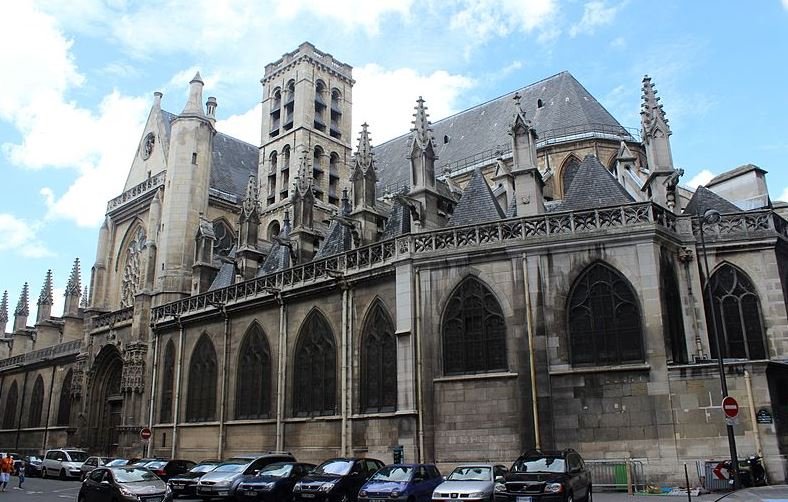
The exterior of the Saint-Germain l’Auxerrois.
Today, the Church of Saint-Germain l’Auxerrois remains an essential part of Parisian religious and cultural life, serving as a temporary home for Notre-Dame’s congregation following the fire of 2019.
Early Foundations
The origins of Saint-Germain l’Auxerrois date back to the 5th century, when a small oratory was established to commemorate a meeting between Saint Germanus and Saint Genevieve, the future patron saint of Paris. This modest structure was later replaced by a larger church, either by King Chilperic I in the late 6th century or by Bishop Saint Landry of Paris in the 7th century. However, this early church was destroyed in 886 during the Norman invasions.
Following its destruction, King Robert II the Pious rebuilt the church in the early 11th century. Subsequent expansions and modifications took place over the centuries, including a major 12th-century renovation that introduced Romanesque elements. By the 13th century, the church was again expanded to accommodate a growing congregation, and by the 15th century, it had largely taken on its present form.
Role in the St. Bartholomew’s Day Massacre
Saint-Germain l’Auxerrois played a dark role in French history during the Wars of Religion. On the night of August 23, 1572, the church’s bell, known as “Marie,” tolled, signaling the start of the St. Bartholomew’s Day Massacre. Thousands of Huguenots, gathered in Paris for a royal wedding, were slaughtered in the ensuing violence. This tragic event remains one of the most infamous episodes of religious conflict in France.
French Revolution and 19th-Century Restoration
During the French Revolution, Saint-Germain l’Auxerrois suffered severe damage. It was desecrated, its treasures looted, and the building was repurposed for various secular uses, including a barn, a printing press, and a gunpowder factory. Despite these degradations, some original stained glass windows survived.
The church was restored to religious use in 1801 but faced further attacks in 1831 during an anti-clerical riot. The damage led to a significant restoration effort between 1838 and 1855, overseen by architects Jean-Baptiste Lassus and Victor Baltard. Their work included removing obstructing buildings and enhancing the church’s visibility.
Architectural Features
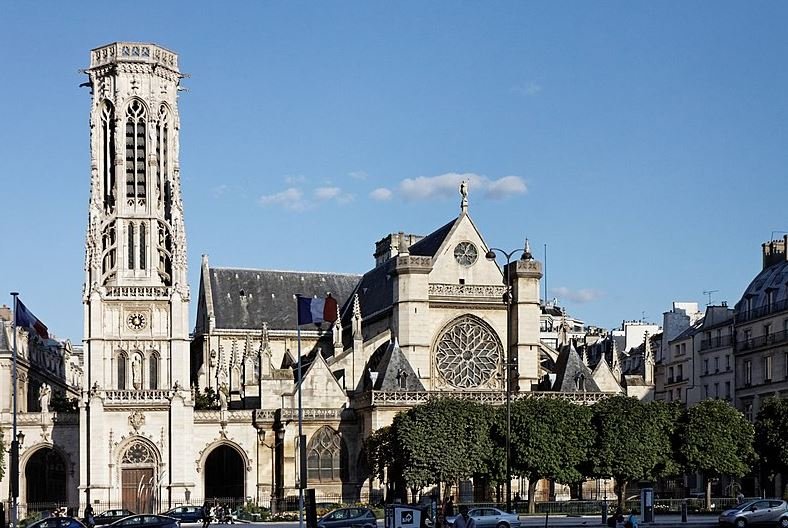
Front view of the Church.
The church’s exterior showcases a blend of Romanesque, Rayonnant, Flamboyant Gothic, and Renaissance architectural styles. The lower sections of the bell tower, dating to the 12th century, are the only remaining Romanesque elements. The western portal, constructed around 1220-1230, once served as a meeting place for the cathedral canons and a classroom for religious instruction.
A notable feature is the balustrade encircling the church, crafted by Jean Gaussel between 1435 and 1439. The west facade also includes 19th-century statues of French saints, including Saint Germanus and Saint Clotilde, alongside intricate sculptures of animals, beggars, and fools. The facade’s arches feature detailed reliefs of apostles, angels, and figures from biblical parables.
The Church of Saint-Germain l’Auxerrois is an architectural and historical gem, reflecting the evolution of Paris over the centuries.
The original south bell tower, constructed in the 12th century, is historically significant as it rang to mark the St. Bartholomew’s Day Massacre. In the 19th century, architect Théodore Ballu added a new north bell tower as part of Baron Haussmann’s urban renovations. The tower harmonizes with the adjacent city hall, which was designed to resemble the church’s facade.
Saint-Germain l’Auxerrois boasts a spacious nave constructed in the 15th century, with a long choir, transept, and aisles lined with chapels. The interior is distinct from typical Gothic churches due to its lighter aesthetic, enhanced by clear Neoclassical upper windows. Notable decorative elements include the monumental wooden choir stalls from 1684, designed for Louis XIV and his court.
Among the church’s most treasured features are its stained glass windows, particularly the rose window in the south transept, attributed to Jean Chastellain. Though much of the original glass was destroyed during the Revolution, replacements in the 19th century maintain the church’s luminous atmosphere.
Notable Chapels
Chapel of the Virgin
One of the most artistically significant areas is the Chapel of the Virgin, dating back to the 14th century. Originally reserved for cathedral canons, it was later opened to the public. The chapel features murals by Eugène Amaury-Duval, whose style was influenced by the Pre-Raphaelites and Fra Angelico. A striking sculpture of Saint Germain of Auxerre, from the 13th century, is also housed here.
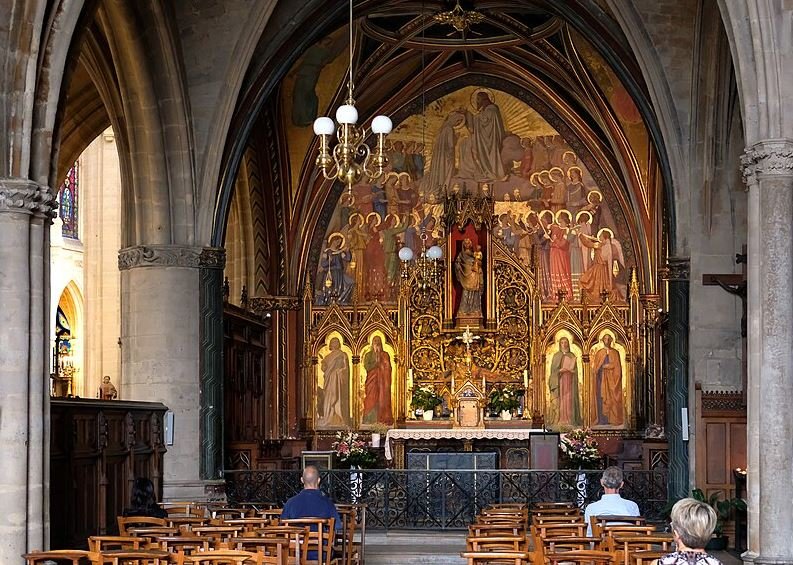
Chapel of the Virgin Mary, as viewed in 2016.
Chapel of the Tomb
Established in 1505 by a wealthy draper named Tronson, the Chapel of the Tomb was once the gathering place for the Drapers’ Guild. Heavily damaged during the 1831 riots, it was restored in the 19th century with new stained glass modeled after the Sainte-Chapelle’s windows.
Chapel of Compassion
This chapel contains one of the church’s most remarkable artworks, a Flemish triptych from 1515, carved in Antwerp. The centerpiece illustrates the Tree of Jesse, tracing Christ’s genealogy, while side panels depict Old and New Testament scenes.
The Organ
The original organ was destroyed during the Revolution. Some accounts suggest that the current instrument was transferred from Sainte-Chapelle in 1791, though its Neoclassical design suggests a later origin. Restorations between 1838 and 1980 attempted to recover the organ’s original sound, with mixed success. A comprehensive restoration began in 2008, preserving as much of the historical mechanism as possible.
Prominent Burials
As the parish church for the Louvre, Saint-Germain l’Auxerrois became the final resting place for several notable artists and architects. Among those interred here are:
- François de Malherbe (1628) – A poet and literary critic.
- Antoine Coysevox (1720) – A prominent sculptor known for his work in Versailles.
- François Boucher (1770) – A leading Rococo painter.
- Jean-Baptiste-Siméon Chardin (1779) – A celebrated still-life painter.
Timeline of the Church of Saint-Germain l’Auxerrois
- 5th Century: A small oratory is founded to commemorate the meeting of Saint Germanus and Saint Genevieve.
- 560 or 650: A large church replaces the oratory, built either by King Chilperic I or Bishop Saint Landry.
- 886: The church is destroyed by Norman invaders.
- 11th Century: King Robert II rebuilds the church, later expanded in the 12th century.
- 13th Century: The current structure takes shape, later modified in the 15th and 16th centuries.
- 1572: The church’s bell signals the start of the St. Bartholomew’s Day Massacre.
- Revolution (1789-1801): The church is closed, vandalized, and repurposed.
- 1831: An anticlerical riot damages the church.
- 1838-1855: Major restoration led by Lassus and Baltard.
- 2019: Becomes the temporary site for Notre-Dame’s services after the cathedral fire.
Frequently Asked Questions
How did the Church of Saint-Germain l’Auxerrois evolve architecturally over time?
It began as a small 5th-century oratory and evolved through Romanesque, Rayonnant, Flamboyant Gothic, and Renaissance architectural styles, undergoing significant expansions in the 12th, 13th, and 15th centuries.
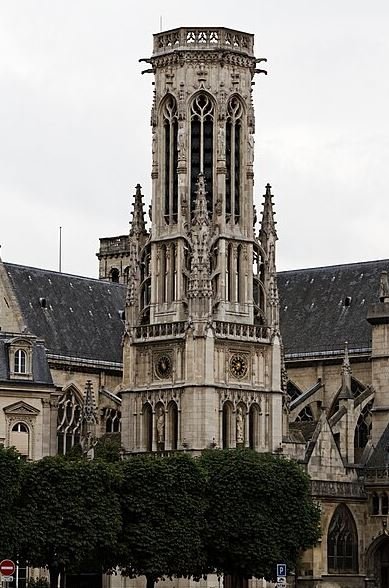
The Church’s north bell tower
What happened to the church during the French Revolution?
It was desecrated, repurposed as a barn, printing shop, and gunpowder factory, and many of its treasures were lost or destroyed before being restored to religious use in 1801.
What is unique about its bell towers?
The original 12th-century bell tower signaled the St. Bartholomew’s Day Massacre, while a new north tower was added in the 19th century as part of Haussmann’s urban transformation.
Why is the interior distinct from other Gothic churches?
Unlike the dark ambiance typical of Gothic architecture, the church has a brighter interior due to Neoclassical upper windows and clear glass elements.
Which notable artworks and features does the church house?
It contains a Flemish triptych from 1515, intricate wooden choir stalls from 1684, and stained glass by Jean Chastellain, alongside sculptures of French saints.
Who are some of the prominent figures buried in the church?
Artists and architects such as François Boucher, Antoine Coysevox, and Jean-Baptiste-Siméon Chardin, who contributed to the Louvre’s decor, are interred here.
How is the church used today?
Beyond its role as a historical site, it temporarily hosts services for Notre-Dame Cathedral’s congregation following the 2019 fire.





