Bayt al-Ahzan
Bayt al-Ahzan translates to “House of Sorrows.” It was a historical structure situated in Al-Baqi Cemetery in Medina, located in the Hejaz region of present-day Saudi Arabia. Bayt al-Ahzan was built as a place of mourning for Fatimah al-Zahra, the daughter of the Prophet Muhammad (S.A.W), following the passing of her father. This structure, however, no longer exists as it was demolished in the early 20th century during the second attack of Wahhabists in Hejaz. Despite its destruction, Bayt al-Ahzan holds deep significance in Islamic history, particularly among Shia Muslims, as it is considered one of the possible locations for Fatimah’s grave.
Historical Context
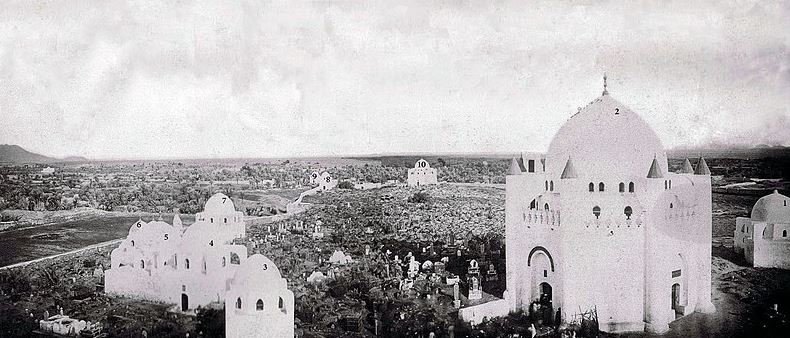
The Bayt al-Ahzan, as seen on the the right.
The death of the Prophet Muhammad in 632 CE (11 A.H.) was a moment of immense grief for his daughter, Fatimah al-Zahra. Historical sources suggest that Fatimah was deeply affected by her father’s passing, mourning him continuously. To provide her with a secluded place to grieve, her husband, Ali ibn Abi Talib, reportedly constructed Bayt al-Ahzan.
ThE structure allowed Fatimah to express her sorrow without external interference, offering her privacy and solace away from the public eye.
The building was located near the graves of several prominent Islamic figures, including ‘Abbas ibn ‘Abd al-Muttalib and the four Shia Imams buried in Al-Baqi Cemetery: Hasan ibn Ali, Zayn al-Abidin, Muhammad al-Baqir, and Ja’far as-Sadiq.
Bayt al-Ahzan was not just a structure but a symbol of mourning and remembrance. Fatimah’s sorrow was so profound that it left an enduring mark on Islamic history. Her continuous grief and subsequent early death contributed to the perception of injustice she suffered following the Prophet’s passing, a topic of significance in Shia Islamic narratives.

The Location of Bayt al-Ahzan
Bayt al-Ahzan was located in Al-Baqi Cemetery, an area that holds the graves of numerous companions and family members of the Prophet Muhammad. It was built south of the grave of ‘Abbas ibn ‘Abd al-Muttalib and positioned behind the burial sites of the four revered Shia Imams.
Given its proximity to these important figures, Bayt al-Ahzan was a place of great spiritual importance. Many historians and Islamic scholars believe that Fatimah may have spent the final days of her life in this house, grieving for her father.
Due to the secrecy surrounding Fatimah’s burial, there has been ongoing debate regarding the exact location of her grave. While some traditions suggest that she was buried in Al-Masjid an-Nabawi (the Prophet’s Mosque), others propose Al-Baqi Cemetery. Among these possibilities, Bayt al-Ahzan is considered the third most likely location of her resting place.

The gates of the Prophet’s Mosque in Medina bear the inscription, ‘Muhammad, the Messenger of God.’
Significance in Islamic Tradition
Bayt al-Ahzan holds a special place in Islamic history, particularly in Shia beliefs, as it symbolizes the sorrow and hardships endured by Fatimah al-Zahra. Her continuous mourning is viewed as an expression of protest against the injustices she faced after the Prophet’s death, including disputes over inheritance and leadership within the Muslim community. The house became a physical representation of Fatimah’s grief, as she would retreat there to cry for her father.
Shia scholars emphasize the significance of Bayt al-Ahzan as a historical landmark representing the oppression of Ahl al-Bayt (the family of the Prophet). It serves as a reminder of Fatimah’s suffering and her unwavering devotion to her father. Some traditions also indicate that angels comforted her in this house, further elevating its spiritual significance. For centuries, Bayt al-Ahzan remained a revered site where visitors would pay respects and reflect on Fatimah’s life and legacy.
Demolition of Bayt al-Ahzan
Bayt al-Ahzan, along with numerous other structures in Al-Baqi Cemetery, was demolished following the occupation of Medina by the Wahhabists in 1926 (1344 A.H.). This act was part of a broader movement to eliminate structures that could be associated with veneration or practices deemed as bid’ah (innovation) in Islam. The Wahhabi ideology promotes a strict interpretation of monotheism, opposing the construction of shrines and tombs that might encourage pilgrimage or reverence toward specific individuals.
Bayt al-Ahzan historical significance lies in its association with Fatimah’s grief, the struggles of Ahl al-Bayt, and the broader historical conflicts within early Islam.
The destruction of Bayt al-Ahzan was met with sorrow and condemnation, particularly from Shia communities and other Muslims who regarded it as an essential part of Islamic heritage. The demolition erased a historical and spiritual landmark, leaving only records and accounts of its existence. Despite its physical absence, the legacy of Bayt al-Ahzan continues to resonate within Islamic discourse.
Etymology and Linguistic Meaning
The name Bayt al-Ahzan is derived from Arabic words that carry profound meanings. The term “Bayt” (بَيْت) translates to “house” or “home,” while “Ahzan” (أحزان) is the plural form of “Hozn” (حُزْن), meaning “sorrow” or “grief.”
Together, Bayt al-Ahzan translates to “House of Sorrows,” aptly describing the purpose and emotional significance of the structure. It was a house built specifically for mourning, where Fatimah found a space to express her deep sorrow for the loss of her father.
In Islamic literature, the concept of sorrow holds a significant place, especially in relation to the trials faced by the Prophet’s family. The name Bayt al-Ahzan itself serves as a reflection of the grief endured by Fatimah al-Zahra and the hardships faced by Ahl al-Bayt after the passing of the Prophet Muhammad.

Cultural and Religious Impact
Even though Bayt al-Ahzan no longer stands, its memory continues to influence Islamic history and religious thought. It is frequently mentioned in religious sermons, books, and historical discussions that examine the struggles of Fatimah al-Zahra and the early conflicts within the Muslim community.
The destruction of such a significant landmark has only strengthened its symbolic power, reinforcing the themes of perseverance, suffering, and devotion that characterize Fatimah’s story.
For Shia Muslims, Bayt al-Ahzan remains an important symbol of the injustices suffered by the Prophet’s family. It is commemorated in various religious gatherings and ceremonies, particularly during events that focus on the hardships of Ahl al-Bayt, such as the mourning rituals of Muharram.
The story of Bayt al-Ahzan serves as a historical reminder of Fatimah’s unwavering dedication to her father’s legacy and her sorrow over the events that followed his death.
Frequently Asked Questions
Why was Bayt al-Ahzan constructed?
Fatimah al-Zahra was deeply affected by her father’s passing and used to grieve extensively. Her husband, Ali ibn Abi Talib, built Bayt al-Ahzan as a private space where she could mourn in solitude.

A calligraphic seal bearing Ali’s name, prominently displayed in the Hagia Sophia in Istanbul.
Where was Bayt al-Ahzan located?
It was situated in Al-Baqi Cemetery in Medina, south of the grave of ‘Abbas ibn ‘Abd al-Muttalib and behind the burial sites of four Shia Imams.
Why is Bayt al-Ahzan significant in Islamic history?
It symbolizes the sorrow and suffering of Fatimah al-Zahra and is seen as a historical representation of the injustices faced by the Prophet’s family, particularly in Shia tradition.

Is Bayt al-Ahzan one of the possible burial sites of Fatimah al-Zahra?
Yes, some historical accounts suggest that Fatimah might have been buried there, although her exact burial site remains unknown.
Why was Bayt al-Ahzan demolished?
It was destroyed in 1926 during the Wahhabi occupation of Medina as part of a broader movement to remove structures associated with veneration and pilgrimage.
How has the destruction of Bayt al-Ahzan impacted Islamic heritage?
Its demolition erased a significant historical and spiritual landmark, but it continues to be remembered in Islamic discourse, particularly among Shia Muslims.
What is the legacy of Bayt al-Ahzan today?
Although no longer standing, it remains an important symbol of love, devotion, and the struggles faced by Ahl al-Bayt, influencing religious thought and historical discussions.
Succession Following the Death of the Islamic Prophet Muhammad





