Emil du Bois-Reymond: The German Physiologist who discovered nerve action potential
Emil Heinrich du Bois-Reymond was a German physiologist, renowned for co-discovering nerve action potentials and pioneering experimental electrophysiology.
Early Life and Education
Emil Heinrich du Bois-Reymond was born on November 7, 1818, in Berlin, Germany, into a family with intellectual roots and diverse backgrounds.
His father, a poor immigrant from Neuchâtel, Switzerland, had settled in Germany, while his mother was of Huguenot descent, a group of French Protestants known for their cultural and intellectual contributions to European society.
His younger brother, Paul du Bois-Reymond, would also gain recognition as a prominent mathematician. The environment in which du Bois-Reymond grew up was one of intellectual curiosity, which greatly influenced his future career in physiology.
Emil du Bois-Reymond’s early education took place at the French College in Berlin, and in 1838, he enrolled at the University of Berlin. Initially uncertain about his career direction, du Bois-Reymond explored various subjects, including theology, geology, and physics, before eventually deciding to pursue medicine.
His interest in physiology was sparked after meeting Johannes Peter Müller, one of the most prominent physiologists of the 19th century. Müller became his mentor and guided du Bois-Reymond’s early studies.
In 1840, du Bois-Reymond became Müller’s assistant in the department of anatomy and physiology at the University of Berlin.
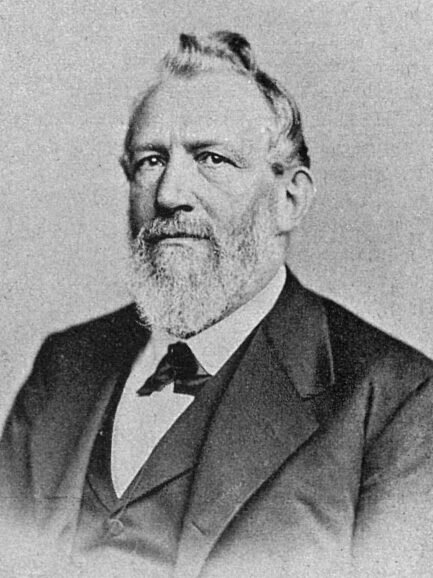
Image: Emil du Bois-Reymond
Inspiration and Focus on Bioelectricity
One of the most significant turning points in du Bois-Reymond’s career came when Müller introduced him to the work of Italian physicist Carlo Matteucci, who had published an influential study on electric phenomena in animals. Matteucci’s work on bioelectricity—how living tissues generate electrical currents—would define the course of du Bois-Reymond’s career. Inspired by this research, du Bois-Reymond began exploring the electrical properties of animal tissues, particularly focusing on muscles and nerves.
His early work, especially his doctoral thesis on electric fishes, laid the foundation for his lifelong research into the electrical activity of living organisms. His investigation into electric fishes and animal electricity marked a significant leap in understanding how electricity played a vital role in physiological processes. The study of these phenomena led him to hypothesize that muscle and nerve cells generated electrical currents as part of their normal function. This was groundbreaking at the time because the role of electricity in biological systems was not fully understood.
Major Work: Investigations of Animal Electricity
Du Bois-Reymond’s most significant and ambitious work, Untersuchungen über thierische Elektricität (Investigations of Animal Electricity), was published in a series of volumes between 1848 and 1884. This work is widely regarded as one of the most important contributions to the field of electrophysiology. In it, du Bois-Reymond systematically described the electrical properties of muscle and nerve cells, offering both experimental data and theoretical models to explain bioelectricity.
The key findings of this work were as follows:
- Nerve Action Potential: Du Bois-Reymond demonstrated that when a nerve is stimulated, it generates a measurable electrical current. This discovery, known as the nerve action potential, was groundbreaking. It provided evidence that nerves communicate with muscles and other nerves through electrical signals. While the full understanding of the action potential was not achieved until later, his work laid the foundation for this fundamental concept in neurophysiology.
- Resting Potential: He observed that muscles and nerves exhibit a constant electrical potential when at rest. This “resting potential” indicated that electrical activity was not simply a response to stimuli but an inherent property of living cells. Du Bois-Reymond’s observations of resting potential were pivotal in understanding how cells maintain electrical gradients, a process essential for normal cellular function.
- The Electrical Nature of Living Tissues: Du Bois-Reymond proposed that muscle and nerve cells could be viewed as systems composed of numerous “electric molecules” whose activities generated electrical phenomena. Although he could not identify the molecular components responsible for bioelectricity, his work prefigured the discovery of ions such as sodium and potassium, which are now known to play a critical role in the generation and maintenance of membrane potentials.
- Invention of Instruments: Du Bois-Reymond invented or improved various instruments to measure bioelectric phenomena, including the galvanometer, which allowed for precise measurements of small electrical currents. His innovations in instrumentation were crucial to advancing the study of electrophysiology and helped establish it as a scientific discipline.
The discovery of the nerve action potential was one of du Bois-Reymond’s most lasting contributions to science. It established that electrical currents within nerves and muscles were central to physiological processes, particularly in communication between different parts of the nervous system and in muscle contraction. This work was pivotal in establishing the field of electrophysiology and set the stage for later discoveries in neurobiology.
The Ionic Model of Action Potential
Despite the groundbreaking nature of du Bois-Reymond’s research, his theory of bioelectricity was not universally accepted during his lifetime. Several contemporary physiologists, most notably Ludimar Hermann, criticized his ideas. Hermann argued that living tissues do not generate electric currents unless they are injured. This led to a debate within the scientific community regarding the nature of bioelectricity and the validity of du Bois-Reymond’s findings.
This controversy was ultimately resolved in 1902 when du Bois-Reymond’s student, Julius Bernstein, developed an ionic theory of the action potential. Bernstein’s work incorporated aspects of both Hermann’s and du Bois-Reymond’s ideas, proposing that the electrical activity in nerves and muscles resulted from the movement of ions (such as sodium and potassium) across cell membranes. This explanation proved to be accurate and is now the accepted model for understanding action potentials in excitable cells.
Other Contributions to Physiology
Although du Bois-Reymond is best known for his work on bioelectricity, he made important contributions to other areas of physiology as well. His research interests extended to various phenomena that could be studied using physical methods, including:
- Diffusion: Du Bois-Reymond studied how molecules move through liquids and tissues, contributing to the understanding of diffusion processes in biological systems.
- Lactic Acid Production: He investigated the production of lactic acid in muscles, which is now recognized as a key component of anaerobic metabolism. His work helped clarify how muscles generate energy during periods of intense activity.
- Electric Fishes: Du Bois-Reymond continued his investigations into electric fishes, studying how these animals generate electric shocks. His research on these creatures shed light on the broader topic of how bioelectricity functions in living organisms.
Academic Career and Influence
In 1858, following the death of his mentor Johannes Peter Müller, du Bois-Reymond was appointed as professor of physiology at the University of Berlin. He held this position until his death in 1896. During his tenure, he became one of the most influential physiologists of his time, both as a researcher and a teacher.
Du Bois-Reymond was instrumental in establishing Berlin as a leading center for physiological research in the 19th century. His laboratory became a hub for young scientists interested in studying the electrical properties of living tissues, and many of his students, including Julius Bernstein, went on to make significant contributions to the field.
In addition to his research, du Bois-Reymond was an active member of the scientific community. He was admitted to the Berlin Academy of Sciences in 1851 and became its perpetual secretary in 1876. His influence extended beyond physiology, as he advocated for the advancement of scientific knowledge in general, introducing students to the latest developments in thermodynamics and evolutionary theory.
Public Engagement and Lectures
Beyond his contributions to scientific research, Emil du Bois-Reymond became widely known for his public lectures, which addressed not only scientific topics but also literature, history, and philosophy. His ability to engage with broader cultural issues made him a respected public intellectual in Germany. He gave several famous speeches that reflected on the role of science in society and the history of human progress.
In 1877, du Bois-Reymond delivered a lecture emphasizing science as the primary driver of civilization, arguing that “science is the chief instrument of civilization” and that “the history of science is the essential history of humanity.” This perspective underscored his belief that scientific advancement was the key to understanding human development and progress.
Another notable lecture, On National Feeling (1878), was a reflection on nationalism, delivered after the Franco-Prussian War. In this address, du Bois-Reymond expressed regret over the hostilities between France and Germany and offered one of the earliest analyses of nationalism, showing an awareness of the destructive potential of excessive national pride.
Controversies and Darwinism
Du Bois-Reymond was also one of the earliest German academics to embrace Darwin’s theory of natural selection. He introduced Darwinism to his students at the University of Berlin and became an outspoken advocate of the theory. However, unlike his contemporary Ernst Haeckel, du Bois-Reymond favored a mechanistic interpretation of natural selection, focusing on the material and physical aspects of evolutionary theory rather than its metaphysical implications.
Despite his strong advocacy for Darwinism, du Bois-Reymond faced backlash from conservative and religious groups, particularly after he wrote an obituary for Charles Darwin in 1883. His outspoken support for Darwin’s ideas, combined with his atheistic or agnostic views, made him a controversial figure in some circles. However, these controversies did little to diminish his standing as one of the leading physiologists of his time.
Legacy
Emil du Bois-Reymond died on December 26, 1896, in Berlin. His contributions to the field of physiology, particularly his discovery of the nerve action potential and his pioneering work on bioelectricity, have left a lasting legacy. His research laid the groundwork for modern neurophysiology and electrophysiology, helping to shape the understanding of how nerves and muscles communicate through electrical signals.
In addition to his scientific achievements, du Bois-Reymond’s influence as a teacher and public intellectual helped raise the profile of physiology as a rigorous scientific discipline. His efforts to advance scientific knowledge in Germany, particularly at the University of Berlin, contributed to the country’s emergence as a global leader in scientific research during the late 19th century.
Frequently Asked Questions about Emil du-Bois-Reymond
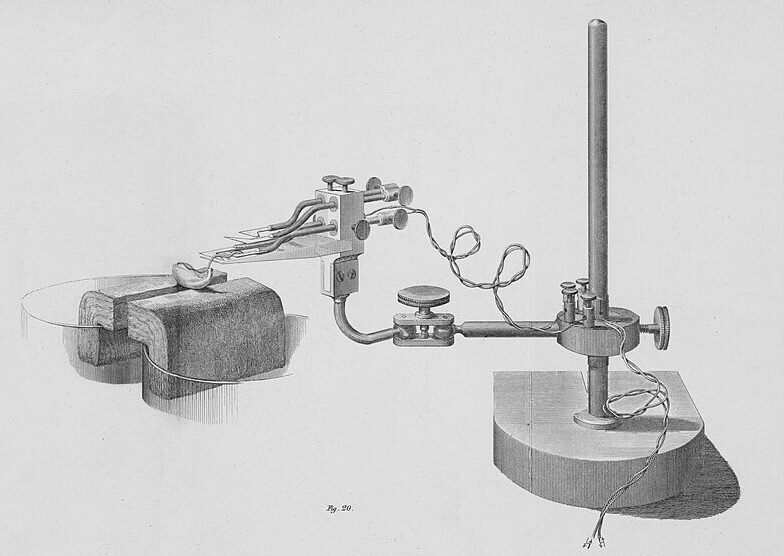
Du Bois-Reymond’s life and work represent a significant chapter in the history of physiology and science, and his legacy continues to influence modern research in bioelectricity and neuroscience. Image: An experimental apparatus of Bois-Reymond.
Where was Emil du Bois-Reymond born?
Emil du Bois-Reymond was born in Berlin. His younger brother was Paul du Bois-Reymond, a mathematician.
What were Emil du Bois-Reymond’s early educational influences?
He studied at the French College in Berlin and enrolled at the University of Berlin in 1838, where he explored theology, geology, and physics before focusing on medicine under the influence of Johannes Peter Müller, a professor of anatomy and physiology.
Müller introduced him to the work of Carlo Matteucci on electric phenomena in animals, which inspired du Bois-Reymond’s lifelong research into bioelectricity.
What was the subject of du Bois-Reymond’s graduation thesis, and what was its significance?
His graduation thesis was on electric fishes, marking the start of his research into bioelectricity, which led to his monumental work Investigations of Animal Electricity (1848–1884).
What was du Bois-Reymond’s contribution to bioelectricity?
He proposed that living tissues, such as muscle, were composed of electric molecules, laying the groundwork for modern understandings of ion gradients and membrane potentials in excitable cells.
Who criticized du Bois-Reymond’s theory, and how was the debate resolved?
His theory was criticized by physiologist Ludimar Hermann, but the debate was later resolved by his student Julius Bernstein, who developed a more comprehensive ionic model of action potential.
What other fields did du Bois-Reymond contribute to besides bioelectricity?
He contributed to the study of diffusion, muscular production of lactic acid, and the electric shock mechanisms of electric fish.
What position did du Bois-Reymond hold at the University of Berlin, and what was his influence as a teacher?
After Johannes Peter Müller’s death in 1858, du Bois-Reymond became a professor of physiology at the University of Berlin. He was a highly influential teacher, advocating for scientific advancements and modernizing the university’s facilities with a modern physiological laboratory in 1877.
How did du Bois-Reymond promote science throughout his career?
He was an advocate for scientific knowledge and helped introduce thermodynamics and Darwinism to his students. He was the first German professor to fully embrace Darwin’s theory.
What were some of du Bois-Reymond’s influential lectures, and what ideas did they emphasize?
In his 1878 lecture On National Feeling, he reflected on the hostilities between France and Germany, offering early analyses of nationalism. In a 1877 lecture, he asserted that “the history of science is the essential history of humanity,” highlighting science as the driver of human progress.
Why did du Bois-Reymond face backlash for his Darwinist views?
His obituary for Charles Darwin in 1883 provoked backlash from conservatives and Catholics in Germany, although he had previously been a respected public figure.