Emperor Tewodros II: Life, Reign, & Major Accomplishments
Tewodros II, originally named Kassa Hailu, was an influential and transformative figure in Ethiopian history, reigning as Emperor from 1855 to 1868.
His reign marked the beginning of modern Ethiopia, as he sought to end the era of regional divisions and noble dominance that had plagued the country for over a century. Known as the Zemene Mesafint, or “Era of the Princes,” this period was characterized by fragmented rule and constant conflicts among the nobility, weakening Ethiopia’s central authority and making it vulnerable to both internal instability and foreign encroachment.
Tewodros, often hailed as a reformer and visionary, pursued a unifying vision for Ethiopia that would make him both a revered and controversial figure.
Early Life and Rise to Power
Kassa Hailu was born around 1818 in the Quara region, in what is now northwestern Ethiopia. Although he was of noble descent, Kassa’s early life was modest. His father, a regional nobleman, died when Kassa was young, leaving him and his mother to face the challenges of a politically unstable and often dangerous environment. This early exposure to hardship is said to have shaped Kassa’s determination and ambition, as well as his eventual desire to unify and strengthen Ethiopia.
During the Era of the Princes, regional lords and warlords held much of Ethiopia’s power, and Kassa grew up observing these struggles. Over time, he garnered a reputation as a skilled military leader, amassing followers and gaining power in his region. His early victories against rival nobles in the northern provinces of Ethiopia further boosted his status and military reputation. Kassa’s strategic acumen and his ability to inspire loyalty among his followers eventually enabled him to amass a powerful force that could challenge the ruling elites of his time.
In 1855, following a series of decisive military victories, Kassa declared himself Emperor of Ethiopia, taking the name Tewodros II. His coronation symbolized a break from the fragmented past, as he set out to consolidate power under a centralized monarchy and end the Zemene Mesafint. Tewodros’ vision was inspired in part by Ethiopia’s ancient Christian tradition and the legacy of previous Ethiopian emperors who had ruled over a unified kingdom.
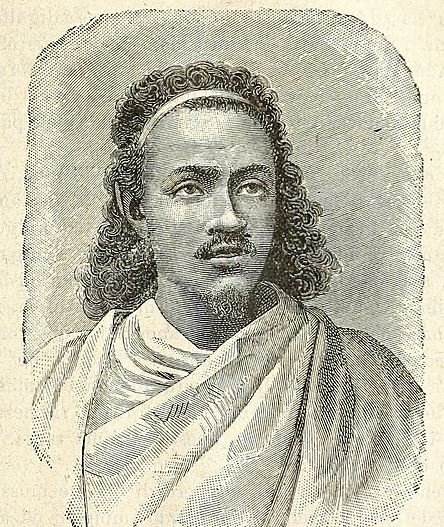
Image: An Italian depiction of Kassa, created around 1850.
Unification Efforts and Reforms
One of Tewodros II’s first priorities was to consolidate the Ethiopian state by subduing regional lords and integrating their territories into a centralized system. His most significant campaign was against Shewa, a powerful and semi-autonomous region in central Ethiopia. Shewa’s ruler had even styled himself “Negus,” or king, which challenged Tewodros’ authority as Emperor. By bringing Shewa under his control, Tewodros reinforced his dominance and secured a region that would later play an important role in Ethiopian history. As part of his unification efforts, Tewodros took a young prince from Shewa, Sahle Maryam, into his guardianship and raised him as his own. Sahle Maryam would later ascend to the throne as Menelik II, a pivotal figure in Ethiopia’s resistance against European colonialism.
To establish an enduring system of governance, Tewodros sought to implement administrative reforms aimed at modernizing Ethiopia’s political and military structures. In place of the traditional feudal system, where local lords wielded significant power over their territories, Tewodros introduced a centralized administration where regional governors and judges were appointed and salaried by the imperial government. This move was designed to reduce the influence of the regional nobility and prevent them from amassing their own power bases.
Additionally, Tewodros established a standing army loyal to the central government, rather than relying on the feudal practice of mobilizing troops through regional nobles. This professionalized military force allowed him to maintain control over his empire and defend it from both internal and external threats. His goal was to create a stable, centralized Ethiopia with a capable military that could enforce his authority and protect the country’s sovereignty.
Religious and Cultural Reforms
Tewodros II was a devout Christian who believed that religious unity and a strong relationship between church and state were essential to Ethiopia’s identity and stability. However, he recognized that the Ethiopian Orthodox Church held vast amounts of land and resources, which allowed it significant influence over the population. Tewodros attempted to reform the church’s role by introducing a tax on church lands to finance state activities, aiming to reduce the church’s independent economic power and strengthen the government’s revenue base.
This effort to assert state control over the church, however, faced fierce resistance. Church leaders were deeply opposed to Tewodros’ policies, as they saw them as an encroachment on their traditional privileges. The confiscation of church lands and attempts to impose a tax alienated the clergy and weakened Tewodros’ support among the religious elite. While his intent was to create a unified and financially stable state, these reforms ultimately isolated him from both the church and sections of the public that remained loyal to ecclesiastical authority.
In addition to his religious reforms, Tewodros showed a commitment to advancing Ethiopia’s intellectual and cultural heritage. He established Ethiopia’s first royal library, where he collected historical and religious manuscripts. This endeavor was part of his larger effort to foster a literate and informed elite who could aid in governing and strengthening the nation. Tewodros also introduced a new tax code to improve state revenues and create a system of accountability within the administration.
Diplomatic Challenges and the British Expedition
One of the defining episodes of Tewodros II’s reign was his ill-fated diplomatic conflict with Britain. In 1862, he sent a letter to Queen Victoria, hoping to establish an alliance with the British Empire to gain support for his modernization efforts and to protect Ethiopia’s sovereignty from Ottoman and Egyptian threats. However, the letter received no response, which Tewodros interpreted as a diplomatic snub. In his frustration, he took several British subjects and missionaries hostage, demanding a response from the British government.
This action led to a diplomatic crisis, and the British government eventually decided to launch a military expedition to secure the release of the hostages and assert its diplomatic authority. In 1868, a British force led by Sir Robert Napier arrived in Ethiopia in what became known as the British Expedition to Abyssinia. Tewodros fortified himself in the mountainous fortress of Magdala, where he prepared to resist the British invasion.
Despite his efforts to mount a defense, Tewodros’ forces were no match for the well-equipped British troops. The Battle of Magdala ended in defeat for Tewodros, who, rather than surrendering, chose to commit suicide on April 13, 1868. His death marked the end of his reign and his ambitious dream of a unified Ethiopian state. The British expedition retrieved their hostages, and Ethiopia was left without the strong central leader it had under Tewodros.

Image: A portrait of Tewodros II.
Legacy and Influence on Modern Ethiopia
Tewodros II’s legacy is complex and deeply woven into the fabric of Ethiopian history. Although he did not fully achieve his vision of a centralized, unified Ethiopian state, his efforts laid the groundwork for subsequent rulers who continued his work toward modernization and consolidation. His centralizing reforms and administrative restructuring set important precedents that influenced later emperors, including Menelik II, who would successfully resist European colonial encroachment.
In Ethiopian collective memory, Tewodros is remembered as a brave and visionary leader who sought to protect Ethiopia’s sovereignty and strengthen its identity. His efforts to modernize Ethiopia, although not entirely successful, marked the beginning of a shift toward centralized rule that would characterize Ethiopian governance in the decades to come. Many Ethiopians regard him as a patriotic figure whose ambitions reflected a deep commitment to Ethiopian unity and independence.
Tewodros’ conflict with Britain and his dramatic end at Magdala added a tragic dimension to his legacy. His defiance in the face of British power and his refusal to surrender are seen as symbolic of Ethiopia’s resilience in resisting foreign domination. The British took several Ethiopian artifacts, including Tewodros’ crown, during their retreat, which remains a sensitive issue in Ethiopian-British relations and adds to the complexity of his legacy.
Although Tewodros faced resistance from the church and nobility, his legacy as a reformer and nation-builder endures. His efforts were carried forward by later rulers, who recognized the need for a strong, centralized state to counter the encroaching powers of colonial Europe. Today, Tewodros II is celebrated as a hero in Ethiopian history, a symbol of strength and resilience in the face of internal division and external threats.
In sum, Tewodros II’s life and reign represent a pivotal chapter in Ethiopia’s journey toward modernity and unity. While his ambitions were met with mixed success, his vision for a strong, centralized Ethiopian state has inspired generations of Ethiopians and remains an essential part of the nation’s historical narrative.
Frequently Asked Questions about Tewodros II

What was the Zemene Mesafint, and how did Tewodros II end it?
The Zemene Mesafint, or “Era of the Princes,” was a time of decentralized rule in Ethiopia where regional lords held significant power. Tewodros II ended this period by uniting Ethiopia’s provinces and establishing a central authority.
How did Tewodros II address the independence of Shewa?
Tewodros II brought Shewa, a particularly independent region, under central control. He took in a Shewan prince, Sahle Maryam, as his ward, who would later become Emperor Menelik II.
What were some of Tewodros II’s main administrative reforms?
Tewodros II sought to centralize Ethiopia’s administration by creating a professional standing army, appointing salaried officials, introducing tax codes, and establishing administrative districts under imperial control.
How did Tewodros II attempt to reform the church, and what challenges did he face?
Tewodros attempted to tax church lands to support government expenses, aiming to reduce wealth disparity and strengthen state finances. However, his actions faced strong opposition from church leaders and isolated him from ecclesiastical and popular support.
What were Tewodros II’s cultural and intellectual contributions?
Tewodros established Ethiopia’s first library, implemented tax codes, and created a more centralized political system. These efforts were part of his goal to modernize Ethiopia and preserve its heritage.
What led to increased resistance against Tewodros II’s rule?
By 1863, regional nobles resisted Tewodros’ centralization efforts, leading to resource and manpower shortages. This opposition weakened his authority and hampered his modernization agenda.
What diplomatic conflict contributed to Tewodros II’s downfall?
In 1862, Tewodros sent a letter to Queen Victoria requesting assistance, which went unanswered. This led to tensions and eventually the British Expedition to Abyssinia in 1868, aimed at freeing British captives held by Tewodros.
How did Tewodros II’s reign come to an end?
During the British Expedition, Tewodros II faced British forces at the Battle of Magdala. Rather than being captured, he chose to commit suicide, ending his reign and unification efforts.
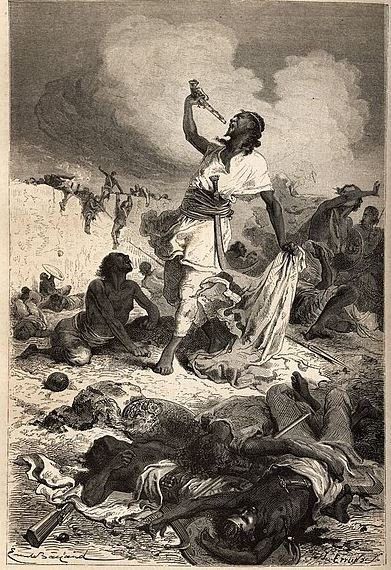
Image: Artwork by French artist Emile Bayard, depicting Tewodros committing suicide.
What legacy did Tewodros II leave behind?
Despite not fully achieving his goals, Tewodros II is remembered for laying the groundwork for a unified Ethiopian state and inspiring future leaders. He remains a symbol of resilience and vision in Ethiopian history.





