English Poet John Dryden
John Dryden, born on August 19, 1631, in Aldwincle, Northamptonshire, is remembered as one of the most influential literary figures of Restoration England. His life and works left an indelible mark on English poetry, criticism, and drama, and his influence on the development of English literary style and form can hardly be overstated. Dryden’s mastery of the heroic couplet, his innovative approach to satire, and his translations of classical literature set standards for his contemporaries and later generations.
Early Life and Background
Dryden was born into a well-connected Puritan family, the eldest of 14 children. His father, Erasmus Dryden, was a landowner, and his maternal grandfather was the rector of All Saints, a position that likely influenced Dryden’s early education and religious upbringing. The Dryden family was supportive of the Puritan cause, and the political and religious values of his family would have shaped his initial views and personality.
In 1644, Dryden entered Westminster School as a King’s Scholar. At Westminster, he studied under the rigorous and influential headmaster Richard Busby, who emphasized a curriculum grounded in the classics and rhetorical training. Busby’s teachings in rhetoric, debate, and persuasive argumentation would have a lasting impact on Dryden’s writing style, influencing his work as both a poet and a critic. After completing his studies at Westminster, Dryden attended Trinity College, Cambridge, in 1650, where he furthered his classical education and graduated with a Bachelor of Arts in 1654.
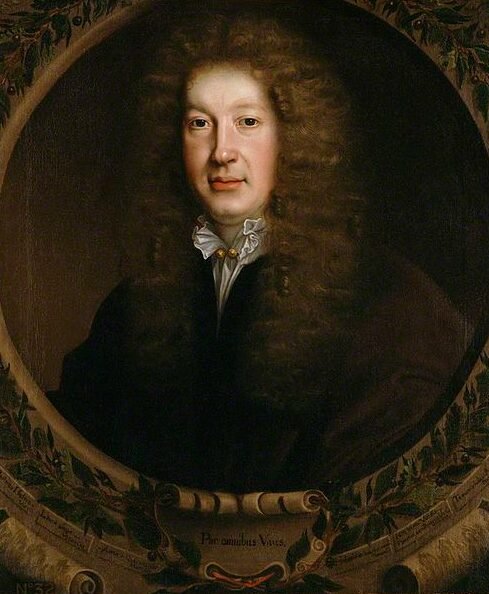
Image: A 1668 portrait of Dryden by English painter John Michael Wright.
Career Beginnings and Changing Allegiances
Dryden’s early literary career began during the politically turbulent period of the English Civil War and the Protectorate. His early work included a eulogy, Heroic Stanzas (1659), commemorating the death of Oliver Cromwell. This poem reflected his alignment with the Puritan values of his upbringing and was cautious in its tone. However, in 1660, with the restoration of the monarchy, Dryden’s allegiances shifted, and he began celebrating the return of Charles II. He published Astraea Redux, a panegyric on Charles II’s return, a work that marked his move to royalist sympathies.
Establishing Himself as a Leading Poet
The Restoration marked the start of Dryden’s prominence in English literary society. Known for his wit, eloquence, and understanding of classical themes, he quickly became an influential poet and critic. In 1662, he was elected a member of the Royal Society, reflecting his growing reputation. That same year, he married Lady Elizabeth Howard, daughter of the Earl of Berkshire. While Dryden’s personal feelings about marriage were sometimes ambivalent, his union with Lady Elizabeth brought him into aristocratic circles, further establishing his status in London’s literary world.
Theatrical Ventures and Poetic Achievements
With the reopening of London’s theaters following the Puritan ban, Dryden began writing plays. His first, The Wild Gallant (1663), was not a success, but he continued to write for the stage, securing a contract with the King’s Company in 1668 to produce plays annually. His plays spanned various genres, including comedy, tragedy, and heroic drama. Some of his notable works in theater include Marriage à la Mode (1673), a comedy, and All for Love (1678), a reimagining of Shakespeare’s Antony and Cleopatra written in blank verse.
Dryden’s dissatisfaction with the theater led him to pursue poetic endeavors. In 1667, he published Annus Mirabilis, a long historical poem that recounts two significant events: England’s victory over the Dutch fleet and the Great Fire of London. This work solidified his reputation as a leading poet and led to his appointment as England’s first Poet Laureate in 1668 and historiographer royal in 1670.
During this period, Dryden also turned to literary criticism, a field in which he would leave a significant legacy. His essay Of Dramatick Poesie (1668) explores the strengths and weaknesses of classical, French, and English drama, arguing in favor of English traditions while critiquing the rigidness of French style. This work, presented as a dialogue, reflects Dryden’s deep engagement with the theoretical aspects of literature and would become a foundational text in English literary criticism.
Satirical Mastery and Religious Writings
Dryden’s talent for satire reached its peak in the 1680s, with works like Mac Flecknoe (1682), a mock-heroic poem aimed at fellow playwright Thomas Shadwell. This work is a masterful example of satire, combining humor with pointed criticism of Shadwell’s perceived literary failings. Dryden’s satirical voice extended to political and religious themes in Absalom and Achitophel (1681), which uses the biblical story of Absalom’s rebellion against his father, King David, as an allegory for political unrest in England.
Another work, The Medal (1682), was also deeply political, targeting Whig opposition to King Charles II. In Religio Laici (1682), Dryden expressed his views on Anglicanism, defending the Church of England against both Catholicism and nonconformist views. However, in 1687, he converted to Catholicism and subsequently wrote The Hind and the Panther, an allegorical poem defending his new faith. This conversion marked a significant turning point, as Dryden’s later works reflected his commitment to his Catholic beliefs.
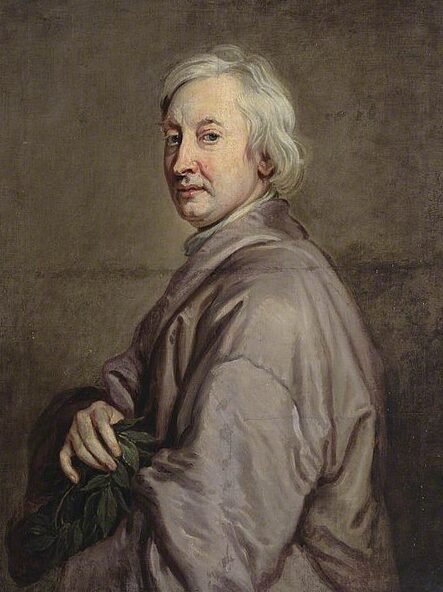
Image: A portrait of John Dryden Sir Godfrey Kneller.
The Glorious Revolution and Its Impact
The Glorious Revolution of 1688, which resulted in the overthrow of the Catholic King James II in favor of the Protestant rulers William and Mary, had a profound impact on Dryden’s life. Due to his refusal to swear allegiance to the new Protestant monarchy, Dryden lost his position as Poet Laureate and his title as historiographer royal. This political and religious shift relegated him to a position of outsider within the literary world. To support himself, he increasingly turned to translations of classical texts.
Translational Works and Later Life
Dryden’s final years saw him devote considerable energy to translating classical works, a pursuit that allowed him to explore the ideas of antiquity and introduce them to English readers. His crowning achievement in this field was The Works of Virgil (1697), a translation that included the Aeneid, Georgics, and Eclogues. Dryden’s translation of Virgil was highly regarded and financially successful, marking one of the most ambitious literary undertakings of his career.
In his last major publication, Fables Ancient and Modern (1700), Dryden presented translations and adaptations of works by Homer, Ovid, Boccaccio, and Chaucer. This collection, interwoven with Dryden’s original poetry, reflects his skill in bringing ancient and medieval texts to a contemporary audience, bridging cultural and historical divides. Fables Ancient and Modern is considered one of Dryden’s greatest achievements, showcasing his ability to reinterpret and modernize timeless themes.

Legacy and Influence
Dryden’s influence on English literature extended far beyond his lifetime. His development and popularization of the heroic couplet set a standard for English poetry, influencing poets like Alexander Pope, who praised Dryden’s ability to blend rhythm with intellectual vigor. Samuel Johnson, another admirer, credited Dryden with refining English poetic diction and introducing a structured elegance to English verse.
In his poetry, Dryden’s approach was often factual and precise, aiming for clarity over emotional complexity. This approach, while later criticized by Romantic poets like Wordsworth, made his work accessible and respected during the 18th century. His heroic couplets and “middle style” of writing became models of English poetic form, shaping the direction of English literature for generations.
Dryden was also known for his impact on English grammar, particularly his preference against ending sentences with prepositions, a rule that he believed was necessary to elevate English to the elegance of Latin. This rule was later adopted by grammarians and became a staple of formal English usage.
Critical Reception and Later Evaluations
Although Dryden was celebrated for his satirical wit and intellectual rigor, not all critics were equally appreciative of his style. Romantic poets, in particular, viewed his neoclassical restraint as too formal and detached, favoring more emotionally expressive styles. Wordsworth criticized Dryden’s translations of Virgil for lacking the emotional richness of the original texts, while later critics such as T.S. Eliot renewed appreciation for Dryden’s contributions, especially his influence on 18th-century poetry.
Eliot famously described Dryden as “the ancestor of nearly all that is best in the poetry of the eighteenth century,” recognizing his foundational role in shaping English verse. Dryden’s emphasis on clarity, balance, and formal structure made him a central figure in the transition from Renaissance to Enlightenment literary ideals.
Personal Life and Death
Despite his professional achievements, Dryden’s personal life remained relatively private. His marriage to Lady Elizabeth Howard produced three sons, although his writings reveal ambivalent feelings toward the institution of marriage. Dryden remained deeply committed to his family, though little is known about his day-to-day relationships.
Dryden died on May 12, 1700, and was initially buried in St. Anne’s Cemetery in Soho. Ten days later, he was reinterred in Westminster Abbey, a fitting resting place for a poet of his stature. His death marked the end of an era, and the literary community mourned his passing, recognizing the considerable contributions he had made to English letters.
Lasting Impact on English Literature
Dryden’s works remain central to the study of Restoration literature, and his innovations in satire, drama, and literary criticism continue to be analyzed for their skillful blending of classical form with contemporary themes. His translations brought classical literature into the English vernacular, making works by Virgil, Horace, and Ovid accessible to English audiences.
The heroic couplet, popularized by Dryden, became the defining poetic form of the 18th century, influencing writers from Pope to Johnson. His use of this form, along with his dedication to clear and measured language, established a model of poetic precision that would endure for generations.
In summary, John Dryden’s life and works represent a bridge between the classical and modern in English literature. His achievements in satire, poetic form, translation, and criticism shaped the trajectory of English literature, setting a high standard for intellectual rigor and artistic integrity. Dryden’s legacy as the “father of English criticism” and as a master of poetic form secures his place as one of the foremost literary figures of his time. His contributions continue to resonate, reminding readers and writers of the enduring power of language to capture and critique the human experience.
Frequently Asked Questions
What were John Dryden’s early influences, and how did his family background shape his upbringing?
Dryden was born into a prominent Puritan family, with his father Erasmus Dryden supporting the Puritan cause. His maternal grandfather was a rector, and Dryden’s devout and politically active family influenced his early perspectives.
Where did Dryden receive his early education?
Dryden first studied in Titchmarsh and then attended Westminster School as a King’s Scholar in 1644, where he was taught by the renowned and strict headmaster Richard Busby. Busby instilled in him a strong foundation in classics and rhetoric, shaping Dryden’s writing.
At Trinity College, Dryden studied classics, rhetoric, and mathematics, graduating in 1654. His time at Cambridge reintroduced him to Puritan ideals, and he ranked highly in his class, gaining skills that would benefit his writing career.
How did Dryden’s career begin, and what was his early political allegiance?
Dryden began his career under John Thurloe, Oliver Cromwell’s Secretary of State, likely through family connections. He initially supported Cromwell and even wrote a eulogy in his honor, Heroic Stanzas, in 1659.
How did Dryden’s allegiance shift after the Restoration, and what did he write to celebrate this change?
Following the Restoration in 1660, Dryden shifted his support to the monarchy. He commemorated Charles II’s return with Astraea Redux, celebrating the restored order and marking his shift in loyalty.
What role did the Restoration play in establishing Dryden as a leading poet and critic?
The Restoration gave Dryden opportunities to rise in prominence, particularly as he published works celebrating public events. He joined the Royal Society in 1662, and this period solidified his reputation.
How did Dryden’s career in playwriting begin, and what were some of his notable theatrical works?
Dryden started writing plays with The Wild Gallant (1663), which was poorly received. However, he continued and became known for Marriage à la Mode (1673) and the heroic tragedy All for Love (1678), a reimagining of Shakespeare’s Antony and Cleopatra.
Which work led to Dryden’s appointment as Poet Laureate, and what themes did it explore?
Annus Mirabilis (1667), which chronicled England’s resilience after the Great Fire of London and the war with the Dutch, solidified Dryden’s status and led to his appointment as Poet Laureate in 1668.
What was Of Dramatick Poesie, and why is it significant in English literary criticism?
Of Dramatick Poesie (1668) was a dialogue exploring classical, French, and English drama. Written during a theater closure, it became a foundational work in English criticism, showcasing Dryden’s literary insights.
What satirical works did Dryden write, and who were his targets?
Dryden’s satirical works included Mac Flecknoe (1682), mocking Thomas Shadwell, as well as Absalom and Achitophel (1681) and The Medal (1682), which targeted political and religious issues of his time.

Image: The cover page of Dryden’s “The Hind and the Panther”
How did the Glorious Revolution affect Dryden’s career, and what was his response?
The Glorious Revolution in 1688 forced Dryden, a Catholic loyalist, to refuse allegiance to William and Mary, leading to the loss of his Poet Laureate title. He turned to translating classical works for income.
What was Dryden’s most ambitious translation project, and why was it significant?
Dryden’s translation of The Works of Virgil (1697) was his most ambitious project, bringing him financial success and solidifying his influence in English literature. This project showcased his skill in adapting classical texts for an English audience.
What was Fables Ancient and Modern, and what did it demonstrate about Dryden’s abilities?
Fables Ancient and Modern (1700) was a collection of translations and adaptations from classical and medieval works, interwoven with Dryden’s poetry. It demonstrated his talent for modernizing classic literature.
How did Dryden’s influence continue after his death, and who admired his work?
Dryden’s influence remained strong, with poets like Alexander Pope admiring his skill in refining English language and verse. Samuel Johnson praised Dryden’s impact on poetic diction and his mastery of the heroic couplet.
What criticism did later poets have of Dryden, and how did Romantic poets view him?
Later poets like Wordsworth criticized Dryden for lacking emotional depth. The Romantic movement viewed his neoclassical style as overly formal, though some critics, like T. S. Eliot, renewed appreciation for his contributions.