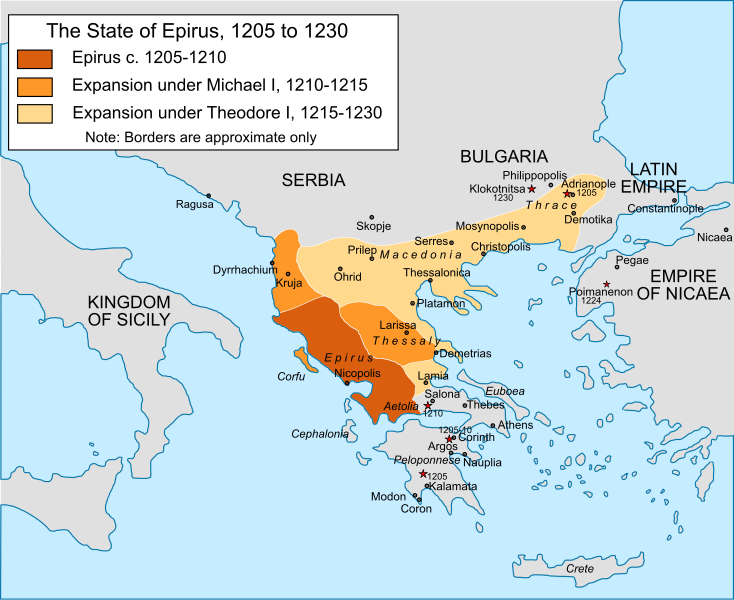
The territorial expansions of the Komnenodoukas dynasty of Epirus up to the Battle of Klokotnitsa.
The Empire of Thessalonica is a historiographic term used to describe the Byzantine Greek polity centered in Thessalonica between 1224 and 1246. Established during the fragmented period following the Fourth Crusade (1204), it was ruled by the Komnenodoukas dynasty of Epirus.
Under its most ambitious ruler, Theodore Komnenos Doukas, Thessalonica sought to restore the Byzantine Empire by seizing Constantinople from the Latin rulers. However, a dramatic turn of events, particularly the Battle of Klokotnitsa (1230) against the Second Bulgarian Empire, led to its rapid decline and eventual absorption into the Empire of Nicaea in 1246.
Below, World History Edu explores the formation, ambitions, decline, and final fate of this short-lived yet significant Byzantine successor state.
Background: The Post-Fourth Crusade Byzantine Successor States
The capture of Constantinople by the Fourth Crusade in 1204 marked the fragmentation of the Byzantine Empire. Several successor states emerged:
- Empire of Nicaea (Asia Minor) under Theodore I Laskaris.
- Despotate of Epirus (Western Greece) under Michael I Komnenos Doukas.
- Empire of Trebizond (Pontus region) under the Grand Komnenoi.
- Kingdom of Thessalonica, a Latin Crusader state ruled by Boniface of Montferrat.
The Despotate of Epirus, founded by Michael I Komnenos Doukas, quickly expanded into Thessaly. His successor, Theodore Komnenos Doukas, captured Thessalonica in 1224, marking the beginning of its imperial aspirations.
How and why did the Roman Catholics sack Constantinople in 1204?
Rise of the Empire of Thessalonica
After taking Thessalonica, Theodore Komnenos Doukas declared himself Emperor (Basileus), challenging the Empire of Nicaea for legitimacy. His coronation was performed by the Archbishop of Ohrid, Demetrios Chomatenos, either in 1225 or 1227/8. This was a direct rejection of the Patriarch of Constantinople, who resided in Nicaea.
Theodore launched a military expansion across the Balkans, consolidating his rule over Macedonia, Albania, and Thrace. He became a formidable power alongside John III Doukas Vatatzes of Nicaea and Ivan Asen II of Bulgaria. His conquests in Thrace forced Nicaea to retreat from Adrianople (1225), temporarily leaving him unchallenged in Europe.
The Empire of Thessalonica was a bold but short-lived attempt to restore the Byzantine Empire under the Komnenodoukas dynasty.
However, rather than attacking Constantinople, Theodore unexpectedly turned against Bulgaria in 1230. His invasion ended disastrously at the Battle of Klokotnitsa, where he was captured and later blinded by the Bulgarian Ivan Asen II. This marked the beginning of Thessalonica’s decline.
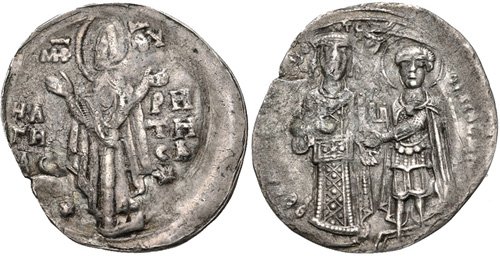
Billon trachy coin issued by Theodore Komnenos Doukas
Decline After Klokotnitsa
Following Theodore’s capture, his brother Manuel Komnenos Doukas took over but was forced to become a Bulgarian vassal. Most of Macedonia, Albania, and Thrace were lost. Seeking support, Manuel aligned with John III Vatatzes of Nicaea, recognizing his religious and political superiority.
Simultaneously, Michael II Komnenos Doukas, an illegitimate relative, seized Epirus, making Thessalonica’s rule even weaker. The state was now split into three rival territories: Thessalonica, Epirus, and Thessaly.
In 1237, Theodore was released and secretly returned to Thessalonica. Since he was blind, he could not reclaim the throne himself but installed his son, John Komnenos Doukas, as ruler, while he remained the de facto authority. Meanwhile, Manuel, supported by Nicaea, gained control of Thessaly.
In 1239, the brothers reached a fragile settlement:
- John ruled Thessalonica.
- Manuel ruled Thessaly.
- Constantine Komnenos Doukas controlled Aetolia and Acarnania.
This fragmentation further weakened Thessalonica’s standing.
Submission to Nicaea
By 1241, John Komnenos Doukas was under increasing pressure from John III Vatatzes of Nicaea. When he visited Nicaea under the promise of safe conduct, he was imprisoned. In 1242, Vatatzes forced Thessalonica to renounce its imperial title, reducing John to a mere Despot, formally making Thessalonica a Nicaean vassal state.
John died in 1244 and was succeeded by his brother, Demetrios Angelos Doukas, an incompetent ruler who quickly alienated the nobility and populace. Seeing an opportunity, John III Vatatzes invaded Thessalonica in 1246. The city’s pro-Nicaean factions opened the gates, and Thessalonica was peacefully annexed. Demetrios was exiled, and the city was placed under Andronikos Palaiologos as governor.
Initially a powerful contender for Constantinople, the Empire of Thessalonica’s ambitions collapsed following Theodore’s capture at Klokotnitsa (1230).
The Fate of Epirus and the Byzantine Restoration
Despite the fall of Thessalonica, the Komnenodoukai of Epirus continued resisting Nicaean dominance. Michael II of Epirus sought alliances against Nicaea, particularly with the Latin Principality of Achaea and Manfred of Sicily. He launched a campaign in 1251–53 but failed to retake Thessalonica.
The decisive moment came in 1259, when Nicaea defeated Epirus and its allies at the Battle of Pelagonia. This paved the way for Constantinople’s recapture in 1261, leading to the restoration of the Byzantine Empire under Michael VIII Palaiologos.
Frequently Asked Questions
Who founded the Empire of Thessalonica?
Theodore Komnenos Doukas, ruler of Epirus, captured Thessalonica in 1224 and declared himself emperor, challenging Nicaea and Bulgaria for dominance.
Why did Theodore Komnenos Doukas fail to capture Constantinople?
Although poised to attack, he delayed for unknown reasons and instead turned against Bulgaria in 1230, leading to his disastrous defeat and capture at the Battle of Klokotnitsa.
What was the significance of the Battle of Klokotnitsa (1230)?
It ended Thessalonica’s imperial ambitions as Theodore was captured and blinded, reducing the state to a Bulgarian vassal and leading to territorial losses.
How did Thessalonica lose its imperial status?
In 1242, Emperor John III Vatatzes of Nicaea forced John Komnenos Doukas to renounce the imperial title, reducing Thessalonica to a despotate under Nicaean suzerainty.
Who were the rulers of the Empire of Thessalonica?
The rulers of Thessalonica belonged to the Komnenodoukas dynasty. Theodore Komnenos Doukas established the empire in 1224 and was crowned emperor in 1225/27, but his defeat in 1230 led to Manuel Komnenos Doukas ruling until 1237. John Komnenos Doukas held the title of emperor until 1242 before being reduced to Despot. Demetrios Angelos Doukas, the last ruler, governed from 1244 to 1246 before Thessalonica was annexed by the Nicaean Empire.
Who was the last ruler of Thessalonica?
Demetrios Angelos Doukas (1244–1246), an unpopular and ineffective ruler, was overthrown when Thessalonica was annexed by the Nicaean Empire under John III Vatatzes.
Thessalonica, once the jewel of Byzantine Greece, remained significant under the Palaiologos dynasty, but never regained imperial status.
What happened to Thessalonica after its annexation by Nicaea?
It became a Nicaean province governed by Andronikos Palaiologos, helping solidify Nicaea’s control over Greece before the Byzantine Empire’s restoration in 1261.
How did the fall of Thessalonica affect Byzantine history?
Its annexation strengthened Nicaea, paving the way for the recapture of Constantinople in 1261 and the re-establishment of the Byzantine Empire under the Palaiologos dynasty.
FACT CHECK: At World History Edu, we strive for utmost accuracy and objectivity. But if you come across something that doesn’t look right, don’t hesitate to leave a comment below.





