The fall of Babylon in 539 BC was a pivotal moment in ancient history, marking the end of the Neo-Babylonian Empire and the rise of the Achaemenid Persian Empire under Cyrus the Great. This event reshaped the political landscape of the Near East, as Babylon, one of the most powerful and culturally rich empires of the ancient world, fell to the emerging Persian forces.
The downfall of Babylon was the result of a combination of factors, including internal strife, political mismanagement, religious tensions, and the military prowess of the Persians.
In the article below, World History Edu takes an in-depth look at the fall of Babylon.

Ruins of ancient Babylon
The Decline of the Neo-Babylonian Empire
The Neo-Babylonian Empire, which had reached its zenith under the reign of Nebuchadnezzar II (r. 605–562 BC), began to decline after his death. Nebuchadnezzar had strengthened Babylon’s position as a dominant force in the Near East, overseeing significant building projects, including the famous Hanging Gardens, and engaging in military campaigns that expanded Babylonian influence.
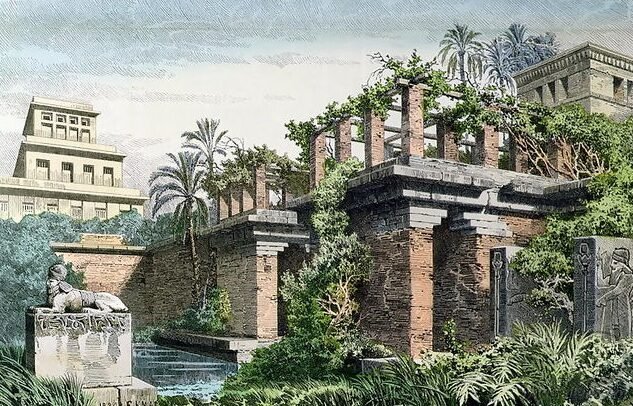
Depiction of the Hanging Gardens of Babylon by Ferdinand Knab 1886. The structure is believed to have been built by Nebuchadnezzar for his wife, Amytis of Babylon, to ease her homesickness.
However, the rulers who succeeded Nebuchadnezzar lacked his vision and capability, leading to internal instability and discontent among various factions within the empire.

Nabonidus, Babylon’s final king, took the throne in 556 BC after overthrowing Labashi-Marduk. Image: The Harran Stela shows Nabonidus praying to the moon god Sîn, the sun, and Venus.
Nabonidus, the last king of Babylon, ascended to the throne in 556 BC, but his reign was marked by controversy and division. Nabonidus’s focus on religious reforms alienated the powerful Marduk priesthood and much of the Babylonian population.
Traditionally, Marduk had been the chief deity of Babylon, and the city’s political and religious structures were closely intertwined with the worship of this god. Nabonidus, however, promoted the moon god Sin, a deity associated with his mother, Adad-guppi, and redirected royal patronage toward the temple of Sin in Harran, an ancient city in modern-day Turkey.
This shift in religious focus caused widespread resentment, especially among the priests of Marduk, who saw Nabonidus’s actions as a threat to their authority and Babylonian religious tradition.
Moreover, Nabonidus was an eccentric ruler, more interested in scholarly pursuits than in governing or military strategy. He spent long periods away from Babylon, delegating much of the administration of the empire to his son, Belshazzar.
While Belshazzar was a capable military leader, he was politically inept and failed to garner the support of key sectors, including the military elite and political leaders. This division between the king, his son, and the religious establishment weakened the empire, making it vulnerable to external threats.

Ancient Babylonia – The Walls of Babylon and the Temple of Bel (Or Babel), by 19th-century illustrator William Simpson – influenced by early archaeological investigations.
The Rise of Cyrus the Great and the Persian Empire
While Babylon was grappling with internal problems, the Persian Empire was rapidly expanding under the leadership of Cyrus the Great.
Cyrus, who came to power as king of Anshan in Persia around 559 BC, quickly established himself as a formidable ruler. He first consolidated his power by defeating the Medes, a neighboring people who had previously dominated the Persians.
By 550 BC, Cyrus had overthrown Astyages, the king of the Medes, and united the Medes and Persians under his rule, forming the foundation of the Achaemenid Empire.

Cyrus the Great was praised by many ancient historians as one who respected the customs and religions of the lands he conquered. Image: The four-winged guardian figure, possibly depicting Cyrus, is from a bas-relief at Pasargadae. An inscription reads, “I am Cyrus, the King, an Achaemenian.” However, some scholars doubt it represents Cyrus, noting the inscription was added later and appears on other buildings in the complex.
Cyrus’s military successes continued as he expanded his empire westward. In 547 BC, he launched a campaign against the kingdom of Lydia, located in what is now western Turkey, and defeated its king, Croesus.
This victory extended Persian control over much of Asia Minor, bringing Cyrus closer to the borders of the Neo-Babylonian Empire. With his forces now in position to threaten Babylon, Cyrus began eyeing the empire as his next target.
READ MORE: Major Accomplishments of Cyrus the Great, Founder of the Persian Empire
The Invasion of Babylonia

Meanwhile, Cyrus the Great had been strengthening the Persian Empire in the east. In 539 BC, after the decisive Battle of Opis, the Persian army entered Babylon without significant resistance, marking the incorporation of Babylonia into the Persian Empire as a satrapy. Image: Location of Opis within Iraq.
By 540 BC, Cyrus had begun his invasion of the Neo-Babylonian Empire. His strategy was multifaceted, involving both military campaigns and diplomatic efforts to win over Babylonian subjects who were disillusioned with Nabonidus’s rule.
Cyrus skillfully exploited the growing dissatisfaction within Babylon, particularly among the religious and political elite who resented Nabonidus’s religious reforms and neglect of the city’s administration.
In October 539 BC, Cyrus’s forces engaged the Babylonians in the Battle of Opis, a decisive confrontation that took place near the city of Opis on the Tigris River.
The Persian army, led by General Gobryas, defeated the Babylonian forces, opening the way for Cyrus to march on Babylon itself. After the battle, the Persians continued their advance, encountering little resistance as they moved through Babylonian territory.

Cyrus’s policy toward Babylon was notably lenient, as recorded in the Cyrus Cylinder, where he promised to respect Babylonian customs and religion. He also allowed exiled peoples, including the Jewish captives, to return to their homelands, thus earning the loyalty of the Babylonian elite. Image: Cyrus Cylinder
Historical accounts of the fall of Babylon differ, particularly regarding whether the city was taken by force or through a relatively peaceful surrender.
According to the Babylonian Chronicles, a set of ancient cuneiform tablets that record the events of the time, Babylon was captured “without battle.” This suggests that the city may have been taken by surprise or that its inhabitants, disillusioned with Nabonidus’s rule, may have welcomed the Persian forces as liberators rather than enemies.
The Cyrus Cylinder, another important ancient source, also describes the fall of Babylon in relatively peaceful terms. This inscription, often regarded as an early example of propaganda, portrays Cyrus as a liberator chosen by the god Marduk to restore order and justice to Babylon. The cylinder claims that Cyrus entered the city without a fight and was welcomed by its inhabitants. Furthermore, it emphasizes Cyrus’s respect for Babylonian religious traditions and his restoration of the temples and religious practices that Nabonidus had neglected.

Marduk – 9th century BC depiction of the Statue of Marduk, with his servant dragon Mušḫuššu. This was Marduk’s main cult image in Babylon
In contrast, Greek historians such as Herodotus and Xenophon provide different versions of the events. According to Herodotus, the Persians besieged Babylon and gained entry by diverting the waters of the Euphrates River, allowing them to enter the city through the dry riverbed. Xenophon, in his work Cyropaedia, a partly fictionalized account of the life of Cyrus, also describes a military assault, claiming that Belshazzar was killed during the Persian invasion.
Despite these varying accounts, what is clear is that Babylon fell to the Persians in October 539 BC, and Nabonidus was captured. Belshazzar, who had been left in charge of the city’s defenses, may have been killed, though some sources suggest that he survived the fall. Nabonidus, who had fled to Borsippa, another city in Babylonia, was later exiled by Cyrus to Carmania (modern-day southern Iran), where he spent the remainder of his life.
READ MORE: How the world was created in Babylonian mythology
Persian Rule in Babylon
After capturing Babylon, Cyrus swiftly integrated it into the Achaemenid Empire. Unlike many conquerors, who imposed harsh rule over their newly acquired territories, Cyrus pursued a policy of tolerance and respect for local customs and religions. He allowed the Babylonians to continue practicing their religion and restored the temples that had been neglected under Nabonidus. This approach helped Cyrus win the loyalty of the Babylonian priesthood and the population at large.
Cyrus’s policies extended beyond Babylon. One of his most significant acts was to allow exiled peoples, including the Jews, to return to their homelands and rebuild their temples. The Cyrus Cylinder and the Hebrew Bible both record this decree, which allowed the Jewish exiles who had been deported by Nebuchadnezzar II to return to Jerusalem. Cyrus’s benevolence toward exiled peoples, including the Jews, is one of the reasons he is remembered favorably in both Persian and Jewish history.
Cyrus adopted the title “King of Babylon” and took great care to present himself as the legitimate successor to the ancient kings of Babylon. He portrayed his conquest not as a violent overthrow but as a divinely sanctioned restoration of order and justice. By aligning himself with the religious and political traditions of Babylon, Cyrus was able to consolidate his rule over the city and its surrounding territories.

Cyrus was widely accepted as the legitimate successor to the ancient Babylonian kings, further consolidating his rule over the former Babylonian territories and securing his place in history as a liberator rather than a conqueror. Image: Standard of Cyrus the Great, founder of the Achaemenid Empire, featuring the Shahbaz (see list of flags used by Iranian peoples)
READ MORE: Rulers of the Achaemenid Persian Empire
The Revolts and Decline of Babylon’s Political Influence
Although Babylon remained an important city under Persian rule, it lost its political independence. Cyrus’s successors, including his son Cambyses II and Darius I, continued to integrate Babylon into the broader structure of the Persian Empire. However, tensions remained, and Babylonia periodically revolted against Persian rule.
One of the most significant revolts occurred during the reign of Darius I (r. 522–486 BC). In 522 BC, a man named Nidintu-Bel led a rebellion in Babylon, declaring himself king and taking the name Nebuchadnezzar III. Darius quickly crushed the revolt, capturing Babylon and executing Nidintu-Bel. A year later, in 521 BC, another revolt broke out, this time led by an Armenian named Arakha, who declared himself Nebuchadnezzar IV. Once again, Darius responded with force, capturing Babylon and destroying parts of its walls to prevent future uprisings.
Despite these revolts, Babylon remained a key administrative and cultural center within the Persian Empire. The city continued to serve as a provincial capital, and its temples, including the great temple of Marduk, the Esagila, remained important religious sites. However, the destruction of parts of Babylon’s defensive walls symbolized the decline of its political power and independence.
Babylon under Alexander the Great and the Seleucids
In 331 BC, Babylon was conquered by Alexander the Great during his campaign against the Achaemenid Empire. After his victory at the Battle of Gaugamela in 331 BC, Alexander entered Babylon and was welcomed by its inhabitants. Like Cyrus before him, Alexander sought to present himself as a liberator and restorer of Babylon’s traditions. He even planned to make Babylon one of the capitals of his vast empire, and he began extensive rebuilding projects in the city.
However, Alexander’s untimely death in 323 BC in Babylon halted these plans. After his death, his empire fragmented, leading to a series of wars among his former generals, known as the Diadochi. Babylonia eventually fell under the control of the Seleucid Empire, one of the successor states to Alexander’s empire.
Under the Seleucids, Babylon’s importance gradually declined as the new capital, Seleucia, was established on the Tigris River. Many of Babylon’s inhabitants were relocated to Seleucia, and the city’s population dwindled. Despite this decline, archaeological evidence shows that Babylon remained inhabited into the Parthian period (150 BC to 226 AD), contradicting earlier beliefs that the city had fallen into complete ruin after the rise of Seleucia.
Historical Legacy and Interpretation
The fall of Babylon and its incorporation into the Persian Empire marked the end of a long and illustrious chapter in the history of Mesopotamia. Babylon had been one of the most important cities in the ancient world, serving as a center of culture, religion, and political power for centuries. Its decline reflected the broader shifts in power in the ancient Near East as new empires, such as the Persians and later the Greeks, rose to prominence.
The ancient texts that describe the fall of Babylon, such as the Cyrus Cylinder and the Nabonidus Chronicle, offer contrasting perspectives on the events. While the Cyrus Cylinder portrays Cyrus as a liberator chosen by Marduk to restore Babylon, modern scholars recognize that these texts were likely propaganda designed to legitimize Cyrus’s rule. Similarly, the accounts of Herodotus and Xenophon offer different interpretations of how Babylon was captured, highlighting the complexities of reconstructing ancient historical events.
The fall of Babylon also had a profound impact on the cultural and religious landscape of the Near East. Cyrus’s policy of allowing exiled peoples to return to their homelands and practice their religions freely set a precedent for religious tolerance in the ancient world. His treatment of the Jews, in particular, earned him a place of honor in Jewish history, as he is credited with allowing the return of the exiles and the rebuilding of the Temple in Jerusalem.
Did you know…?
Scholar Gauthier Tolini suggests that Babylon was taken by force. He proposes that Persian forces, led by General Ugbaru, breached the Enlil Gate and captured the city. This theory is supported by archaeological evidence and aligns with Herodotus’s account of the Persians entering Babylon by diverting the Euphrates River.

Conclusion
The fall of Babylon in 539 BC was a defining moment in ancient history, signaling the end of the Neo-Babylonian Empire and the rise of the Persian Empire under Cyrus the Great.
While internal strife and religious divisions weakened Babylon, the strategic and diplomatic skills of Cyrus facilitated his conquest of the city.
Under Persian rule, Babylon continued to thrive as a cultural and religious center, though it lost its political independence. The city’s legacy as a symbol of ancient Mesopotamian civilization endures, even as the empires that once ruled it faded into history.
Frequently Asked Questions

Painting titled Cyrus the Great Defeating the Babylonian Army by English painter John Martin, created in 1831.
What was the significance of the fall of Babylon in 539 BC?
The fall of Babylon marked the end of the Neo-Babylonian Empire and the rise of the Achaemenid Persian Empire under Cyrus the Great. It was a turning point that shifted power in the ancient Near East, ushering in Persian dominance.
Who was Nabonidus, and why was he unpopular in Babylon?
Nabonidus was the last king of Babylon. He was unpopular, especially among the Marduk priesthood, for favoring the moon god Sin over Marduk, the chief Babylonian deity. His neglect of Babylonian traditions and his long absences from Babylon further alienated the religious elite and political class.
What role did Belshazzar play in Babylon’s downfall?
Belshazzar, the son of Nabonidus, managed the defense of Babylon while his father was away. Although a competent military leader, he lacked political skills and alienated the military and elite classes, contributing to the instability of the Babylonian Empire.

King Nabonidus often delegated rule to his son, Belshazzar, who proved to be a capable soldier but failed to maintain the support of the priesthood and military, weakening the empire. Image: Nabonidus, depicted on a stele, likely from Babylon, Iraq, housed in the British Museum.
How did Cyrus the Great take advantage of Babylon’s instability?
Cyrus the Great of Persia capitalized on Babylon’s internal discontent and weakened leadership. After consolidating his rule over Persia, he launched a campaign against Babylon, undermining Nabonidus’s authority and eventually invading Babylonia in 539 BC.
Were there conflicting accounts of how Babylon was captured?
The Babylonian Chronicles and the Cyrus Cylinder state that Babylon was taken without battle, while Greek historians like Herodotus and Xenophon describe a siege. The biblical Book of Daniel also mentions the death of King Belshazzar.
What happened to Nabonidus and Belshazzar after the fall of Babylon?
According to historical records, Nabonidus surrendered to the Persian forces and was exiled. Some accounts suggest that Belshazzar was killed during the invasion, though the details of his death vary across different sources.
How did Cyrus the Great present himself after capturing Babylon?
Cyrus portrayed himself as a liberator rather than a conqueror. He adopted the title “King of Babylon” and sought to restore order and justice. His policies, including allowing exiled peoples to return to their homelands, helped him gain the loyalty of Babylon’s subjects.
What role did the Marduk priesthood play in legitimizing Cyrus’s rule?
The Marduk priesthood, alienated by Nabonidus’s neglect of their god, supported Cyrus’s claim to the throne. They saw him as a savior who would restore the favor of Marduk and preserve Babylonian traditions.
What was the fate of Babylon under Persian rule?
Under Persian rule, Babylon became a key province of the Achaemenid Empire. Although it remained a major city, it lost its political independence. Subsequent revolts during the reign of Darius I were crushed, and the city’s walls were partially destroyed after one rebellion.
How did the conquest of Babylon affect the Jewish population?
The Persian conquest of Babylon allowed the Jewish population, previously exiled by the Neo-Babylonian Empire, to return to their homeland. This event is referenced in the Hebrew Bible, where Cyrus is praised for allowing the rebuilding of the Temple in Jerusalem.
Did Babylon continue to exist as an important city after its fall?
Despite its political decline, Babylon remained an important cultural and religious center. Alexander the Great conquered the city in 331 BC, and it continued to thrive into the Parthian period (150 BC to 226 AD), contradicting the belief that it fell into ruin after the rise of the Seleucid Empire.
How does modern scholarship view the ancient accounts of Babylon’s fall?
Modern scholars recognize that documents like the Cyrus Cylinder were used for propaganda purposes, portraying Nabonidus negatively and Cyrus as a liberator. These accounts were designed to legitimize Cyrus’s conquest and may not accurately reflect the historical events.
How did the timing of the Persian invasion contribute to its success?
The Persian invasion occurred during a festival in Babylon, which caught the city’s defenders off guard. This element of surprise likely contributed to the ease with which the city was captured, as indicated by accounts from Herodotus, Xenophon, and the Book of Daniel.
What new system of government did the Persians introduce after the fall of Babylon?
After Babylon’s fall, the Persian Empire instituted a multi-national system of governance. Under Cyrus and his successors, the empire expanded, incorporating local customs while maintaining centralized control. This system allowed the Persian Empire to effectively govern its vast territories.
How did the fall of Babylon influence religious and cultural developments in the region?
The fall of Babylon had significant religious and cultural implications. Cyrus’s policies allowed exiled populations, including the Jews, to return to their homelands and rebuild their temples. This event is also linked to the development of the Book of Isaiah, which praises Cyrus as a deliverer.

Engraving of Isaiah’s vision of Babylon’s destruction, created by French artist Gustave Doré.
What long-term impact did the fall of Babylon have on Mesopotamian civilization?
The fall of Babylon marked the decline of Mesopotamian civilization and the rise of Persian dominance in the region. While Babylon remained a significant cultural center, its political power diminished, symbolizing the end of an era in ancient Near Eastern history.





