The Battle of Gaugamela in 331 BCE
The Battle of Gaugamela, fought on October 1, 331 BCE, was a decisive conflict between the forces of Alexander the Great of Macedon and Darius III of Persia. This confrontation, near modern-day Mosul in Iraq, sealed the fate of the Achaemenid Empire (also known as the Persian Empire), marking the end of Persian dominance in the ancient world and establishing Alexander as one of the most significant military leaders in history. The battle stands out not only for its size and importance but also for the tactical brilliance that Alexander demonstrated, which overcame the numerical superiority of the Persian forces.

Image: Engraving of the Battle of Gaugamela.
Background of the Conflict
Alexander’s campaign against the Persian Empire began in 334 BCE, when he crossed into Asia Minor with an army of around 35,000 soldiers. His ambition was not merely to defeat the Persians but to conquer their entire empire. The Achaemenid Empire, under Darius III, had ruled vast territories stretching from the Aegean Sea to the borders of India. After Alexander’s initial victories at the Granicus River (334 BCE) and the Battle of Issus (333 BCE), he gained control of the western part of the Persian Empire, including Egypt. However, Darius III still commanded the heart of the Persian Empire and sought to confront Alexander once again.
The Persian king, after his defeat at Issus, understood that he had underestimated Alexander’s capabilities. Darius knew that a final stand was necessary to preserve his empire. He assembled a vast army from across his empire, pulling together forces from Babylon, Susa, Bactria, and other regions. Darius chose Gaugamela, a flat plain near the Tigris River, as the battlefield, believing it would allow him to use his cavalry and war chariots effectively. He even had the ground cleared and leveled to maximize the impact of his war chariots, which were equipped with scythe-like blades attached to their wheels.
READ MORE: Rulers of the AchaemenidEmpire
Alexander’s Army
Alexander’s army, although much smaller than the Persian force, was highly trained and loyal. His core force consisted of the Macedonian phalanx, a tightly organized infantry formation armed with long spears (sarissas), and the Companion Cavalry, an elite unit led personally by Alexander. The total size of his army at Gaugamela was around 47,000 men, including infantry and cavalry from various Greek city-states and mercenaries.
Alexander’s forces were not only highly disciplined but also benefited from innovative tactics and a flexible command structure. He had proven his leadership in previous battles, and his ability to read the battlefield and adapt his tactics accordingly made him a formidable opponent. His officers, especially Parmenion, were experienced commanders who could execute complex strategies on the battlefield.
READ MORE: Famous Battles Alexander the Great Fought in
Darius III’s Army
Darius III, aware of Alexander’s military prowess, gathered one of the largest armies ever seen in the ancient world. Estimates of the Persian forces range widely, but some ancient sources claim that Darius had over 100,000 soldiers, with some accounts even inflating the number to several hundred thousand. The Persian army included infantry, cavalry, archers, war chariots, and even elephants. Darius also positioned elite units such as the Immortals, his personal guard, and contingents from various regions of the empire.
Darius’s war chariots were a significant part of his strategy. These chariots, equipped with scythe-like blades, were intended to break through Alexander’s infantry lines. Additionally, his cavalry outnumbered Alexander’s, and Darius hoped to use this advantage on the wide, open plains of Gaugamela. Despite the massive size of his army, Darius faced challenges in commanding such a diverse force, with soldiers from different regions, speaking different languages, and varying levels of training and loyalty.

Image: A mosaic of Darius III.
The Battle
The battle began with Alexander’s careful approach to the battlefield. Darius had already positioned his forces on the plain of Gaugamela, and Alexander advanced with his army in a diagonal formation. This allowed him to approach the Persians at an angle, stretching Darius’s lines and forcing the Persian king to respond.
Darius positioned his troops with his strongest forces, including his war chariots, in the center, while his cavalry was spread across the flanks. He hoped to envelop Alexander’s forces by using his numerical superiority, particularly his cavalry. Darius’s plan was to outflank Alexander, break his lines, and use his chariots to wreak havoc among the Macedonian infantry.
Alexander’s Strategy
Alexander, however, anticipated this move. His plan involved a combination of a strong cavalry charge and the use of his phalanx to hold the center. As the battle began, he sent light infantry and cavalry to the wings, where they engaged the Persian cavalry. At the same time, Alexander held his elite Companion Cavalry in reserve, waiting for the right moment to strike.
Darius launched his war chariots early in the battle, but Alexander’s light infantry was prepared for them. The Macedonian soldiers opened gaps in their lines to allow the chariots to pass through harmlessly, and they then attacked the charioteers. This neutralized one of Darius’s key tactical advantages. As the battle continued, the Persian cavalry on the flanks began to push against Alexander’s forces, but the Macedonian lines held firm.
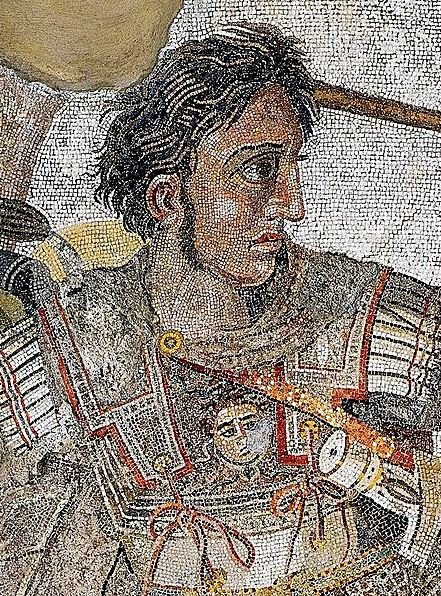
Image: Mosaic of Alexander the Great.
The Decisive Moment
The turning point in the battle came when Alexander led a direct cavalry charge at the Persian center. With his Companion Cavalry, Alexander personally led the attack against Darius’s position. The Macedonian cavalry punched through the Persian lines, and Alexander himself aimed to reach Darius. Seeing Alexander’s charge and the collapse of his center, Darius panicked. Fearing for his life, he turned and fled the battlefield, abandoning his army.
Darius’s flight triggered chaos among the Persian forces. Without their leader, many Persian soldiers began to retreat, and the battle quickly turned into a rout. However, despite this collapse in the center, the Persian forces on the flanks continued to fight. On the left flank, Parmenion, Alexander’s second-in-command, was hard-pressed by Persian cavalry and sent urgent messages to Alexander for help.
Aftermath of the Battle
Alexander faced a choice: continue his pursuit of Darius or turn back to assist Parmenion. He chose to help his general, a decision that allowed the Macedonian army to maintain cohesion and achieve a complete victory. After assisting Parmenion, Alexander resumed his pursuit of Darius but was unable to catch him that day. Darius fled eastward, but his fate was sealed. He would eventually be betrayed by his own commanders and killed in 330 BCE.
The Battle of Gaugamela marked the effective end of the Achaemenid Empire. Although Darius was not captured immediately, the defeat at Gaugamela left him without the resources or support to mount another significant defense. Alexander’s victory opened the way for him to capture the Persian capitals of Babylon, Susa, and Persepolis, and by 330 BCE, the Persian Empire had fallen under his control.
Significance of the Battle
The Battle of Gaugamela is considered one of the greatest tactical masterpieces in military history. Despite being heavily outnumbered, Alexander’s use of battlefield tactics, combined with his leadership and the discipline of his army, allowed him to overcome the vast numerical advantage of the Persian forces.
Alexander’s victory at Gaugamela also had far-reaching consequences for the ancient world. It marked the end of the Achaemenid Empire, which had dominated the Near East for over two centuries, and the rise of Alexander as the ruler of a vast empire stretching from Greece to the borders of India. The battle also demonstrated the effectiveness of combined arms tactics, where different types of military units—infantry, cavalry, and skirmishers—were used in coordination to achieve victory.
Furthermore, the battle cemented Alexander’s reputation as one of the greatest military commanders in history. His ability to inspire his men, his tactical brilliance, and his personal courage made him a legendary figure in both ancient and modern times. The victory at Gaugamela ensured that his name would be remembered for centuries and that his empire would serve as a model for future conquerors.
The Fall of the Achaemenid Empire
After Gaugamela, Alexander moved swiftly to consolidate his control over the former Persian territories. Babylon surrendered without a fight, and the Persian capitals of Susa and Persepolis soon followed. In a symbolic gesture, Alexander burned the palace at Persepolis, possibly as revenge for the Persian sack of Athens during the Greco-Persian Wars a century earlier.
Darius’s death in 330 BCE left Alexander as the uncontested ruler of the Persian Empire, but his ambitions did not stop there. He continued his campaigns eastward, eventually reaching the borders of India, where he fought his final major battle at the Hydaspes River in 326 BCE.
READ MORE: Major Accomplishments of the Persian Empire
Legacy
The Battle of Gaugamela has been studied by military historians for centuries, both for its tactical lessons and for its broader historical significance. Alexander’s ability to use a smaller, highly trained force to defeat a much larger army has inspired generations of military leaders. His use of deception, mobility, and coordination between different types of forces remains relevant in military strategy to this day.
Gaugamela also marked a turning point in the history of the ancient Near East. The fall of the Achaemenid Empire paved the way for the spread of Hellenistic culture throughout the region, as Alexander and his successors sought to blend Greek and Persian traditions. The cities founded by Alexander, such as Alexandria in Egypt, became centers of learning and culture that influenced the development of the ancient world for centuries.
Conclusion
The Battle of Gaugamela was not just a military victory; it was a pivotal moment in world history. Alexander’s triumph over Darius III reshaped the political and cultural landscape of the ancient world, leading to the spread of Greek culture across the Near East and setting the stage for the rise of the Hellenistic kingdoms. The battle also solidified Alexander’s legacy as one of history’s greatest military strategists and empire builders.
Questions and Answers about the Battle of Gaugamela, 331 BCE

Alexander’s main objective was to confront Darius III and bring him into battle as he advanced into Mesopotamia. Image: An illustration of Alexander’s victory at the Battle of Gaugamela.
How did Alexander’s forces move after crossing the Euphrates River?
After crossing the Euphrates without opposition, Alexander led his army eastward along the foothills of the Armenian mountains and then crossed the Tigris River.
Alexander organized his army into battle formation and personally led a contingent of cavalry and light infantry to engage and scatter the Persian cavalry, capturing several of them.
What information did Alexander gather from his Persian captives?
Alexander learned that Darius III was stationed at Gaugamela, a small village near the Bumodus River, and was preparing for battle.
How did Alexander prepare his forces after learning Darius was nearby?
Alexander halted his advance, set up a fortified camp, and later moved his troops after nightfall to a position overlooking the Persian camp, ready for battle.
Why did Alexander refuse to make a night attack on the Persian camp?
Alexander refused the night attack because he knew from scouting that the Persians were expecting such a move, and their army was already prepared and in battle formation.
What was the composition of Darius’s army and how did it compare to Alexander’s forces?
Darius’s army included cavalry from Bactria, Scythia, Arachosia, and other regions, along with infantry, Greek mercenaries, 100 scythed chariots, and 15 elephants. His forces were estimated between 90,000 to 250,000, far outnumbering Alexander’s 40,000 infantry and 7,000 cavalry.
What advantages did the Macedonian army have over the Persian army?
The Macedonians were highly disciplined and organized, with heavily armored infantry in phalanx formation, wielding long sarissas (spears up to 18 feet). This allowed them to engage the enemy from a distance and provided them a tactical edge in close combat.
What was Darius’s initial response to Alexander’s cavalry movement?
Darius ordered his left-wing cavalry to counter Alexander’s cavalry movement. He also directed his forces to envelop Alexander’s cavalry as the Macedonian line advanced.
Alexander engaged in a fierce cavalry battle with Darius’s left wing, initially facing heavy resistance. However, after persistent fighting, Alexander’s cavalry broke through the Persian left.
How did the Macedonian light infantry deal with the Persian chariots and elephants?
The Macedonian light infantry neutralized the Persian chariots by killing the horses and drivers. Any chariots that reached the phalanx were dealt with by the Hypaspists and horse grooms stationed at the rear.
What was the decisive moment in the Battle of Gaugamela?
The decisive moment came when Alexander wheeled his cavalry left, forming a wedge, and charged into the gap in the Persian center, aiming for Darius. Seeing the charge, Darius fled, causing his troops to panic and retreat.





