Family Life in Ancient Rome
The family, or familia, was the cornerstone of Roman society. In ancient Rome, family life was not merely a private matter but a fundamental aspect of societal organization, politics, and culture. The family structure in Rome was hierarchical and patriarchal, deeply influenced by Roman law, religion, and tradition.
Structure of the Roman Family
The Paterfamilias (Head of the Family)
The paterfamilias held absolute authority (patria potestas) over all members of the household, including his wife, children, slaves, and property. He was responsible for maintaining the family’s honor, managing finances, and performing religious rituals.
Also, his power extended to life and death decisions, though such authority was exercised with restraint by the late Republic and early Empire.

An ancient gold portrait depicting a small Roman family, made up of just the husband and wife.
The Wife (Matrona)
Roman wives were expected to manage the household, oversee slaves, and bear children to ensure the continuation of the family line.
Although subordinate to the paterfamilias, elite Roman women often wielded significant influence within the home and, indirectly, in public life.
In the nutshell, marriage served political and social functions, frequently arranged to strengthen alliances.
Children
Children were considered the family’s future and were raised with discipline and a sense of duty. Sons were groomed for public roles, while daughters were prepared for marriage.
Education, especially for boys, emphasized literacy, rhetoric, and moral values. Wealthy families often employed tutors or sent their sons to formal schools.
Extended Family and Dependents
A Roman familia extended beyond the nuclear family to include slaves, freedmen, and sometimes even clients.
Slaves were integral to the household, performing tasks ranging from domestic chores to tutoring children.
READ MORE: How did one become a citizen in Ancient Rome?
Marriage and Family Bonds
Roman marriages were monogamous and often arranged with an emphasis on property and social alliances.
Two main forms of marriage existed:
- Cum manu: The wife came under the authority of her husband.
- Sine manu: The wife remained under her father’s authority.
Also, divorce was relatively simple and could be initiated by either party.
Fathers were disciplinarians but were also expected to instill moral virtues and a sense of duty in their children. Mothers played a nurturing role, especially during early childhood.
Daily Life in a Roman Family

Household Organization
Roman homes (domus) were hierarchical spaces, with separate areas for the family and slaves. The atrium served as a public reception area, while the tablinum was a space for the head of the household’s business dealings.
Meals and Socialization
Mealtimes were central to family bonding and social life. Wealthy families dined in the triclinium (dining room), reclining on couches.
Food was prepared by slaves, and meals often featured dishes reflecting the family’s wealth and status.
Education
Boys received formal education, advancing to study rhetoric and philosophy if destined for public roles.
Girls were taught domestic skills, although some from elite families received an advanced education.
Religious Practices
Religion was integral to family life, with daily rituals honoring household gods (Lares and Penates).
The paterfamilias conducted ceremonies to ensure the family’s prosperity and protection.
Social and Legal Aspects of Family Life
Roman law codified the family’s structure, emphasizing the authority of the paterfamilias. Women and children had limited legal independence but could gain autonomy through certain legal mechanisms, such as emancipation or inheritance.
Family dynamics varied across social classes. Elite families prioritized public roles and political alliances, while lower-class families focused on survival and labor.
Family life in ancient Rome was complex, shaped by a combination of tradition, law, and societal expectations.
Slaves were considered part of the household and played a significant role in daily life. Relationships between slaves and their owners varied, with some slaves achieving freedom and integrating into Roman society.
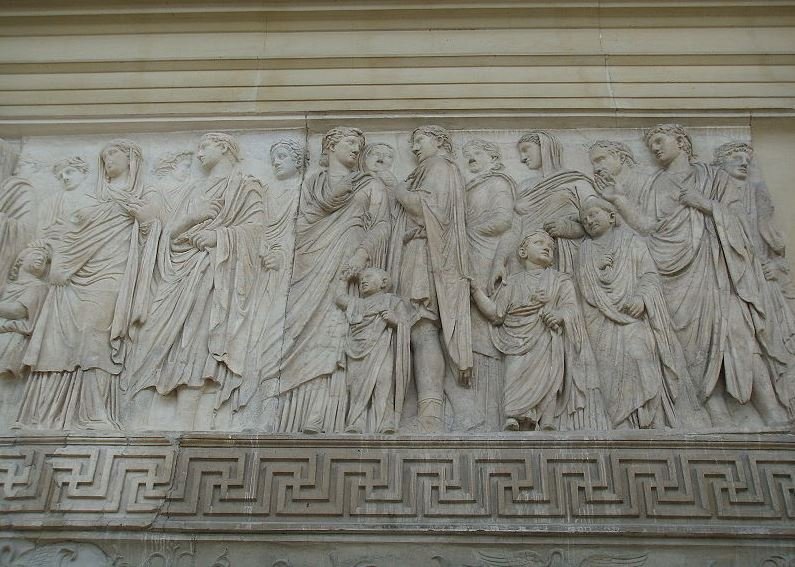
Image: A relief work depicting the imperial family of Augustus.
Cultural and Political Significance
The hierarchical structure of the Roman family mirrored the organization of the Roman state. Respect for authority within the family paralleled loyalty to the state.
Large, prosperous families were symbols of prestige and power. Adoption was common among elite families to ensure a male heir and preserve the family name.
Family connections were vital for political advancement. Patronage networks often extended through family alliances.
Challenges and Changes in Family Life
Rome’s military campaigns and territorial expansion often disrupted family life, as men were conscripted and families were separated. The influx of slaves and wealth altered traditional family dynamics.
Women from elite families gained more influence during the late Republic and Empire, managing estates and participating in cultural patronage. Legal reforms gradually increased women’s rights, including property ownership.
By the late Empire, traditional family structures and values faced challenges from economic pressures and cultural changes.
Questions and answers about the Ancient Roman Family Life
Who was the head of the Roman family?
The head of the Roman family was the paterfamilias, or father, who held absolute authority under Roman law. If no father existed, the eldest living male assumed this role.
What powers did the paterfamilias have?
The paterfamilias held patria potestas—absolute paternal power—over his household, which included his wife, children, grandchildren, and slaves. He had authority over financial matters, marriage arrangements, and even discipline.
Why was lineage important in Roman society?
Lineage defined a Roman male’s social rank and dignity (dignitas). Blood ties (cognati) were prioritized over relationships acquired through marriage (adfinitas), highlighting the importance of family ancestry.
What was the primary purpose of marriage in Roman society?
Marriage was primarily a tool for political, social, or financial alliances rather than romantic love. It was often arranged to secure power, wealth, or alliances.
At what age did Roman girls typically marry?
Roman girls typically married between the ages of 12 and 15, though some were married earlier. Consummation of the marriage might be delayed.
What were Roman marriage ceremonies like?
Marriage ceremonies varied in scale. Simple unions required no state involvement, while elaborate ceremonies featured priests, contracts, and sacrifices. Brides wore yellow tunics (tunica recta), and weddings often culminated in a procession to the groom’s home.
How was divorce handled in Roman society?
Divorce was straightforward, requiring no specific justification. A couple could end their marriage by mutual declaration.
What rights did Roman women have?
Roman women could inherit property but could not vote or hold public office. Their control transferred from their father to their husband upon marriage.
What freedoms did Roman women enjoy?
Roman women could appear in public with their husbands, attend theaters, and use public baths in segregated spaces. They managed households, supervised servants, and could work as bakers, pharmacists, or doctors over time.
Why didn’t Roman women have first names?
Roman women’s names derived from their father’s family name. For example, Cicero’s daughter was Tullia, derived from his middle name, Tullius.
What was the primary goal of marriage for Roman families?
The primary goal of marriage was to produce children and heirs to continue the family line.
Why was childbirth dangerous for Roman women?
Childbirth was perilous due to poor hygiene, malnutrition, and lack of medical knowledge, making it the leading cause of death for young women.
What was the role of the paterfamilias in a newborn’s life?
The paterfamilias decided whether to accept or reject a newborn. Rejected infants, particularly girls, were often abandoned.
What was the mortality rate for Roman children?
Infant mortality was high, with many children dying before their first birthday. Surviving children faced numerous health challenges but had a higher life expectancy after age ten.
What education did Roman children receive?
Wealthier families provided formal education for boys and basic education for girls. Boys might attend advanced schools or study abroad, while girls were often educated at home.
How did traditional family roles change over time in Rome?
Traditional family roles shifted as the absolute authority of the paterfamilias weakened. Women gained modest independence, and children had more freedom in choosing their spouses.
What reforms did Augustus enact to address changes in Roman family life?
In 18 BCE, Emperor Augustus enacted laws promoting marriage, fidelity, and childbirth. He adopted the title pater patriae (father of the country), extending familial principles to his role as emperor.

Bust of Augustus
READ MORE: 10 Greatest Achievements of Augustus, the First Roman Emperor