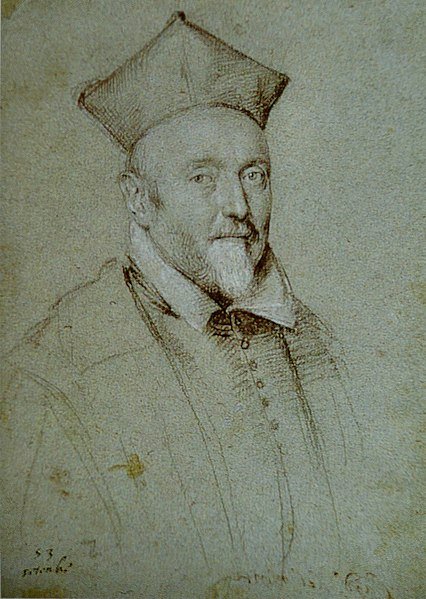
A portrait of Cardinal Francesco Maria del Monte by the Italian painter Ottavio Leoni.
Francesco Maria del Monte was an Italian cardinal, diplomat, and patron of the arts, best known for supporting Caravaggio and amassing an extensive art collection.
Early Life and Background
Francesco Maria Bourbon del Monte Santa Maria was born on July 5, 1549, in Venice to the aristocratic del Monte family, which originated from Tuscany. His father, Marquis Ranieri Bourbon del Monte, was the first Count of Monte Baroccio, while his mother, Minerva Pianosa, hailed from a distinguished lineage. Raised in an environment of privilege and learning, del Monte received a classical education that prepared him for a prominent role in the ecclesiastical and political spheres of his time.
As a young man, del Monte embarked on his religious career by assuming the position of Abbot commendatario of Santa Croce a Monte Fabali. This was a significant appointment, as it provided him with the opportunity to gain administrative experience within the Church while also establishing connections with influential figures. Seeking greater opportunities, he moved to Rome at an early age, where his talents and ambitions found fertile ground for growth.
Rise in the Church and Political Influence
Del Monte’s early career was shaped by his association with Cardinal Alessandro Sforza, under whom he served as an auditor. His abilities did not go unnoticed, and he later joined the court of Cardinal Ferdinando de’ Medici. This affiliation proved to be instrumental in his rise through the ranks of the clergy. In 1580, he was appointed Referendary of the Tribunals of the Apostolic Signature of Justice and of Grace, which further cemented his position within the papal administration.
His most significant career advancement came in 1588 when Pope Sixtus V appointed him as a cardinal deacon. A year later, he was assigned the deaconry of Santa Maria in Domnica. Del Monte quickly gained recognition as a skilled diplomat and an adept administrator. His diplomatic skills were particularly valuable in the power struggle between France and Spain over the influence within the papacy. Despite the tensions of the period, del Monte remained a staunch supporter of the Grand Duke of Tuscany, the former Cardinal Ferdinando de’ Medici, advocating for Florentine interests in Rome.
During his tenure, del Monte took part in several papal conclaves, including those of 1590, 1591, and 1592. His political influence continued to grow, leading to his appointment as Prefect of the Tridentine Council from 1606 to 1616. Additionally, he served as the Bishop of Palestrina from 1615 to 1621. He aspired to the papacy and actively participated in the conclave of 1621, but his close ties to France ultimately led to his exclusion by the Spanish faction, which wielded considerable influence in Vatican politics.
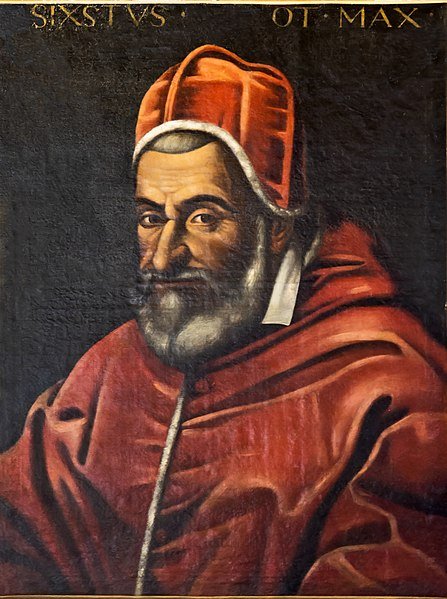
Pope Sixtus V
Patronage and Intellectual Engagements
Francesco Maria del Monte was not only a political figure but also a passionate patron of the arts and sciences. His support for intellectual and artistic endeavors earned him a distinguished reputation in Rome. His household at Palazzo Madama became a hub of cultural and scientific discourse, attracting some of the most brilliant minds of the time.
One of his most significant contributions was his patronage of Galileo Galilei. Together with his brother, he played a crucial role in securing Galileo a lectureship in mathematics at Pisa in 1589 and at Padua in 1592. When Galileo made groundbreaking astronomical discoveries, including the identification of Jupiter’s moons, he presented del Monte with a copy of his Sidereus Nuncius (Sidereal Messenger) and a telescope as tokens of appreciation. The cardinal, in turn, facilitated Galileo’s introduction to influential figures in Rome, including members of the Vatican.
Apart from the sciences, del Monte was a great lover of art. He was an early patron of German painter Adam Elsheimer and Italian artist Andrea Sacchi, but his most famous artistic connection was with Michelangelo Merisi da Caravaggio.
10 significant figures in science that shaped our understanding
Patronage of Caravaggio
Francesco Maria del Monte is best remembered today for his crucial role in the career of the Baroque master Caravaggio. It was under his patronage that Caravaggio found a stable environment to refine his innovative artistic style. Del Monte first encountered the young painter through an introduction by the dealer Costantino Spada, recognizing his extraordinary talent.
Del Monte provided Caravaggio with accommodation at his residence, Palazzo Madama, and commissioned a number of paintings from him. This support allowed the artist to focus on his craft without financial insecurity. Several of Caravaggio’s most notable early works can be traced back to this period under del Monte’s guidance, including The Musicians, The Lute Player, and Bacchus.
One of the defining characteristics of del Monte’s patronage was his preference for intimate and humanistic subjects in art. Unlike many religious patrons who favored grand biblical scenes, del Monte’s commissions often revolved around themes of music, allegory, and youthful beauty. Scholars have speculated about the motivations behind his artistic preferences, with some suggesting that his personal inclinations may have influenced his tastes.
Controversies and Personal Life
Del Monte’s personal life has been the subject of historical scrutiny. Some scholars, such as Posner, Frommel, and Hibbard, have argued that he may have been homosexual based on certain historical accounts, particularly the writings of Dirk van Ameyden. Van Ameyden’s descriptions suggest that del Monte exhibited more than paternal interest in the young men he mentored. However, historian Graham-Dixon has pointed out that these accusations were likely politically motivated, as van Ameyden was aligned with the Spanish faction, which sought to discredit the pro-French del Monte.
Ultimately, the question of del Monte’s sexuality remains unresolved. Some sources suggest that he had courted women in his youth, while others emphasize his close relationships with young male artists and musicians. Regardless of his personal life, what remains undeniable is his profound impact on the artistic and intellectual culture of his time.
The Del Monte Art Collection
Del Monte’s passion for art extended beyond Caravaggio. By the time of his death, his personal collection included over six hundred paintings. His extensive holdings provided provenance for many significant works from the late Renaissance and early Baroque periods. Among the most notable paintings in his collection were:
- The Lute Player by Caravaggio (Hermitage Museum, Saint Petersburg)
- The Musicians by Caravaggio (The Metropolitan Museum of Art, New York)
- Saint Catherine of Alexandria by Caravaggio (Museo Thyssen-Bornemisza, Madrid)
- Bacchus by Caravaggio (Uffizi Gallery, Florence)
- The Fortune Teller by Caravaggio (Louvre, Paris)
- The Cardsharps by Caravaggio (Kimbell Art Museum, Fort Worth)
Del Monte was also the first recorded owner of the Portland Vase, an exquisite Roman cameo glass vessel that later became one of the most famous artifacts of antiquity.
Death and Legacy
Francesco Maria del Monte passed away on August 27, 1627, at his residence in Palazzo Madama. He was interred in the church of Sant’Urbano in Rome, where his epitaph describes him as an “excellent patron of the good arts.”
His legacy as a patron of the arts endures primarily through his association with Caravaggio, whose career flourished under his support. The influence of his patronage can still be seen in the masterpieces that emerged from his collection, many of which continue to be celebrated today.
Beyond the arts, del Monte’s contributions to science and diplomacy further establish him as a pivotal figure in early modern history. His role in supporting Galileo and advancing scientific discourse demonstrates his forward-thinking approach to intellectual inquiry. In a time when Rome was a battleground for competing political and artistic interests, Francesco Maria del Monte stood out as a key patron who nurtured talent, fostered innovation, and left an indelible mark on the cultural landscape of his era.
Frequently Asked Questions
What role did Francesco Maria del Monte play in Caravaggio’s career?
Del Monte was an early patron of Caravaggio, commissioning several of his works and providing him with crucial support in his early career.
What were his main diplomatic and ecclesiastical roles?
He served as a cardinal, a diplomat for the Grand Duke of Tuscany, Prefect of the Tridentine Council, and Bishop of Palestrina.
What was his connection to Galileo Galilei?
He supported Galileo’s academic career, helping him secure lectureships and introducing him to influential circles in Rome.
Why was he not elected Pope in 1621?
His pro-French stance led to his veto by Spanish interests during the papal conclave.
What was the significance of his art collection?
His collection, which included over 600 paintings, provides provenance for many Baroque masterpieces, particularly by Caravaggio.
What is known about his personal life and sexuality?
Some scholars suggest he may have been homosexual, but evidence is inconclusive, and some claims may have been politically motivated.
Where was he buried?
Francesco Maria del Monte was buried in the church of Sant’Urbano in Rome after his death at Palazzo Madama.





