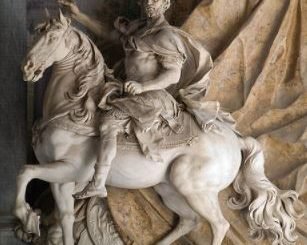
Francis II and I: Holy Roman Emperor and Emperor of Austria
Francis II (1768–1835) was a pivotal figure in European history, serving as the last Holy Roman Emperor and the first Emperor of Austria. Born on February 12, 1768, in Florence, he was the eldest son of Archduke Leopold of Austria and Maria Luisa of Spain. At the time, his father governed as the Grand Duke of Tuscany, instilling in Francis an appreciation for governance and state affairs from an early age.

Francis II and I’s reign was marked by significant challenges and transformations. He navigated the complexities of the French Revolution, the rise and fall of Napoleon, and the restructuring of Europe. Image: Portrait of Francis by English artist Thomas Lawrence.
Early Life and Education
Francis’s early years in Florence were marked by a relatively liberal upbringing. However, this changed when he was summoned to Vienna at the age of 16 by his uncle, Emperor Joseph II.
Recognizing the importance of preparing his nephew for future leadership, Joseph II took charge of Francis’s education. He emphasized statecraft, military training, and administrative skills, aiming to mold him into a capable ruler. Despite these efforts, Francis was often perceived as unimaginative and resistant to change. Nevertheless, he developed a strong sense of duty and a commitment to conservative values, traits that would define his reign.
Accession to the Throne
In 1790, following the death of Joseph II, Francis’s father ascended to the imperial throne as Leopold II. Leopold’s reign was brief; he died unexpectedly in 1792, leaving the 24-year-old Francis to inherit the complex political landscape of the Holy Roman Empire.
Educated politically by his uncle Joseph II, Francis II was considered diligent but inflexible. He ascended to the throne in 1792 during the upheaval of the French Revolution.
His ascension coincided with the turbulent times of the French Revolution, which posed significant challenges to monarchies across Europe. The execution of King Louis XVI in France sent shockwaves through the continent, and revolutionary ideals threatened the established order.
Early Reign and the French Revolutionary Wars
Determined to counter the spread of revolutionary fervor, Francis led Austria into the French Revolutionary Wars as part of the First Coalition.
Aligning with Britain, Prussia, and other European powers, the coalition sought to restore the French monarchy and suppress republicanism. Despite their efforts, Austrian forces suffered significant defeats, particularly against French General Napoleon Bonaparte.
The Treaty of Campo Formio in 1797 forced Austria to cede the Austrian Netherlands and recognize French control over the left bank of the Rhine, marking substantial territorial losses.

Conflicts with Napoleon and the Decline of the Holy Roman Empire
The rise of Napoleon Bonaparte presented an even greater challenge. In 1799, Austria joined the Second Coalition against France but faced further setbacks. Acknowledging Napoleon’s escalating power, Francis sought to elevate his own status to maintain imperial parity.
In 1804, following Napoleon’s declaration as Emperor of the French, Francis proclaimed the Austrian Empire and adopted the title Francis I, Emperor of Austria. This move consolidated the Habsburg lands under a singular imperial title, aiming to strengthen his position both domestically and internationally.
Francis II’s decisions, from dissolving the Holy Roman Empire to participating in the Congress of Vienna, had lasting impacts on the continent’s political landscape.
Despite these efforts, Austria suffered a crushing defeat at the Battle of Austerlitz in 1805 during the War of the Third Coalition. The subsequent Treaty of Pressburg imposed harsh terms on Austria, including significant territorial concessions. Napoleon’s establishment of the Confederation of the Rhine in 1806—a coalition of German states under French influence—further undermined the Holy Roman Empire’s authority.
Recognizing the altered political reality, Francis dissolved the Holy Roman Empire on August 6, 1806, abdicating his title as Holy Roman Emperor. This act ended an institution that had lasted for over a millennium, symbolizing the profound shifts occurring in Europe.

Image: Napoleon Bonaparte
Continued Opposition to Napoleon
Undeterred by previous defeats, Francis continued to oppose Napoleon. In 1809, Austria initiated the War of the Fifth Coalition but was defeated again at the Battle of Wagram. The resulting Treaty of Schönbrunn further diminished Austrian power. In a strategic but uneasy decision, Francis agreed to Napoleon’s request to marry his daughter, Archduchess Marie Louise, in 1810. This marriage aimed to secure peace and forge a familial alliance between the two empires, although it was met with resentment by many Austrians who viewed Napoleon as an adversary.
The Fall of Napoleon and the Congress of Vienna
The tide turned following Napoleon’s failed invasion of Russia in 1812. Sensing an opportunity, Francis shifted his position from neutrality to active opposition. In 1813, Austria joined the Sixth Coalition alongside Russia, Prussia, Britain, and other nations. The coalition’s victory at the Battle of Leipzig, known as the Battle of Nations, dealt a decisive blow to Napoleon.
By 1814, coalition forces had entered Paris, leading to Napoleon’s abdication and exile to Elba. Francis played a significant role in these events, helping to restore Austria’s standing in Europe.
The Congress of Vienna, held from 1814 to 1815, aimed to restore order and stability after the Napoleonic Wars. Hosted in Vienna, the congress was significantly influenced by Francis’s chancellor, Klemens von Metternich. The delegates sought to reestablish a balance of power, redraw national boundaries, and prevent the resurgence of revolutionary movements.
Austria regained some of its lost territories and emerged as a key player in the new European order. The establishment of the German Confederation, with Francis as its president, was intended to coordinate the affairs of the German states while suppressing nationalist and liberal sentiments.

Domestic Policies and Governance
In the post-war period, Francis embraced conservative policies to maintain the status quo. He implemented strict censorship laws, expanded the secret police, and employed repressive measures to curb liberal and nationalist ideas. The influence of the Catholic Church was restored, reversing many of the Enlightenment-inspired reforms of his predecessors. These actions were part of what became known as the Metternich System, named after his influential chancellor, which sought to preserve the traditional monarchical order and suppress revolutionary activities through collective action among European powers.
While these policies provided short-term stability, they also stifled social and political development. Francis’s resistance to change and suppression of dissent contributed to growing discontent among various segments of society, including intellectuals, students, and the emerging middle class. His reign became associated with reactionary absolutism, opposing the liberal and nationalist currents gaining momentum across the continent.
Family Life
Francis’s personal life was marked by multiple marriages and a large family. He was married four times:
- Elisabeth of Württemberg (married in 1788): This union was short-lived, as Elisabeth died in 1790 due to complications from childbirth.
- Maria Teresa of the Two Sicilies (married in 1790): This marriage produced numerous children, including:
- Marie Louise (1791–1847): She married Napoleon Bonaparte in 1810, becoming Empress of the French.
- Ferdinand I (1793–1875): He succeeded Francis as Emperor of Austria.
- Archduke Franz Karl (1802–1878): Father of Emperor Franz Joseph I of Austria and Emperor Maximilian I of Mexico.
Maria Teresa died in 1807.
- Maria Ludovika of Austria-Este (married in 1808): This marriage did not produce any children, and Maria Ludovika died in 1816.
- Caroline Augusta of Bavaria (married in 1816): This marriage also remained childless, but Caroline Augusta was a supportive consort who engaged in charitable works.
Francis valued his family and saw marriage alliances as strategic tools for diplomacy. His children’s marriages were often arranged to strengthen Austria’s political ties.
Later Years and Death
Francis continued to rule until his death on March 2, 1835, in Vienna. His reign of 43 years as Emperor of Austria was one of the longest in European history. Upon his death, he was succeeded by his eldest surviving son, Ferdinand I. However, Ferdinand was considered mentally unfit to rule effectively. Real power shifted to a regency council led by Metternich and other advisors, maintaining the conservative course set by Francis.
Legacy
The legacy of Francis II and I is complex. On one hand, he successfully navigated Austria through a period of immense external threats, preserving the Habsburg monarchy during the tumultuous times of the French Revolution and the Napoleonic Wars. His efforts at the Congress of Vienna helped shape the post-war European order, reestablishing Austria as a significant power.
On the other hand, his internal policies contributed to mounting pressures that would eventually demand fundamental changes. The suppression of liberal and nationalist movements, along with the stifling of intellectual and social progress, fostered widespread dissatisfaction. These repressive measures set the stage for the Revolutions of 1848, which erupted across Europe and posed significant challenges to the Austrian Empire.
Who were the greatest generals of the Revolutionary and Napoleonic Wars?
Conclusion
Francis II and I’s life and reign encapsulate a critical era in European history marked by dramatic shifts in political power and social structures. His steadfast commitment to traditional monarchical principles helped preserve his empire during times of external upheaval.
However, his resistance to internal reform and suppression of emerging societal forces highlighted the limitations of absolutist governance in the face of changing times. His reign serves as a bridge between the old order and the forces that would eventually reshape Europe in the 19th century.
Frequently Asked Questions

Francis II and I (1768–1835) was the last Holy Roman Emperor (1792–1806) and the first Emperor of Austria (1804–1835). He also held the titles of King of Hungary, Croatia, and Bohemia, and became the first president of the German Confederation in 1815. Image: Friedrich von Amerling’s portrait of Francis.
What significant historical period did Francis’s reign coincide with?
His reign coincided with the French Revolution and the Napoleonic Wars, eras marked by revolutionary upheaval and significant changes in European political structures.
How did Francis become the Holy Roman Emperor?
He ascended to the throne in 1792 at the age of 24 after the unexpected death of his father, Emperor Leopold II.
What challenges did Francis face early in his reign?
He faced the threat of revolutionary France, which destabilized monarchies across Europe, leading Austria into wars where it suffered major defeats.
How did Francis respond to Napoleon declaring himself Emperor of the French?
In 1804, to maintain imperial parity, Francis proclaimed the Austrian Empire and took the title Emperor Francis I of Austria.
What was the outcome of the Battle of Austerlitz for Austria?
Austria faced a devastating defeat in 1805, resulting in the Treaty of Pressburg, which imposed severe territorial losses on Austria.
Why did Francis dissolve the Holy Roman Empire?
In 1806, after Napoleon established the Confederation of the Rhine, undermining the empire’s authority, Francis dissolved the Holy Roman Empire and abdicated his imperial title.
What strategic marriage did Francis agree to in 1810?
He consented to his daughter Archduchess Marie Louise marrying Napoleon, aiming to secure peace and form a familial alliance despite public resentment.
How did Francis contribute to Napoleon’s downfall?
In 1813, he joined the Sixth Coalition against Napoleon, contributing to key victories that led to Napoleon’s abdication and exile in 1814.
What was the significance of the Congress of Vienna for Francis and Austria?
The congress, influenced by his chancellor Metternich, restored Austria’s territories, redefined national boundaries, and established Francis as the president of the German Confederation.
What domestic policies did Francis implement after the Napoleonic Wars?
He embraced conservative policies, enforcing strict censorship, expanding the secret police, suppressing liberal and nationalist movements, and restoring the influence of the Catholic Church.
What was the long-term impact of Francis’s conservative rule?
His repressive policies led to widespread discontent, contributing to the revolutions of 1848, which challenged the stability of the Austrian Empire and underscored the need for significant reforms.