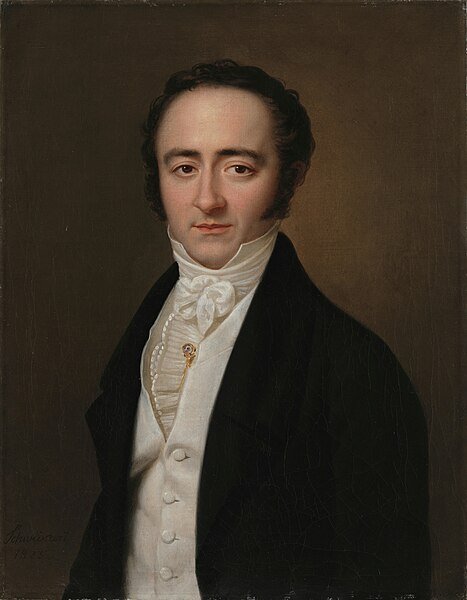
Franz Xaver Wolfgang Mozart (July 26, 1791 to July 29, 1844)
Franz Xaver Wolfgang Mozart (26 July 1791 – 29 July 1844), often referred to as Wolfgang Amadeus Mozart, Jr., was a composer, pianist, conductor, and teacher. Born as the youngest of six children to the renowned Wolfgang Amadeus Mozart and his wife Constanze, Franz Xaver lived under the towering shadow of his father’s legacy. He contributed to the late classical and early Romantic music periods, his style reflecting his father’s influence while hinting at Romanticism. Respected by his contemporaries, including Franz Schubert and Robert Schumann, Franz Xaver remains a fascinating yet underappreciated figure in music history.
Early Life and Education
Franz Xaver Wolfgang Mozart was born in Vienna on 26 July 1791, just months before his father’s death in December of the same year. Though christened as Franz Xaver, his family affectionately referred to him as Wolfgang. His musical education began early, with some of the era’s most distinguished teachers. Antonio Salieri, Johann Nepomuk Hummel, Johann Georg Albrechtsberger, and Sigismund von Neukomm all contributed to his development as a composer and performer.
Following in his father’s footsteps, Franz Xaver displayed prodigious talent, excelling on both the piano and violin. He began composing at a young age, making his public debut in April 1805 at the age of 13 during a concert at Vienna’s Theater an der Wien.
Career and Professional Life
By 1808, financial pressures led Franz Xaver to seek employment in the region of Galicia (modern-day Ukraine). He initially served as a music teacher for the daughters of Count Wiktor Baworowski in Pidkamin but struggled with loneliness in the rural setting. In 1809, he moved to Burshtyn, where Count von Janiszewski employed him as a teacher. These roles introduced him to the local aristocracy, allowing him to perform both his own works and his father’s compositions in public concerts.
Franz Xaver relocated to Lemberg (modern-day Lviv) in 1813, where he would reside for 25 years. His time in Lemberg was marked by a blend of teaching, performing, and conducting. He trained notable students, including Julie von Webenau, and became a significant figure in the local musical community. From 1826 to 1829, he conducted the choir of Saint Cecilia, which consisted of 400 amateur singers. His efforts led to the establishment of the first music school in Lemberg.
During this period, he also gave concerts across Europe, visiting Warsaw, Elbing, and Danzig between 1819 and 1821. He continued to promote his father’s works, conducting the Requiem at St. George’s Cathedral in 1826. His commitment to music education and performance in Lemberg left a lasting legacy in the region.
Later Years
In 1838, Franz Xaver left Lemberg for Vienna and Salzburg. He became the Kapellmeister of the Mozarteum in Salzburg, where he focused on promoting his father’s legacy. Among his students was the pianist Ernst Pauer. His final years were marked by declining health, and he passed away from stomach cancer on 29 July 1844 in Karlsbad (modern Karlovy Vary). His tombstone bears a poignant epitaph: “May the name of his father be his epitaph, as his veneration for him was the essence of his life.”
Musical Style and Legacy
Franz Xaver’s compositions reflect a blend of his father’s classical techniques and the burgeoning Romantic style. Despite his modest output, his works display emotional depth and technical proficiency. He wrote primarily for the piano and chamber ensembles, with two piano concertos standing out as his most significant contributions.
His orchestral compositions include a symphony and the Overture in D major. His two piano concertos, written in 1808 and 1818, reveal his evolving style. The first concerto closely resembles the late works of his father, marked by youthful vigor and classical elegance. The second concerto demonstrates greater virtuosity and a more contemporary Romantic sensibility.
Franz Xaver Wolfgang Mozart’s contributions to classical and early Romantic music, particularly his piano and chamber works, demonstrate his artistic merit.
Franz Xaver’s chamber music includes the Piano Quartet in G minor, Op. 1, and several sonatas for violin and piano. His piano works, such as the Six Polonaises Mélancoliques (Op. 17), showcase his melodic inventiveness and sensitivity.
His choral works include the cantata Der erste Frühlingstag (The First Spring Day) and Festchor, composed for the unveiling of his father’s monument in Salzburg. Franz Xaver also wrote a variety of songs with piano accompaniment, blending German Lieder traditions with his unique voice.
Struggles with Identity
Franz Xaver spent much of his life grappling with the immense legacy of his father. His self-critical nature and comparisons to Wolfgang Amadeus Mozart often hindered his confidence. While he achieved moderate success, his reluctance to step out of his father’s shadow limited his output and public recognition. This struggle is poignantly reflected in the inscription on his tombstone, underscoring the profound influence of his father on his life and career.
Significant Works by Genre
Franz Xaver’s compositions span several genres, though his oeuvre is relatively small. Key works include:
Orchestral
- Piano Concerto No. 1 in C major, Op. 14 (1808)
- Piano Concerto No. 2 in E-flat major, Op. 25 (1818)
Chamber Music
- Piano Quartet in G minor, Op. 1
- Sonata for Violin and Piano in F major, Op. 15
Piano Works
- Variations on Minuet from Don Giovanni, Op. 2
- Six Polonaises Mélancoliques, Op. 17
Choral and Vocal
- Der erste Frühlingstag (cantata), Op. 28
- Festchor, Op. 30 (1840)
Monuments and Recognition
A monument to Franz Xaver Wolfgang Mozart stands in Lviv, Ukraine, commemorating his contributions to the city’s musical heritage. While he is less celebrated than his father, his works continue to be performed and recorded, preserving his unique voice within the classical music canon.
Frequently Asked Questions
What was Franz Xaver Wolfgang Mozart’s relation to Wolfgang Amadeus Mozart?
He was the youngest child of Wolfgang Amadeus Mozart and Constanze, and one of their two surviving children.
What characterized Franz Xaver’s musical style?
His style was influenced by his father’s late classical period and showed early Romantic elements.
Who were Franz Xaver’s notable musical influences and teachers?
He studied under Antonio Salieri, Johann Nepomuk Hummel, Johann Georg Albrechtsberger, and Sigismund von Neukomm.
How did Franz Xaver’s career differ from his father’s?
Unlike his extroverted and highly prolific father, Franz Xaver was introverted, self-deprecating, and produced a relatively small body of work.
What notable positions and achievements did Franz Xaver hold?
He taught in Lemberg (now Lviv), conducted a 400-member choir, founded the musical brotherhood of Saint Cecilia, and became Kapellmeister of the Mozarteum in Salzburg.
What is significant about Franz Xaver’s piano concertos?
His two piano concertos reflect the transition from classical to Romantic styles, with the second concerto showcasing a more virtuosic approach.
Why was Franz Xaver’s work mistakenly attributed to Franz Liszt?
His Five Variations on a Romance from Méhul’s Joseph was misattributed due to a copyist’s error but later correctly credited to Franz Xaver.





