
Friedrich Engels
Friedrich Engels (1820–1895) was a revolutionary socialist, philosopher, historian, journalist, and businessman. He is most widely recognized as Karl Marx‘s close collaborator and co-founder of Marxist theory. Together, Engels and Marx laid the foundation for modern socialism and communism, reshaping political thought and inspiring movements worldwide. Engels was instrumental in advancing Marxist ideas and also made his own lasting contributions to political economy, philosophy, and social theory.
Family Background
Born in Barmen, Prussia (now Wuppertal, Germany), Engels came from a wealthy Calvinist family. His father owned textile mills, which provided Engels with an early glimpse into industrial capitalism’s disparities.
Education and First Encounters with Philosophy
Though Engels’s formal education ended prematurely due to his father’s insistence on a business career, he became self-educated in philosophy, particularly influenced by Hegelianism during his youth. By 1838, Engels began publishing critical essays and poetry under pseudonyms.
First Encounters with Industrial Capitalism
Engels was sent to Manchester in 1842 to work at his father’s textile mill. This experience exposed him to the stark inequalities faced by workers in industrialized cities. Observing the harsh conditions in Manchester’s slums shaped Engels’s views on capitalism and class struggle.
“The Condition of the Working Class in England”
Engels’s experiences in Manchester culminated in his groundbreaking book, The Condition of the Working Class in England (1845). It provided a vivid and detailed critique of the exploitation of workers, emphasizing the degradation caused by industrial capitalism.
Engels Collaboration with Karl Marx
Engels met Karl Marx in Paris in 1844, marking the beginning of one of history’s most influential intellectual partnerships. They bonded over shared revolutionary ideas and began collaborating on works critiquing the political and economic systems of their time.
Friedrich Engels’s partnership with Marx and independent works provided a framework for understanding capitalism, class struggle, and socialism.
Engels co-authored seminal works with Marx, including The Communist Manifesto (1848), which outlined their theory of historical materialism and the inevitability of class struggle leading to socialism. Other key collaborations include The German Ideology and The Holy Family.
Key Contributions to Marxist Theory
Engels’s financial backing allowed Marx to dedicate himself to his magnum opus, Das Kapital. After Marx’s death, Engels edited and published the second and third volumes of Das Kapital, ensuring the continuation of their work.
Engels contributed significantly to Marxist theory, particularly in areas like historical materialism and dialectics. His works, such as Anti-Dühring and Dialectics of Nature, explored the interplay between material conditions, social development, and scientific progress.
Independent Works
The Origin of the Family, Private Property, and the State
In this 1884 work, Engels analyzed the historical development of family structures, linking them to the evolution of private property and social hierarchies. He argued that monogamous marriage emerged as a tool for class and property control, proposing its eventual dissolution in a communist society.
Dialectics of Nature
Engels applied Marxist principles to science, exploring how dialectical materialism could explain natural phenomena. Though unfinished, this work was groundbreaking in its ambition to unify scientific and social theories.
What was Engels’s Role in the Communist League?
Engels and Marx joined the underground Communist League, where they formulated the principles of communism. The League later commissioned them to write The Communist Manifesto.
Involvement in the 1848 Revolutions
Engels participated in revolutionary uprisings in Germany during 1848–1849, advocating for workers’ rights and fighting against feudal and autocratic systems. His experiences informed his later writings on revolution and class struggle.
Later Life
In 1870, Engels moved to London, where he spent the remainder of his life. He continued to support socialist movements and remained active in the international working-class struggle. Despite retiring from business in 1869, Engels remained a central figure in the European socialist movement.
Death and Commemoration
Engels died of throat cancer in 1895. In accordance with his wishes, his ashes were scattered off Beachy Head in England. He left a significant intellectual legacy, influencing socialist and communist movements for decades.
Personality and Private Life
Engels was known for his charm and sociable nature. He had a long-term relationship with Mary Burns, an Irish working-class woman, and later with her sister, Lizzie. Engels opposed traditional marriage, viewing it as a tool of class oppression.
Engels enjoyed poetry, fox hunting, and hosting gatherings for intellectual discussions. He was described as a witty and energetic individual who valued camaraderie and intellectual debate.
Engels’s Impact on Modern Thought
Engels’s writings and collaborations with Marx laid the foundation for Marxist theory, shaping socialist movements worldwide. His analysis of class struggle and capitalism’s contradictions remains relevant in contemporary political and economic discourse.
Engels has been criticized for oversimplifying Marxist theory and influencing its dogmatic interpretation in later communist regimes. However, many historians argue that his contributions were critical to preserving and advancing Marx’s ideas.
Frequently Asked Questions about Friedrich Engels
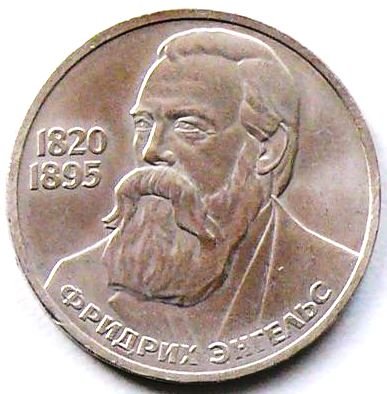
A 1985 Soviet Union 1 rouble coin celebrating the 165th anniversary of Engels’ birth.
What were Engels’s contributions to Marxism?
Engels co-authored The Communist Manifesto (1848) with Marx and supported him financially, enabling Marx to write Das Kapital. After Marx’s death, Engels edited and completed Volumes II and III of Das Kapital. His own major works include The Condition of the Working Class in England (1845), Anti-Dühring (1878), and The Origin of the Family, Private Property and the State (1884).
What was Engels’s early life like?
Born in 1820 in Prussia (modern-day Germany) to a wealthy family of textile manufacturers, Engels was raised as a Calvinist. Despite his father’s expectations for him to join the family business, Engels developed radical views, influenced by Hegelian philosophy, and began writing critiques of industrial society.

How did Engels meet Marx?
Engels met Karl Marx in 1844 in Paris, where they quickly developed a strong friendship and intellectual partnership. They worked together on various projects, including The Holy Family and The German Ideology.
What was Engels’s role in The Communist Manifesto?
Engels and Marx wrote The Communist Manifesto in 1848 as a commission from the Communist League. It outlined their vision of class struggle and revolutionary socialism, famously ending with, “Working Men of All Countries, Unite!”
What is The Condition of the Working Class in England?
This 1845 book detailed the harsh realities of industrial capitalism based on Engels’s observations in Manchester. It analyzed the exploitation of workers and became a foundational text in socialist literature.
What was Engels’s view on family and property?
In The Origin of the Family, Private Property and the State (1884), Engels argued that the family structure evolved with economic systems. He claimed that capitalism reinforced monogamy and female subjugation, which would dissolve under socialism.
What was Engels’s relationship with Mary Burns?
Mary Burns, an Irish working-class woman, was Engels’s companion for 20 years. They shared a disdain for the institution of marriage. After her death, Engels formed a relationship with her sister, Lydia Burns.
What were Engels’s later contributions?
After Marx’s death in 1883, Engels focused on editing Das Kapital and writing works like Socialism: Utopian and Scientific. He also debated strategies for achieving socialism, balancing revolutionary and evolutionary approaches.





